
What Does COVID-19 & Influenza A+B Combo Rapid Testing Detect—and What Can It Miss?
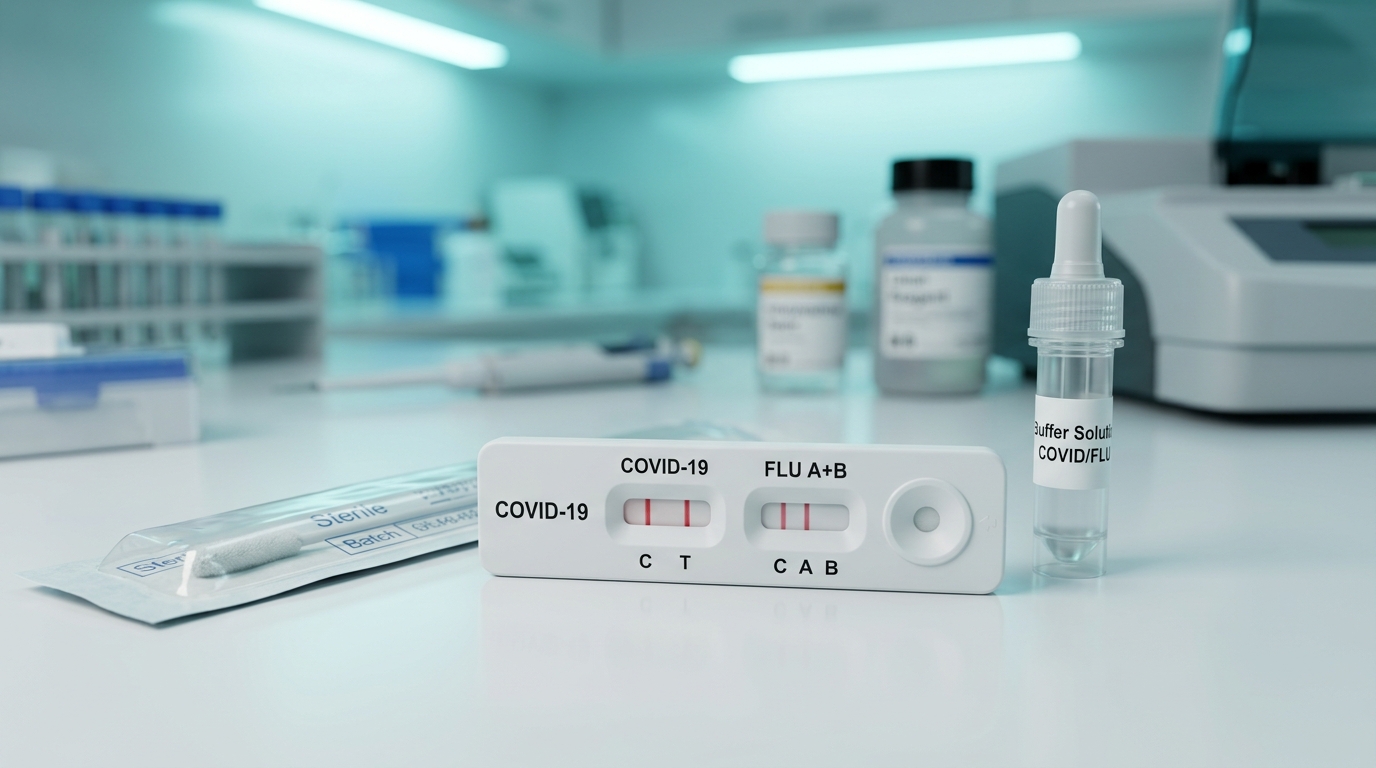
In outpatient clinics, emergency departments, and occupational health settings across the UAE, healthcare providers are routinely confronted with patients presenting with acute respiratory illness. Symptoms such as sudden fever, chills, cough, sore throat, myalgia, and fatigue are clinically indistinguishable between SARS-CoV-2 and influenza viruses. Implementing validated respiratory rapid test kits for clinics enables practitioners to obtain differential diagnostic insights within 15 minutes, allowing immediate clinical triage before patients leave the consultation room.
Clinical Role of Dual Multiplex Rapid Antigen Assays in Outpatient Triage
The primary clinical value of a dual COVID-19 and Influenza A+B rapid test cassette lies in its multiplex architecture. Rather than executing two separate lateral flow tests requiring multiple patient swabs, a combination cassette utilizes a single patient specimen to interrogate multiple independent test strips or integrated reaction zones.
From an epidemiological and therapeutic perspective, rapid differentiation is time-critical. While supportive care suffices for mild viral illnesses, specific high-risk cohorts benefit enormously from early antiviral interventions. For instance, neuraminidase inhibitors (such as oseltamivir) for Influenza A and B must be initiated within 48 hours of symptom onset to significantly reduce complications and hospital stays. Similarly, oral antivirals for COVID-19 (such as nirmatrelvir/ritonavir) must be administered within five days of symptom initiation. A rapid combo test provides the immediate diagnostic confidence required to prescribe these targeted therapies without waiting 24 to 48 hours for centralized laboratory RT-PCR turnaround.
Intended Specimen Types, Pre-Analytical Swabbing, and Optimal Timing Window
The diagnostic performance of any rapid antigen immunoassay is intimately tied to pre-analytical specimen collection quality. According to technical documentation recognized by the FDA In Vitro Diagnostics Regulatory Guidelines, nasopharyngeal (NP) swabs provide the highest viral yield, followed closely by anterior nasal (mid-turbinate) swabs when collected strictly in accordance with manufacturer Instructions for Use (IFU).
Timing relative to symptom onset is the single most critical factor governing sensitivity. Rapid antigen tests require a relatively high viral load (typically corresponding to RT-PCR cycle threshold [Ct] values below 28 to 30) to generate a visible test line. In the natural course of both COVID-19 and influenza infections, viral shedding in the upper respiratory tract peaks between day 1 and day 4 of acute symptoms. Testing during this window delivers maximum clinical sensitivity (often exceeding 92% to 96% for symptomatic presentations). Testing too early (within 24 hours of exposure before viral replication peaks) or too late (after day 5 to 7 when immune clearance reduces shedding) substantially increases the likelihood of a false-negative result.
| Assay Target / Feature | What the Rapid Combo Test Detects | What the Rapid Combo Test Can Miss | Clinical Action Required |
|---|---|---|---|
| SARS-CoV-2 (COVID-19) | Active replication of SARS-CoV-2 nucleocapsid antigen (high viral load) | Very early incubation (<24h), late convalescent shedding, low viral loads (Ct >32) | If negative but clinical suspicion remains high, repeat in 48h or perform RT-PCR |
| Influenza Type A | Conserved nucleoprotein of Influenza A (including H1N1, H3N2 subtypes) | Does not sub-type the strain; may miss low shedding or early onset (<12h) | Initiate oseltamivir if symptomatic within 48h and positive |
| Influenza Type B | Conserved nucleoprotein of Influenza B lineages (Victoria, Yamagata) | Lower sensitivity if specimen extraction is sub-optimal or dry swab is used | Differentiates from Influenza A; guide institutional outbreak reporting |
| Other Respiratory Pathogens | None (Assay is highly specific to SARS-CoV-2 and Flu A/B) | RSV, Parainfluenza, Adenovirus, Rhinovirus, Mycoplasma, Bacterial pneumonia | Consider broad syndromic multiplex PCR if symptoms persist and test is negative |
Analytical Detection Parameters: What the Test Detects—and What It Can Miss
Understanding analytical boundaries prevents clinical misinterpretation. A positive band on a validated COVID-19 & Flu combo cassette indicates active viral shedding and high contagiousness. Analytical specificity across CE-marked and FDA-authorized assays consistently exceeds 98.5% to 99.5%, meaning false-positive results are exceedingly rare when read within the specified 15 to 20-minute window.
However, clinicians and laboratory professionals must be fully cognizant of what the test can miss:
- Low Viral Titer Infections: In patients with high preexisting immunity, vaccinated individuals, or those tested late in illness, viral shedding may fall below the assay’s Analytical Limit of Detection (LoD). While an RT-PCR test with its enzymatic amplification will easily flag these specimens positive, a lateral flow test will appear negative.
- Other Common Respiratory Pathogens: Respiratory Syncytial Virus (RSV), Human Metapneumovirus (hMPV), Rhinovirus/Enterovirus, and seasonal coronaviruses share identical clinical presentations. A negative COVID/Flu combo test does not mean the patient is free of viral infection—it merely excludes SARS-CoV-2 and Influenza A/B.
- Viral Subtypes and Antimicrobial Resistance: Rapid antigen cassettes differentiate between Influenza A and Influenza B, but they do not identify avian strains (e.g., H5N1) or drug-resistant mutations.
- Post-15 Minute Phantom Lines: Reading the cassette after 30 minutes can result in non-specific evaporation lines that mimic faint positive test bands. Adherence to strict timing is mandatory.
Rapid Lateral Flow vs Laboratory RT-PCR: Reference Method Comparison
Guidelines issued by the World Health Organization on Rapid Immunoassays for Respiratory Pathogens underscore that while Reverse Transcription PCR remains the analytical reference standard, rapid antigen testing offers superior operational efficiency during respiratory surges.
In real-world clinical practice, a diagnostic test with 93% sensitivity available in 15 minutes is vastly more effective for immediate patient isolation and antiviral prescription than a 99% sensitive test that takes 36 hours to process. The CDC Guidance on Influenza and SARS-CoV-2 Testing in Healthcare Facilities explicitly advises that in high-prevalence settings, negative rapid antigen tests in vulnerable or severely ill patients should be reflexed to confirmatory molecular RT-PCR.
Point-of-Care Quality Checklist and Frequently Asked Questions (FAQ)
Ensure reliable diagnostic execution in your clinical facility with this operational checklist:
- Check Storage Conditions: Store cassettes between 2°C and 30°C; never freeze test strips or extraction buffers.
- Swab Rotation Technique: Rotate the sterile swab at least 5 times against the nasal wall to dislodge adequate epithelial cells.
- Extraction Incubation: Swirl the swab in the extraction buffer tube for the full duration specified in the IFU (typically 15 to 30 seconds) and squeeze the tube walls while extracting.
- Timer Precision: Record results strictly at 15 minutes. Discard cassettes after 20 minutes to eliminate false evaporation artifacts.
Authoritative Medical References:
- Centers for Disease Control and Prevention (CDC). Influenza Virus and SARS-CoV-2 Testing in Healthcare Settings. Available from: cdc.gov/flu/professionals/diagnosis/table-testing-methods.htm
- World Health Organization (WHO). Antigen-detection in the diagnosis of SARS-CoV-2 infection using rapid immunoassays. Geneva: WHO; Available from: who.int/publications/i/item/WHO-2019-nCoV-Antigen_Detection-2021.1
- U.S. Food and Drug Administration (FDA). In Vitro Diagnostics EUAs – Molecular and Antigen Diagnostic Tests for SARS-CoV-2 and Influenza. Available from: fda.gov/medical-devices/in-vitro-diagnostics-euas