
What Does H. pylori Antigen Rapid Testing Detect—and What Can It Miss?
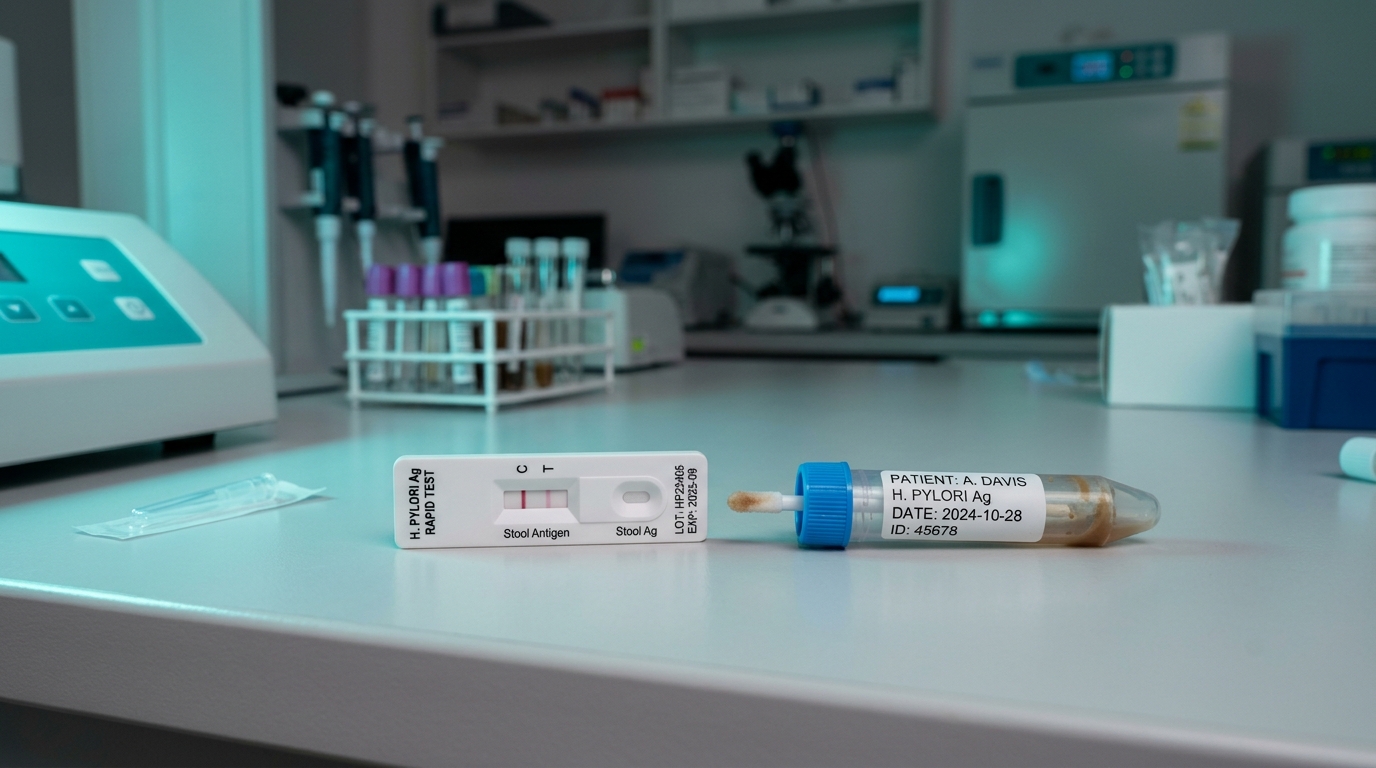
In outpatient gastroenterology consultations and primary care clinics across the UAE, complaints of dyspepsia, persistent epigastric gnawing pain, postprandial fullness, bloating, and unexplained nausea represent some of the most frequent clinical encounters. Because Helicobacter pylori is an established Class I human carcinogen, accurate and rapid diagnosis is critical for clinical eradication. Utilizing certified gastrointestinal rapid diagnostic kits provides clinicians with immediate, non-invasive diagnostic certainty without subjecting patients to invasive endoscopic procedures.
Clinical Role of H. pylori in Peptic Ulcer Disease and Gastric Pathology
Helicobacter pylori is a microaerophilic, spiral-shaped Gram-negative bacterium uniquely adapted to survive the harsh acidic environment of the human stomach. Utilizing a high-output urease enzyme, the organism converts endogenous urea into carbon dioxide and ammonia, creating a protective neutral microclimate that shields it from gastric acid.
Over time, flagellar motility and specialized virulence factors (such as the cytotoxin-associated gene A [CagA] and vacuolating cytotoxin A [VacA]) disrupt the protective gastric mucosal barrier, provoking chronic active mucosal inflammation. H. pylori infection accounts for over 90% of duodenal ulcers and up to 80% of gastric ulcers. Left untreated, persistent lifelong infection leads to atrophic gastritis, intestinal metaplasia, and substantially elevates the long-term risk of gastric adenocarcinoma and Mucosa-Associated Lymphoid Tissue (MALT) lymphoma. Eradicating the organism with targeted combination antimicrobial therapy cures peptic ulcers and dramatically attenuates gastric cancer risk.
How the Stool Antigen Rapid Test (SAT) Works
The H. pylori Stool Antigen Test (SAT) is an immunochromatographic lateral flow immunoassay designed to detect soluble bacterial surface antigens expelled in feces. The patient collects a small fecal sample using a specialized collection stick pre-measured into an extraction buffer tube.
The extracted sample is dispensed into the test cassette well. As the liquid migrates by capillary action along the nitrocellulose membrane, H. pylori antigens bind to immobilized gold-conjugated monoclonal antibodies. In modern CE-IVD certified assays, the use of highly purified monoclonal antibodies (rather than older polyclonal mixtures) provides exceptional diagnostic accuracy, delivering clinical sensitivity of 94% to 98% and clinical specificity of 96% to 99% compared to invasive endoscopic biopsy histopathology and rapid urease testing (CLO test).
| Diagnostic Modality | What It Measures | Turnaround Time | Key Clinical Limitation |
|---|---|---|---|
| Stool Antigen Rapid Test (SAT) | Direct active H. pylori surface antigens in stool | 10 – 15 minutes | False negatives if patient is taking PPIs, bismuth, or antibiotics |
| Urea Breath Test (UBT – 13C/14C) | Urease enzymatic activity in exhaled breath | 20 – 30 minutes | Requires specialized scintillation/spectrometry equipment and fasting |
| Blood Antibody Serology (IgG) | Circulating anti-H. pylori host antibodies | Central lab (24h) | Cannot differentiate active from past cured infection; NOT recommended |
| Endoscopic Biopsy (Histology/CLO) | Mucosal histology and urease tissue activity | Invasive procedure | High cost; invasive; subject to patchy mucosal sampling error |
What the Test Detects vs What It Can Miss: Pharmacological Suppression
While the monoclonal stool antigen test is exceptionally reliable, healthcare providers must master the clinical factors that can lead to false-negative results, codified under international guidelines such as the American College of Gastroenterology (ACG) Clinical Guidelines on H. pylori and the Maastricht VI / Florence European Consensus Report:
- Proton Pump Inhibitor (PPI) Suppression: PPIs (such as omeprazole, esomeprazole, pantoprazole) raise gastric pH, causing H. pylori to transform from its active vegetative spiral form into an inactive, dormant coccoid state. This reduces bacterial metabolic shedding, cutting stool antigen concentrations below the assay’s Limit of Detection (LoD) and causing up to 20% to 30% false-negative rates. Patients must discontinue PPIs for at least 14 days prior to testing.
- Recent Antibiotic and Bismuth Exposure: Any systemic antimicrobial therapy (such as amoxicillin, clarithromycin, metronidazole) or bismuth subsalicylate (Pepto-Bismol) temporarily suppresses bacterial load. Testing must be delayed for at least 4 weeks following the last dose of antibiotics or bismuth.
- Active Gastrointestinal Bleeding: In patients with bleeding peptic ulcers, large volumes of blood in the gastrointestinal tract can degrade fecal antigen stability or non-specifically interfere with lateral flow migration, occasionally causing false-negative readings during acute hemorrhage.
- Liquid / Diarrheal Stool Dilution: Watery, diarrheal stool substantially dilutes bacterial antigen concentration. Testing should be performed on solid or semi-solid stool whenever feasible.
Stool Antigen vs Urea Breath Test (UBT): Comparative Performance
A systematic meta-analysis published in PubMed / World Journal of Gastroenterology established that monoclonal Stool Antigen Testing and 13C-Urea Breath Testing share equivalent diagnostic accuracy (concordance >95%) for both initial pre-treatment diagnosis and post-treatment test-of-cure verification.
The primary advantage of the rapid stool antigen cassette is operational practicality. The Urea Breath Test requires specialized, expensive infrared spectrometry or isotope ratio mass spectrometry instrumentation, patient fasting, and ingestion of radioactive or stable isotope capsules that pediatric patients often cannot swallow. In contrast, the rapid stool test can be performed immediately in any clinic or outpatient laboratory with zero specialized instrumentation, delivering definitive results in 10 minutes at a fraction of the cost.
Clinical Testing Protocol, Test-of-Cure Timeline, and FAQs
Adhere to this evidence-based clinical testing protocol for optimal diagnostic accuracy:
- Enforce Medication Washout Windows: Verify that the patient has ceased PPIs for 14 days and antibiotics/bismuth for 28 days before sampling.
- Use H2-Blockers or Antacids as Substitutes: If a patient experiences severe dyspeptic symptoms during the PPI washout, prescribe H2-receptor antagonists (famotidine) or simple antacids, which do not interfere with test accuracy.
- Perform Mandatory Test-of-Cure: Always confirm eradication by repeating a stool antigen test at least 4 weeks post-completion of eradication therapy.
- Screen Family Members: In regions with high endemic transmission, investigate symptomatic household contacts to prevent reinfection.
Authoritative Medical References:
- Chey WD, et al. ACG Clinical Guideline: Treatment of Helicobacter pylori Infection. American Journal of Gastroenterology; Available from: journals.lww.com/ajg/Fulltext/2017/02000/American_College_of_Gastroenterology_Guideline_on.13.aspx
- Malfertheiner P, et al. Management of Helicobacter pylori infection: The Maastricht VI/Florence Consensus Report. Gut; Available from: gut.bmj.com/content/71/9/1724
- Atkinson NSS, et al. Systematic Review and Meta-Analysis: Accuracy of Monoclonal Stool Antigen Testing for Helicobacter pylori. World Journal of Gastroenterology / PubMed; Available from: pubmed.ncbi.nlm.nih.gov/28848325/