
Multiplex PCR vs Singleplex PCR: Key Differences Explained
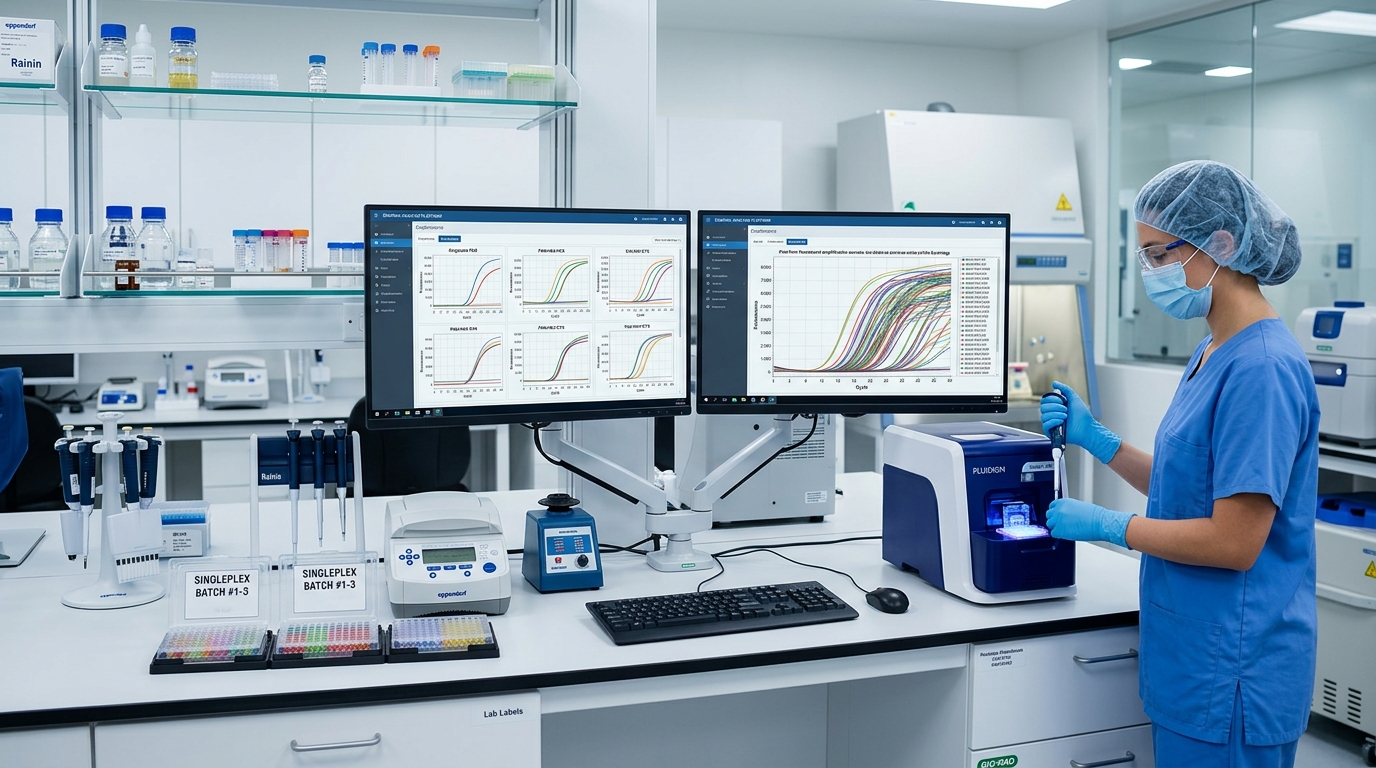
In modern molecular diagnostic laboratories, Polymerase Chain Reaction (PCR) forms the technological backbone for detecting pathogens and human genetic variants. Historically, testing an individual presenting with acute urogenital or respiratory symptoms required setting up multiple individual test tubes—one for each suspected microorganism. Today, reference laboratories and tertiary medical centers utilize advanced multiplex PCR diagnostic solutions to simultaneously amplify dozens of diagnostic targets from a single patient extraction, such as in the comprehensive Urogenital 38 infections screen plus or emergency syndromic meningitis PCR panel.
Fundamental Differences: Architectural Principles
The defining divergence between the two modalities lies in reaction vessel complexity:
- Singleplex PCR: Employs one forward primer, one reverse primer, and one fluorescent probe (or intercalating dye like SYBR Green) targeted to amplify a single specific genomic locus. Reaction kinetics are clean, with zero inter-primer competition.
- Multiplex PCR: Introduces multiple distinct primer sets and fluorophore-conjugated probes into the same reaction mixture. Each target probe is labeled with a distinct emission reporter dye (e.g., FAM, HEX/VIC, ROX, Cy5) allowing automated real-time thermal cyclers to monitor several independent amplification curves concurrently.
Head-to-Head Comparison Matrix
The operational tradeoffs between singleplex and multiplex architectures are detailed below:
| Technical Dimension | Singleplex PCR | Multiplex Real-Time PCR |
|---|---|---|
| Targets per Tube | 1 target (plus internal control) | 3 to 30+ targets concurrently |
| Specimen Volume Required | High (requires separate aliquot per pathogen) | Extremely Low (one 5 µL extract covers all targets) |
| Turnaround Time (TAT) | Hours to days if tested sequentially | 1 to 2 hours for complete syndromic answer |
| Reagent Cost per Target | High ($10–$25 per pathogen run) | Low ($1–$4 per pathogen on multiplex run) |
| Technician Hands-On Time | Extensive pipetting across 96-well plates | Single master mix setup or microfluidic cartridge |
| Risk of Cross-Inhibition | Minimal | Requires strict buffer balancing ($MgCl_2$, dNTPs) |
Clinical Applications: Where Multiplex PCR Dominates
Multiplex PCR has become the indispensable clinical gold standard in syndromic infectious disease diagnostics:
1. Syndromic Respiratory Infection Panels
Patients presenting with acute cough, fever, and dyspnea can harbor influenza, SARS-CoV-2, RSV, adenovirus, human metapneumovirus, or parainfluenza. Rather than running six separate assays, a single multiplex run provides full differential identification in 60 minutes.
2. Urogenital and STI Screening
Co-infections are common in sexual health. A patient infected with Chlamydia trachomatis frequently harbors concurrent subclinical Mycoplasma genitalium, Ureaplasma, or Trichomonas. Multiplex panels interrogating first-catch urine detect all fastidious pathogens in a single workflow.
3. Acute Gastrointestinal and Neuro-Infectious Panels
In patients with acute watery diarrhea or suspected meningitis, time-to-treatment is vital. Syndromic stool and CSF multiplex panels test for bacterial toxins, parasitic cysts, and viral genomes simultaneously, preventing empirical antibiotic overuse.
When Singleplex PCR Remains Superior
Despite the efficiency of multiplexing, singleplex PCR remains essential in specialized laboratory scenarios:
- Quantitative Viral Load Monitoring: For monitoring HIV-1, Hepatitis B (HBV), and Hepatitis C (HCV) viral suppression during antiviral therapy, singleplex assays provide superior dynamic analytical range ($10^1$ to $10^8$ copies/mL) without probe competition.
- Rare or Emerging Pathogen Detection: Developing a rapid singleplex assay for a novel variant or rare genetic mutation takes days, whereas re-optimizing and clinically validating a 20-target multiplex panel requires months of regulatory trials.
- Ultra-Low Copy Sensitivity: Singleplex reactions achieve the absolute lowest limit of detection (down to 1–2 genomic copies per reaction), vital in forensic analysis and trace minimal residual disease (MRD) oncology.
Peer-Reviewed Clinical References
- Elnifro, E. M., et al. Multiplex PCR: Optimization and Application in Diagnostic Virology. Clinical Microbiology Reviews, 2000; 13(4): 559-570.
- Buss, S. N., et al. Multicenter Evaluation of the BioFire FilmArray Gastrointestinal Panel for Etiologic Diagnosis of Infectious Gastroenteritis. Journal of Clinical Microbiology, 2015; 53(3): 915-925.
- Markoulatos, P., et al. Multiplex PCR: Features and Applications in Diagnostic Microbiology. Journal of Clinical Laboratory Analysis, 2002; 16(1): 47-51.