
What Does Respiratory Adenovirus Antigen Rapid Testing Detect—and What Can It Miss?
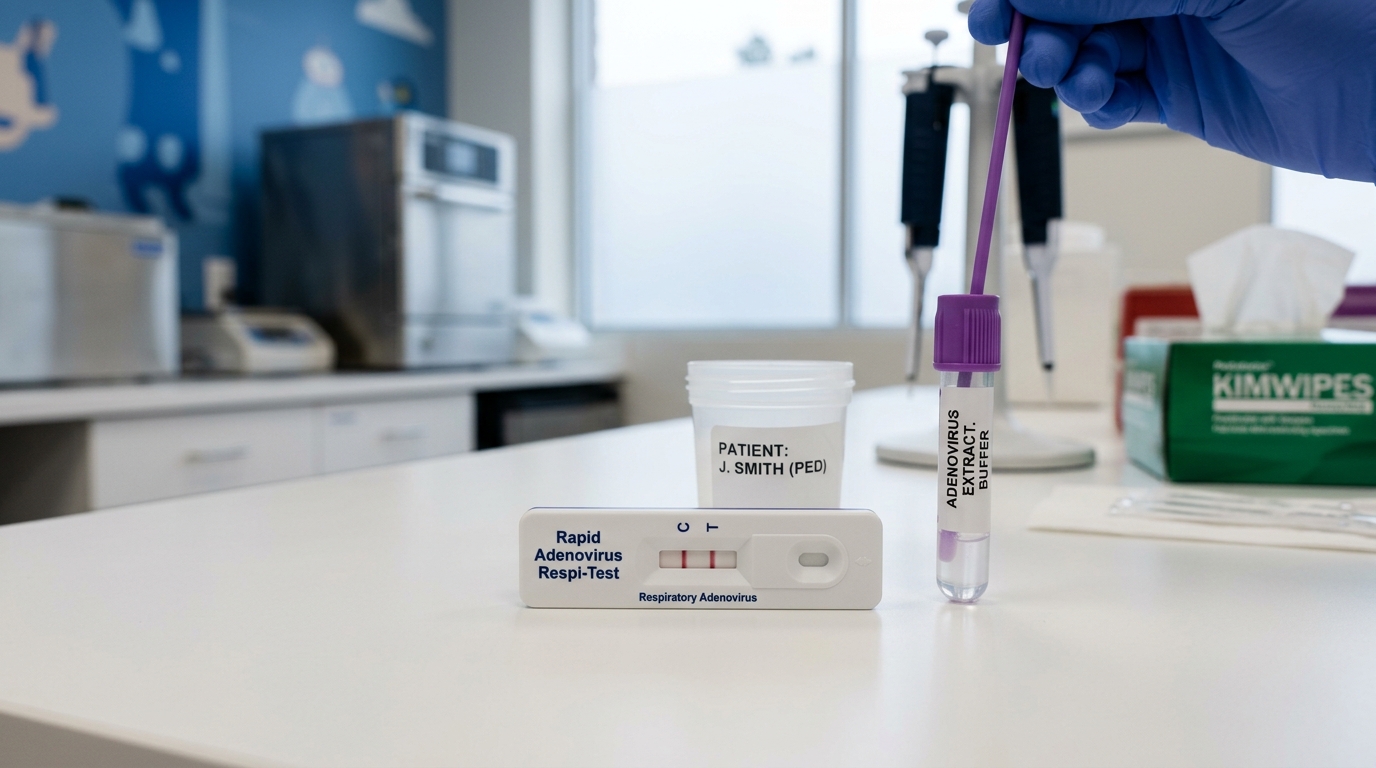
Human adenoviruses are non-enveloped double-stranded DNA viruses comprising over 100 genotypes categorized into seven species (A through G). Species B (types 3, 7, 14, 21), Species C (types 1, 2, 5), and Species E (type 4) are the primary culprits behind acute epidemic respiratory illness in children, immunocompromised patients, and military recruits. For primary care clinics across the UAE utilizing respiratory rapid test kits for clinics, rapid assays provide instantaneous actionable differentiation between bacterial exudative tonsillitis (such as Group A Strep) and viral adenoviral adenopharyngoconjunctival syndrome.
Assay Architecture: What Does the Rapid Test Actually Detect?
Respiratory adenovirus rapid diagnostic tests operate on sandwich lateral flow immunochromatography principles:
- Target Antigen (The Hexon Protein): The viral capsid consists of 240 hexon capsomers and 12 vertex pentons. The hexon protein possesses group-reactive antigenic determinants shared across all human respiratory adenovirus serotypes. Monoclonal antibodies impregnated on the membrane test line selectively bind these conserved epitopes.
- Colloidal Gold or Fluorescence Reporter: Swab specimens extracted in alkaline buffer release viral proteins that migrate across the nitrocellulose membrane. Hexon antigens form antibody-antigen-colloidal gold complexes, producing a distinct colored or fluorescent band at the Test (T) zone.
- Procedural Control: A separate Control (C) line captures excess goat anti-mouse antibodies, guaranteeing adequate capillary migration and reagent functionality.
Analytical Strengths vs Clinical Blind Spots: What Can It Miss?
| Clinical Parameter | What the Rapid Antigen Test Detects | What the Rapid Antigen Test Can Miss |
|---|---|---|
| Viral Shedding / Load | High-titer viral excretion (>10^5 to 10^6 viral copies/mL) typical of acute Day 1–3 fever | Low viral loads (<10^4 copies/mL) during late symptomatic stages or prodromal phases |
| Serotype Specificity | Pan-adenoviral group hexon antigen across species A–F | Cannot identify specific serotypes (e.g., cannot differentiate benign HAdV-3 from severe virulent HAdV-7 or HAdV-14) |
| Lower Respiratory Infections | Upper airway shedding via nasopharyngeal or oropharyngeal swabs | Deep parenchymal lung replication in adenoviral pneumonia where upper tract swab titers have cleared |
| Coinfections | Isolated adenovirus antigen (unless run as a combo kit with RSV or Influenza) | Bacterial superinfections, Mycoplasma pneumoniae, or concurrent respiratory viruses |
| Viability & Replication | Presence of intact or disassembled hexon capsid protein | Cannot confirm active viral replication vs residual non-replicating viral debris |
Why Symptom Duration Governs Test Sensitivity
Adenovirus viral shedding peaks early during the first 48 to 72 hours of acute high fever and pharyngitis. Clinical investigations demonstrate that:
- Days 1 to 3 of Illness: Rapid antigen test sensitivity reaches 75% to 85% due to intense shedding in nasopharyngeal secretions.
- Days 4 to 7 of Illness: Sensitivity declines to 40% to 55% as mucosal host IgA antibodies bind to viral hexons, sterically blocking monoclonal capture antibodies on the test strip.
- Beyond Day 7: Rapid antigen assays are largely non-contributory; molecular amplification via reverse transcription PCR is required.
Differential Diagnosis: When Symptoms Mimic Allergic or Bacterial Etiologies
Adenoviral infections frequently present with non-specific systemic signs—conjunctivitis, follicular pharyngitis, and rhinitis—that mimic environmental allergies or other respiratory infections. In recurrent or ambiguous presentations, UAE physicians correlate findings with:
- Allergic Sensitization: Persistent seasonal sneezing, clear watery rhinorrhea, and ocular itching without high fever are hallmarks of allergic rhinitis, investigated via the Respiratory Allergy 47 panel.
- Comprehensive Molecular Panels: When patients exhibit severe lower respiratory distress or unresolving bronchopneumonia, advancing to hospital-grade multiplex PCR diagnostic solutions identifies up to 24 pathogens simultaneously with single-copy analytical sensitivity.
Clinical Decision Workflow for UAE Outpatient Clinics
- Examine Clinical Criteria: Patient presents with acute fever (>38.5°C), pharyngeal erythema, conjunctival injection (pharyngoconjunctival fever), or cervical lymphadenopathy.
- Perform Group A Strep & Adenovirus Rapid Swab: Rule out Streptococcal tonsillitis to avoid inappropriate antibiotic prescription.
- If Rapid Adenovirus Is POSITIVE: Confirms viral etiology. Initiate supportive care, hydration, ocular lubricants, and antipyretics; halt unnecessary antibacterial therapy.
- If Rapid Adenovirus Is NEGATIVE in High-Risk Patient: If the patient is immunocompromised, pediatric, or exhibiting signs of bronchospasm or oxygen desaturation, submit an NP swab in transport medium for multiplex RT-PCR confirmation.
Frequently Asked Questions (FAQs)
Can a respiratory adenovirus rapid test be used for eye discharge (conjunctivitis)?
Only if the manufacturer Instructions for Use (IFU) specifically validates conjunctival swabbing. While specialized ophthalmic adenovirus rapid kits exist for diagnosing “pink eye” (epidemic keratoconjunctivitis), standard respiratory kits are formulated and buffered primarily for nasopharyngeal mucosal specimens.
Does a positive rapid test mean the patient requires an antiviral medication?
In immunocompetent patients, adenoviral respiratory illness is self-limiting and managed with supportive care. Intravenous antivirals like cidofovir are reserved strictly for severe disseminated disease in hematopoietic stem cell or organ transplant recipients.
Why are children more prone to false-positive or false-negative results?
Young children frequently resist deep nasopharyngeal swabbing, yielding insufficient mucosal cellular material (false negatives). Conversely, prolonged asymptomatic shedding of adenovirus in tonsillar tissue following prior infections can occasionally cause weak positive antigen reactions.
Scientific References & Peer-Reviewed Evidence
- Clinical Infectious Diseases. Human Adenovirus Infections in Children and Adults: Clinical Manifestations and Diagnostic Advances. Clin Infect Dis. 2020;71(5):1230-1241.
- Journal of Clinical Virology. Comparison of Rapid Antigen Detection Assays with Real-Time PCR for the Diagnosis of Adenoviral Respiratory Infections. J Clin Virol. 2018;100:44-48.
- Centers for Disease Control and Prevention (CDC). Adenovirus Clinical Guidance and Laboratory Testing Procedures. Updated 2024.
- American Academy of Pediatrics (AAP). Red Book: 2021–2024 Report of the Committee on Infectious Diseases – Adenovirus Infections. 32nd Edition.
- World Health Organization (WHO). Laboratory Testing Guidelines for Viral Respiratory Pathogens. Geneva: WHO Guidelines Approved by the Guidelines Review Committee; 2022.