
What Does Rotavirus Antigen Rapid Testing Detect—and What Can It Miss?
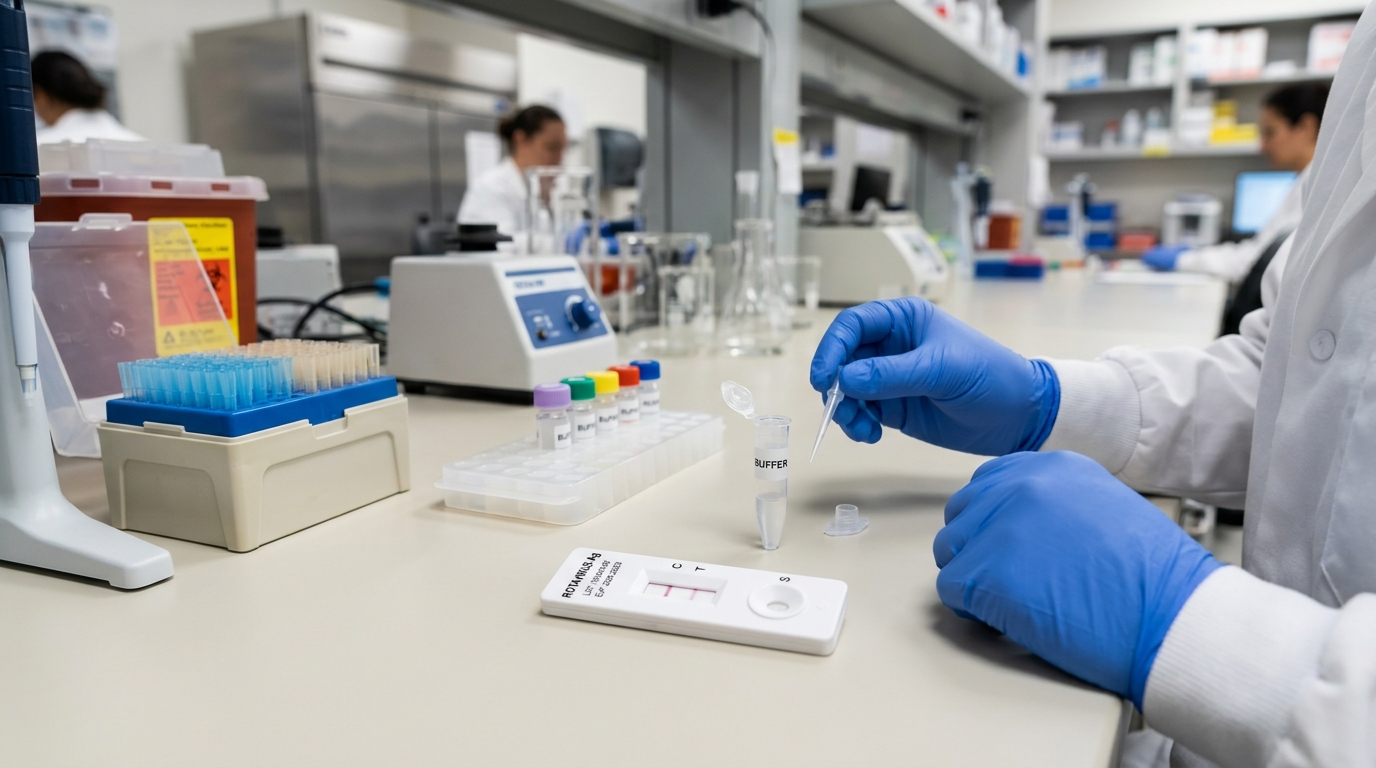
In pediatric emergency departments across the UAE, acute gastroenteritis presents with explosive watery diarrhea, persistent vomiting, and rapid dehydration. Distinguishing rotaviral enteritis from dietary food sensitivities, addressed through specialized panels such as the Food Allergy 44 package, or bacterial food poisoning is critical to prevent unnecessary antibiotics and guide immediate oral or intravenous rehydration.
Assay Target: The VP6 Inner Capsid Protein
The rotavirus virion is an architectural triple-layered icosahedral particle:
- The Target (VP6 Antigen): Viral Protein 6 (VP6) is the major structural protein forming the intermediate capsid layer, constituting more than 50% of total viral mass. VP6 bears the highly conserved group-specific antigenic determinants shared by all Group A rotaviruses, which account for >95% of human infections.
- Monoclonal Capture Technology: The test cassette contains nitrocellulose membranes striped with high-affinity anti-VP6 monoclonal antibodies coupled with colloidal gold particles, yielding a sharp visual line upon binding.
Analytical Strengths vs Clinical Blind Spots: What Can It Miss?
| Diagnostic Parameter | What the Rapid Antigen Test Detects | What the Rapid Antigen Test Can Miss |
|---|---|---|
| Viral Species & Groups | Group A Rotaviruses (the predominant pediatric human pathogen) | Non-Group A rotaviruses (Groups B and C, which cause sporadic adult outbreaks) |
| Stool Viral Shedding Load | High-titer excretion (>10^6 viral particles/mL) typical during Days 1 to 4 of watery diarrhea | Low viral titers (<10^4 particles/mL) during late recovery stages or early incubation |
| Coinfections & Other Pathogens | Rotavirus antigen only (unless run as a combo kit with Adenovirus) | Norovirus, Astrovirus, Sapovirus, or bacterial enteropathogens (Salmonella, Shigella, Campylobacter) |
| Vaccine Shedding vs Wild-Type | Presence of intact VP6 viral protein | Cannot differentiate wild-type natural infection from benign post-vaccine shedding (Rotarix/Rotateq) within 1–2 weeks of immunization |
Specimen Collection Protocol for Maximum Sensitivity
To avoid false-negative results, healthcare providers must adhere to rigorous pre-analytical handling:
- Collection Timing: Collect the specimen during the acute phase of diarrhea (Days 1 to 4), when viral shedding peaks.
- Specimen Integrity: Use raw stool collected in a clean, sterile container without transport medium, preservatives, or urine contamination. Do not submit dry diapers.
- Solid vs Liquid Stool: For liquid stool, use the sample applicator to transfer 100 μL directly into the extraction buffer tube. Avoid excessive fecal particulate, which can cause non-specific strip clogging.
For more details on diagnostic testing workflows and quality systems, visit our About QuRapid Diagnostics page or review our comprehensive Diagnostic FAQs.
Frequently Asked Questions (FAQs)
Can rotavirus rapid testing be done on blood?
No. Rotavirus is an enteric mucosal pathogen that replicates inside small intestinal enterocytes. It is excreted in high titers in stool; blood tests do not detect active acute rotaviral gastroenteritis.
Can a vaccinated child still test positive for rotavirus?
Yes. While rotavirus vaccines protect against severe dehydration and hospitalization in over 85% of children, mild breakthrough infections with variant strains can still occur and test positive on rapid assays.
How does rotavirus differ from norovirus on rapid testing?
Norovirus is genetically and structurally distinct from rotavirus. A rotavirus rapid test will NOT detect norovirus. Clinics must use specialized norovirus antigen kits or multiplex GI PCR panels when norovirus is clinically suspected.
Scientific References & Clinical Guidelines
- World Health Organization (WHO). Manual of Rotavirus Detection and Characterization Methods. Geneva: World Health Organization; 2018.
- Journal of Clinical Virology. Diagnostic Accuracy and Clinical Utility of Rapid Lateral Flow Stool Antigen Tests for Rotavirus. J Clin Virol. 2018;107:22-26.
- Centers for Disease Control and Prevention (CDC). Rotavirus Laboratory Guidance, Surveillance, and Assay Considerations. Updated 2024.