
Recurrent Urinary Tract Infections: What Tests Help Investigate the Cause?
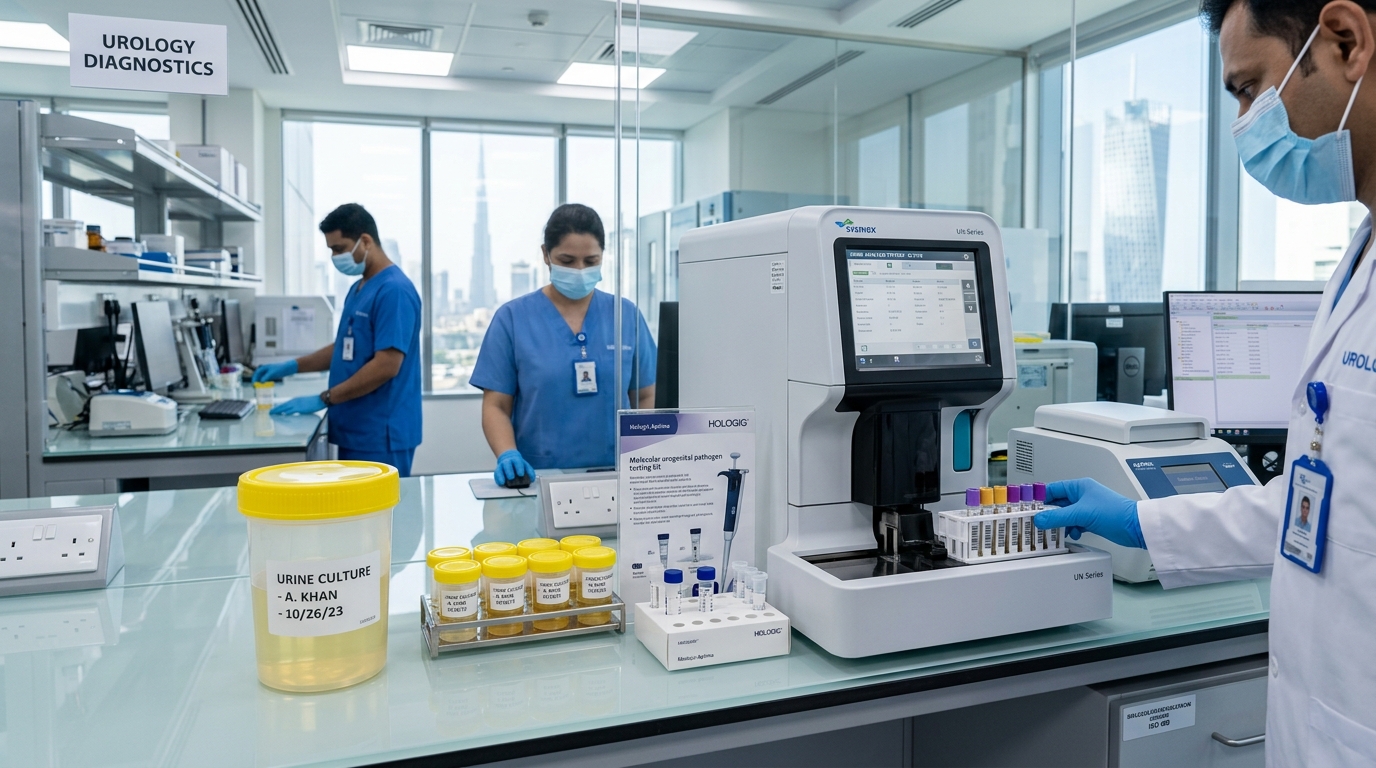
Patients in Dubai seeking long-term relief from recurrent bladder irritation frequently encounter negative standard cultures despite having active symptoms. In many cases, fastidious or intracellular pathogens—such as Ureaplasma urealyticum, Mycoplasma hominis, or enterococci embedded in protective mucosal biofilms—evade standard agar detection. Investigating specialized urogenital screening options provides the molecular precision required to guide targeted therapy.
Diagnostic Workup: Step-by-Step Investigation Strategy
Urological guidelines from the American Urological Association (AUA) and European Association of Urology (EAU) establish a structured diagnostic hierarchy:
| Investigation Tier | Diagnostic Assay | What the Test Evaluates & Detects | Clinical Role in Recurrent UTI |
|---|---|---|---|
| Tier 1: Initial Screening | Automated Urinalysis & Microscopy | Pyuria (leukocyte esterase, WBCs >10/hpf), bacteriuria, hematuria, nitrites | Confirms active urothelial inflammation; nitrites indicate Gram-negative enterobacteriaceae |
| Tier 2: Microbiological Gold Standard | Quantitative Urine Culture & AST | Colony-forming units ($CFU/mL$) and Minimum Inhibitory Concentrations (MIC) of antibiotics | Mandatory before initiating antibiotics; differentiates bacterial persistence from re-infection |
| Tier 3: Molecular Pathogen Detection | Multiplex Urogenital NAAT/PCR Panel | Fastidious organisms: Ureaplasma, Mycoplasma, Gardnerella, Trichomonas, Chlamydia | Resolves “culture-negative” burning; identifies non-culturable organisms missed on standard agar |
| Tier 4: Structural & Imaging Assessment | Renal/Bladder Ultrasound & Post-Void Residual | Urinary stasis, nephrolithiasis (kidney stones), diverticula, incomplete bladder emptying | Identifies obstructive or anatomical nidus harboring persistent bacterial colonization |
Bacterial Persistence vs Re-Infection: Why Culture Matters
Documenting acute episodes through clean-catch midstream quantitative urine culture enables clinicians to differentiate two distinct pathologies:
- Bacterial Persistence (Relapse): Recurrence caused by the exact same bacterial strain isolated in the initial infection within two weeks of antibiotic completion. This indicates deep urothelial intracellular bacterial communities (IBCs), bladder calculi acting as a microbial nidus, or antibiotic treatment failure due to insufficient tissue penetration.
- Re-Infection: Infection caused by a different strain or species (or the same strain isolated more than 4 weeks later). Re-infections stem from ascending periurethral colonization from the gastrointestinal reservoir or vaginal dysbiosis.
The Role of Fastidious Pathogens: Beyond Standard Cultures
Standard urine culture protocols incubate urine on blood agar and MacConkey agar for 24 to 48 hours under ambient air. However, fastidious urogenital organisms require specialized transport media and prolonged microaerophilic incubation. Patients suffering from chronic urethral burning with negative cultures benefit from targeted multiplex screening, such as the Urogenital 29 Pathogens screen or the extended Urogenital 38 Pathogens screen plus, which identify slow-growing urogenital bacteria with single-copy sensitivity.
Evidence-Based Prevention Strategies for Recurrent UTIs
- Aggressive Daily Hydration: Drinking at least 2.0 to 2.5 liters of water daily produces regular mechanical flushing of the bladder, significantly reducing bacterial colonization rates.
- Post-Coital Voiding: Prompt urination following sexual intercourse expels bacteria introduced into the female urethra before they can adhere to urothelial receptors.
- Vaginal Estrogen Therapy for Postmenopausal Women: Topically applied vaginal estrogen restores normal lactobacillus-dominated acidic vaginal flora, lowering vaginal pH and preventing uropathogen colonization.
- Non-Antibiotic Prophylaxis: D-mannose (which competitively binds FimH adhesins on uropathogenic E. coli) and methenamine hippurate provide evidence-backed, non-antibiotic preventative alternatives.
Frequently Asked Questions (FAQs)
Can a pelvic examination help find the cause of recurrent UTIs?
Yes. A pelvic exam evaluates for pelvic organ prolapse (cystocele), vaginal atrophy due to hypoestrogenism, urethral diverticula, or pelvic floor hypertonicity, all of which strongly predispose women to recurrent bladder infections.
Why do I get UTI symptoms even when my urine culture is negative?
Negative cultures with persistent urinary burning can indicate infection by fastidious bacteria that do not grow on standard culture media (such as Ureaplasma or Mycoplasma), interstitial cystitis/bladder pain syndrome, pelvic floor myofascial spasm, or urethral irritation from topical hygiene products.
When is a cystoscopy necessary for recurrent UTIs?
Cystoscopy is recommended if a patient exhibits painless microscopic or macroscopic hematuria, persistent infection with urea-splitting bacteria (like Proteus, suggesting bladder stones), atypical severe pain, or failure to respond to culture-directed antibiotic regimens.
Scientific References & Clinical Guidelines
- American Urological Association (AUA). Recurrent Uncomplicated Urinary Tract Infections in Women: AUA/CUA/SUFU Guideline. J Urol. 2019;202(2):282-289.
- European Association of Urology (EAU). EAU Guidelines on Urological Infections: Diagnosis and Management of Recurrent Cystitis. Eur Urol. 2021;79(5):660-671.
- Clinical Microbiology Reviews. Pathogenesis and Molecular Diagnostics of Recurrent Urinary Tract Infections. Clin Microbiol Rev. 2019;32(2):e00092-18.