
When to Get an STD Test After Unprotected Sex: Window Periods & Timeline Guide
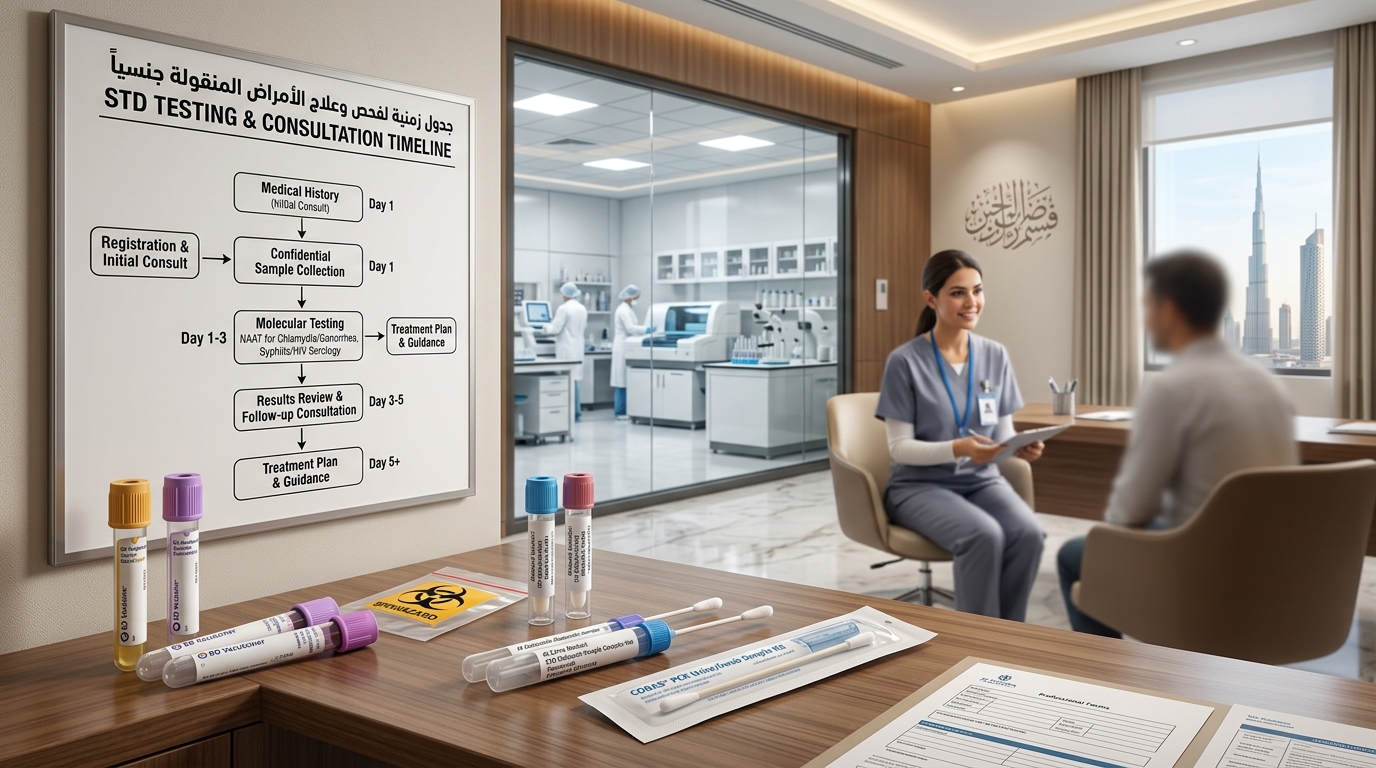
Experiencing potential exposure during unprotected sexual intercourse often creates severe acute anxiety. Many individuals rush to clinics the very next morning hoping for immediate clearance. However, standard laboratory diagnostics—whether nucleic acid amplification tests (NAAT/PCR), antigen assays, or antibody serology—cannot detect micro-organisms before minimum physiological incubation thresholds are reached. For proactive individuals in Dubai and across the Emirates, choosing comprehensive confidential STD test packages in Dubai aligned with precise biological timelines prevents misleading reassurance and ensures prompt, curative medical therapy.
Understanding the “Window Period” in STI Diagnostics
In medical microbiology, the window period refers to the time interval between the initial acquisition of a sexually transmitted pathogen and the point when a validated laboratory diagnostic assay can reliably detect its presence:
- Incubation Period vs. Window Period: The incubation period is the duration until clinical symptoms (such as urethral discharge, genital ulcers, or pelvic discomfort) become noticeable. In contrast, the diagnostic window period is when laboratory instruments can identify pathogen DNA, RNA, antigens, or host-produced antibodies—often weeks before symptoms appear or even in asymptomatic carriers.
- Analytical Sensitivity Thresholds: Modern molecular NAAT technologies possess ultra-low limits of detection (LOD), capable of detecting single-digit bacterial copies in urine or swab samples. However, if the sample is collected within 48 to 72 hours of exposure, bacterial proliferation may remain below the assay’s biochemical detection floor.
- Seroconversion Dynamics: For viral infections like HIV, Hepatitis B, and Syphilis, diagnostic blood tests rely heavily on host immunoglobulins (IgM and IgG). Humoral immune responses require 2 to 12 weeks to generate sufficient antibody titers for serological confirmation.
Immediate Emergency Action: The 72-Hour PEP Window
If you have experienced high-risk exposure to Human Immunodeficiency Virus (HIV)—such as a broken condom with a partner of unknown or detectable viral status—you must not wait for a routine test. Instead, you must seek immediate clinical evaluation for Post-Exposure Prophylaxis (PEP).
PEP is a 28-day emergency course of antiretroviral medications that must be initiated within 72 hours (ideally within 24 hours) following exposure. Initiating PEP halts viral replication and prevents HIV from establishing permanent proviral DNA integration in host lymphatic tissue. Routine testing is performed as a baseline before starting PEP, and subsequent confirmatory testing occurs at 4 to 6 weeks and 3 months post-completion.
Comprehensive Window Period Timeline Table by Pathogen
The following table outlines the minimum, optimal, and conclusive testing timelines across the most common sexually transmitted infections encountered in clinical practice:
| Infection / Pathogen | Diagnostic Technology | Earliest Reliable Detection | Optimal Testing Window | 100% Conclusive Milestone |
|---|---|---|---|---|
| Chlamydia trachomatis | Multiplex PCR / NAAT (Urine/Swab) | 5 to 7 days | 14 days post-exposure | 21 days |
| Neisseria gonorrhoeae | Multiplex PCR / NAAT | 3 to 5 days | 7 to 14 days post-exposure | 21 days |
| Mycoplasma genitalium / Ureaplasma | Targeted Molecular NAAT | 10 to 14 days | 14 to 21 days | 28 days |
| HIV 1/2 (4th Gen Ag/Ab Duo) | p24 Antigen + IgM/IgG Serology | 14 to 18 days | 28 days (4 weeks) | 45 days (lab vein blood) |
| HIV RNA (Viral Load NAAT) | Real-Time Qualitative PCR | 7 to 10 days | 14 days | 28 to 30 days |
| Syphilis (Treponema pallidum) | TPHA, EIA / RPR Serology | 14 to 21 days | 4 to 6 weeks | 90 days (3 months) |
| Hepatitis B Virus (HBV) | HBsAg Surface Antigen Assay | 3 to 6 weeks | 6 to 8 weeks | 6 months (unvaccinated) |
| Hepatitis C Virus (HCV) | HCV Antibody / HCV RNA PCR | 1 to 2 weeks (RNA) | 8 to 12 weeks (Antibody) | 6 months (Antibody) |
| Herpes Simplex (HSV-1 & HSV-2) | Lesion Swab PCR vs IgG Serology | Day 1 of active ulcer (PCR) | 6 to 8 weeks (IgG blood) | 12 to 16 weeks (IgG) |
Step-by-Step Testing Strategy: What to Do and When
To avoid diagnostic errors while ensuring complete peace of mind, clinicians recommend structured multi-stage screening rather than a single haphazard test:
Step 1: Days 1 to 3 (Immediate Post-Exposure)
Assess exposure risk. If high-risk for HIV, present to an emergency clinic or infectious disease specialist immediately for PEP evaluation. If symptomatic with severe dysuria or purulent discharge within 48 hours, medical evaluation is indicated to rule out early acute gonococcal urethritis. Otherwise, asymptomatic testing on Day 1 is diagnostically premature.
Step 2: Day 14 (The 2-Week Bacterial Screening Window)
At two weeks post-exposure, high-sensitivity NAAT/PCR testing for Chlamydia trachomatis, Neisseria gonorrhoeae, and Trichomonas vaginalis achieves clinical accuracy exceeding 98%. Collecting a first-catch urine specimen (having refrained from urinating for at least 1 hour) or targeted genital swabs at this stage provides rapid diagnosis before pathogens cause ascending pelvic inflammation.
Step 3: Day 28 (The 4-Week Comprehensive Blood & Swab Panel)
At 28 days (4 weeks), a 4th-generation HIV antigen/antibody combo blood test captures over 95% of infections due to peak p24 antigenemia. This milestone is also ideal for molecular Mycoplasma genitalium testing and initial syphilis enzyme immunoassays. When integrated with certified clinical rapid test kits, point-of-care triaging delivers actionable answers within 15 minutes.
Step 4: Day 90 (The 3-Month Conclusive Confirmation)
Three months post-exposure marks the universal gold-standard milestone. Repeating HIV 4th generation serology, Syphilis RPR/TPHA, and Hepatitis B/C serology at this time delivers 99.9% conclusive clinical clearance, resolving all lingering diagnostic uncertainty.
Best Practices for Sample Collection Accuracy
- First-Catch Urine for Men: Collect the initial 15 to 30 mL of urine stream, not the midstream portion. Ensure you have not urinated for at least one to two hours prior to the test to allow bacterial cells to concentrate in the anterior urethra.
- Swab Technique for Women: Vaginal flocked swabs self-collected by patients provide equal or superior sensitivity compared to clinician-collected endocervical swabs for Chlamydia and Gonorrhea PCR.
- Swab Active Lesions Immediately: If painful blisters, sores, or chancres develop, do not wait for the blood test window. Direct lesion swab PCR for HSV and Syphilis delivers immediate, conclusive results while the lesion is open.
Frequently Asked Questions (FAQs)
Can I get an accurate STD test 24 hours after unprotected sex?
No. Tests conducted 24 hours after exposure cannot detect sexually transmitted infections because pathogens have not multiplied sufficiently, and immune antibodies have not yet formed. The only medical action required within 24 to 72 hours is evaluating the need for HIV Post-Exposure Prophylaxis (PEP).
What is the most accurate test at 2 weeks?
At 2 weeks post-exposure, multiplex PCR / NAAT testing for Chlamydia and Gonorrhea is highly reliable (>98% sensitive). Qualitative HIV RNA PCR can also detect viral copies as early as 10 to 14 days.
Is a negative HIV test at 4 weeks conclusive?
A 4th-generation HIV p24 antigen/antibody laboratory blood test from a vein at 28 days detects over 95% of infections. While highly reassuring, international guidelines recommend a confirmatory repeat test at 6 to 12 weeks for 100% conclusive closure.
Scientific References & Clinical Guidelines
- Centers for Disease Control and Prevention (CDC). Sexually Transmitted Infections Treatment Guidelines: Clinical Principles and Screening Timelines. MMWR Recomm Rep. 2021;70(4):1-18.
- World Health Organization (WHO). Laboratory Diagnosis of Sexually Transmitted Infections, Including Human Immunodeficiency Virus. WHO Guidelines. 2021; ISBN 978-92-4-002223-2.
- British Association for Sexual Health and HIV (BASHH). United Kingdom Guideline on the Use of HIV Post-Exposure Prophylaxis (PEP) Following Sexual Exposure. BASHH. 2021;22(3):145-160.