
Syphilis Blood Test Types Explained: Treponemal vs Non-Treponemal (RPR, VDRL, TPHA & FTA-ABS)
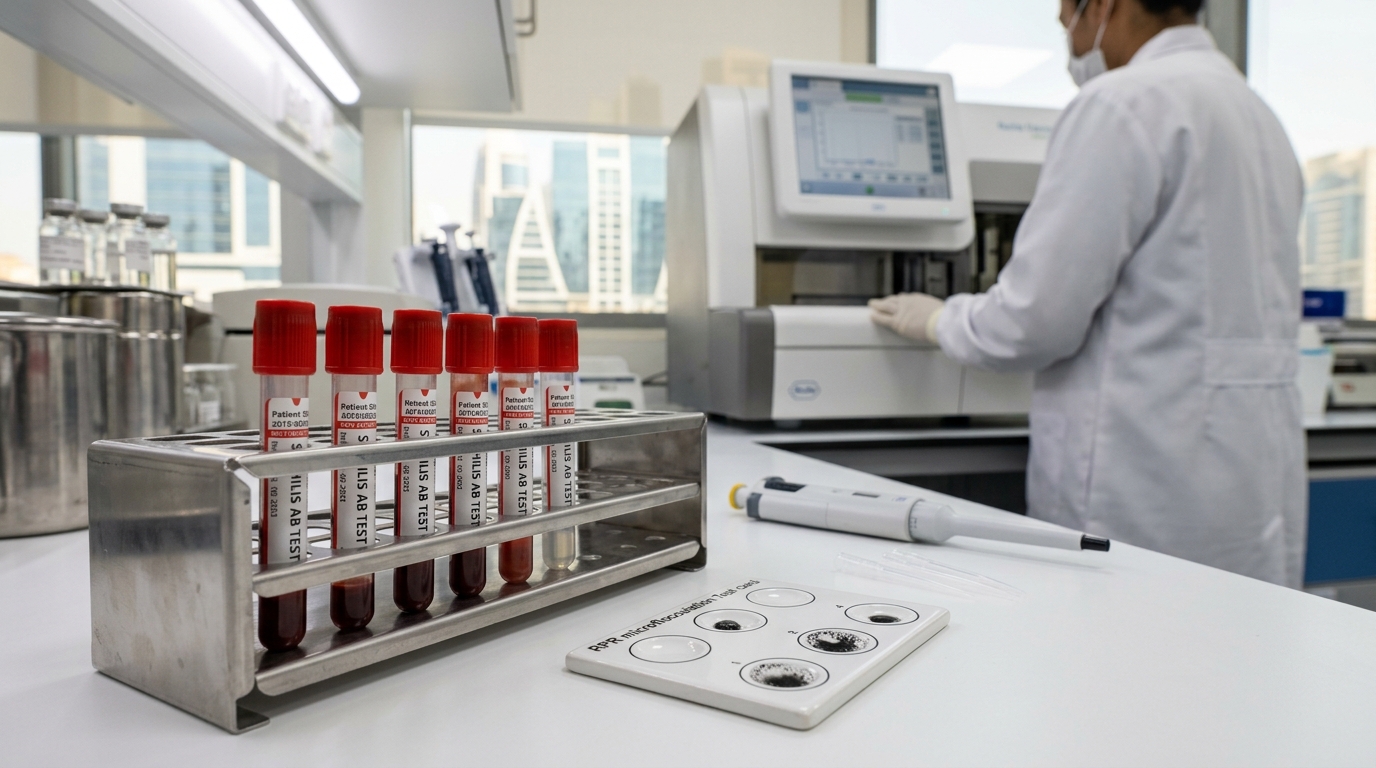
Patients and healthcare professionals across Dubai and the UAE frequently experience confusion when reviewing syphilis laboratory reports. A patient may receive a “Positive” treponemal antibody screen alongside a “Non-Reactive” RPR titer, raising urgent questions: Is this an active contagious infection, a biologically false-positive reaction, or successful cure of a past exposure? For individuals seeking confidential, scientifically validated screening, scheduling advanced STD test packages in Dubai with dual-algorithmic reflex testing delivers precise diagnostic clarity.
The Biological Classification: Two Distinct Test Categories
Serological diagnosis of syphilis requires two complementary classes of blood assays that measure fundamentally different immunological targets:
- Non-Treponemal Tests (Biomarkers of Active Disease & Cellular Damage): These tests (such as RPR and VDRL) do not measure antibodies against the bacterium itself. Instead, they detect anti-cardiolipin antibodies—an immunoglobulin response directed against lipoidal antigens released from damaged host mammalian cells and the spirochete surface during active spirochetal multiplication.
- Treponemal Tests (Specific Pathogen Antibodies): These assays (such as TPHA, TP-PA, FTA-ABS, and automated chemiluminescent immunoassays) detect antibodies specifically directed against native recombinant Treponema pallidum protein antigens (e.g., TmpA, TpN47, TpN17). Once positive, treponemal tests typically remain reactive for life, serving as an indelible immunological scar.
Comprehensive Comparison of Syphilis Diagnostic Modalities
The following detailed clinical table compares the six major syphilis testing modalities utilized in UAE clinical laboratories:
| Test Name & Acronym | Category | Biochemical Target | Clinical Role & Indication | Response Post-Curative Therapy |
|---|---|---|---|---|
| RPR (Rapid Plasma Reagin) | Non-Treponemal | Cardiolipin-lecithin-cholesterol antigen (flocculation) | Primary disease activity marker; quantitative titer tracking (e.g., 1:16, 1:32) | Titers decline 4-fold within 6–12 months; typically reverts to non-reactive |
| VDRL (Venereal Disease Research Lab) | Non-Treponemal | Microscopic flocculation of cardiolipin antigen | Standard test for Cerebrospinal Fluid (CSF) neurosyphilis evaluation | Declines following successful intravenous penicillin neuro-treatment |
| TPHA / TP-PA (Particle Agglutination) | Treponemal | Avian red cells or gelatin particles sensitized with T. pallidum | Confirmatory qualitative testing; high specificity (>99%) | Remains permanently positive in 85% to 90% of cured individuals |
| EIA / CIA (Enzyme / Chemiluminescent Immunoassay) | Treponemal | Recombinant T. pallidum antigens (automated high-throughput) | Frontline screening in reverse-sequence algorithms; ultra-early IgG/IgM detection | Remains reactive indefinitely (lifelong marker of treponemal exposure) |
| FTA-ABS (Fluorescent Treponemal Antibody Absorption) | Treponemal | Indirect immunofluorescence microscopy on fixed spirochetes | Historical gold-standard referee test for discordant screening results | Remains permanently positive |
| Direct Darkfield Microscopy / Lesion PCR | Direct Pathogen Detection | Live motile spirochetes (darkfield) or T. pallidum DNA (PCR) | Primary chancre or moist condyloma lata swab before seroconversion occurs | Direct test becomes negative immediately upon antibiotic initiation |
Diagnostic Algorithms: Traditional vs. Reverse Sequence Screening
Clinical laboratories have evolved two distinct strategic pathways for syphilis screening:
1. Traditional Algorithm (Historical Approach)
The lab initiates testing with an inexpensive non-treponemal screen (RPR or VDRL). If reactive, the specimen is confirmed using a specific treponemal test (TPHA or FTA-ABS). While effective in populations with high acute disease prevalence, this approach misses up to 30% of very early primary syphilis and untreated late latent cases where non-treponemal cardiolipin antibodies have naturally waned.
2. Reverse Sequence Algorithm (Modern Automated Standard)
The contemporary standard adopted across advanced UAE diagnostic centers begins with a highly sensitive automated treponemal test (EIA/CIA IgG/IgM). If reactive, the laboratory automatically reflex-tests the specimen with a quantitative RPR:
- Treponemal Reactive + RPR Reactive: Confirms untreated active syphilis (or recently treated infection with residual titers). Clinical stage and history dictate penicillin dosage.
- Treponemal Reactive + RPR Non-Reactive: Requires a second discordant-clearing treponemal test (TP-PA). If TP-PA is positive, it indicates either successfully treated historical syphilis or late latent untreated infection. If TP-PA is negative, the original EIA was a biological false positive.
- Treponemal Non-Reactive: Rules out syphilis (unless exposure occurred within the initial 2-week window).
Understanding RPR Titers: What Does 1:64 vs 1:2 Mean?
Non-treponemal tests are reported as serial two-fold dilution titers (e.g., 1:1, 1:2, 1:4, 1:8, 1:16, 1:32, 1:64, 1:128):
- High Titer (≥ 1:16 or 1:32): Indicates robust bacterial replication and intense immunological activation, typical of secondary syphilis, early latent infection, or reinfection in sexually active individuals.
- Low Titer (≤ 1:4): Typical of very early primary infection, late latent disease, or the “serofast state” where low residual cardiolipin antibodies persist indefinitely despite complete biological cure.
- The 4-Fold Change Rule: In clinical venereology, treatment response or reinfection is defined by a four-fold (two dilution) change in RPR titer. For example, a decline from 1:32 to 1:8 proves successful cure, whereas a rise from 1:4 to 1:16 proves treatment failure or reinfection. Integrating with certified point-of-care rapid testing diagnostics ensures seamless clinical tracking.
Biological False Positives (BFP): When the Test is Wrong
Non-treponemal cardiolipin antigens cross-react with non-syphilitic conditions that trigger autoimmune or cellular tissue disruption:
- Acute False Positives (<6 months): Febrile viral illnesses, pregnancy, recent vaccinations, malaria, and acute viral hepatitis.
- Chronic False Positives (>6 months): Systemic lupus erythematosus (SLE), antiphospholipid syndrome (APS), rheumatoid arthritis, intravenous drug use, and advanced liver cirrhosis.
Frequently Asked Questions (FAQs)
Why is my syphilis test positive if I was treated years ago?
Treponemal antibody tests (such as TPHA and EIA) remain permanently positive in up to 90% of individuals for life, even after 100% curative treatment. To check if an infection is currently active, physicians examine the quantitative non-treponemal RPR titer.
What is the earliest blood test for syphilis after exposure?
Automated treponemal EIA/CIA tests detecting both IgM and IgG can turn positive within 2 to 3 weeks following exposure. Non-treponemal RPR tests typically turn positive around 3 to 6 weeks. If an active genital ulcer is present, direct darkfield or PCR testing detects the bacterium on Day 1.
What does a “serofast” state mean?
Serofast refers to a clinical situation where a patient’s RPR titer drops appropriately following penicillin therapy (proving cure) but plateaus at a low level (such as 1:1 or 1:2) indefinitely without turning completely non-reactive. This is biologically harmless and does not require repeat treatment.
Scientific References & Clinical Guidelines
- Centers for Disease Control and Prevention (CDC). Syphilis – STI Treatment Guidelines and Laboratory Diagnostic Principles. MMWR Recomm Rep. 2021;70(4):47-60.
- World Health Organization (WHO). Guidelines for the Laboratory Diagnosis of Treponema pallidum (Syphilis). WHO Guidelines Approved by the Guidelines Review Committee. 2021; ISBN 978-92-4-001804-4.
- Clinical Infectious Diseases. The Modern Laboratory Diagnosis of Syphilis: Innovations, Reverse Screening, and Challenges in Interpretation. Clin Infect Dis. 2020;71(Suppl 1):S1-S12.