
Prolactin Fertility Testing Meaning: Hyperprolactinemia, Ovulation Inhibition & Normal Ranges
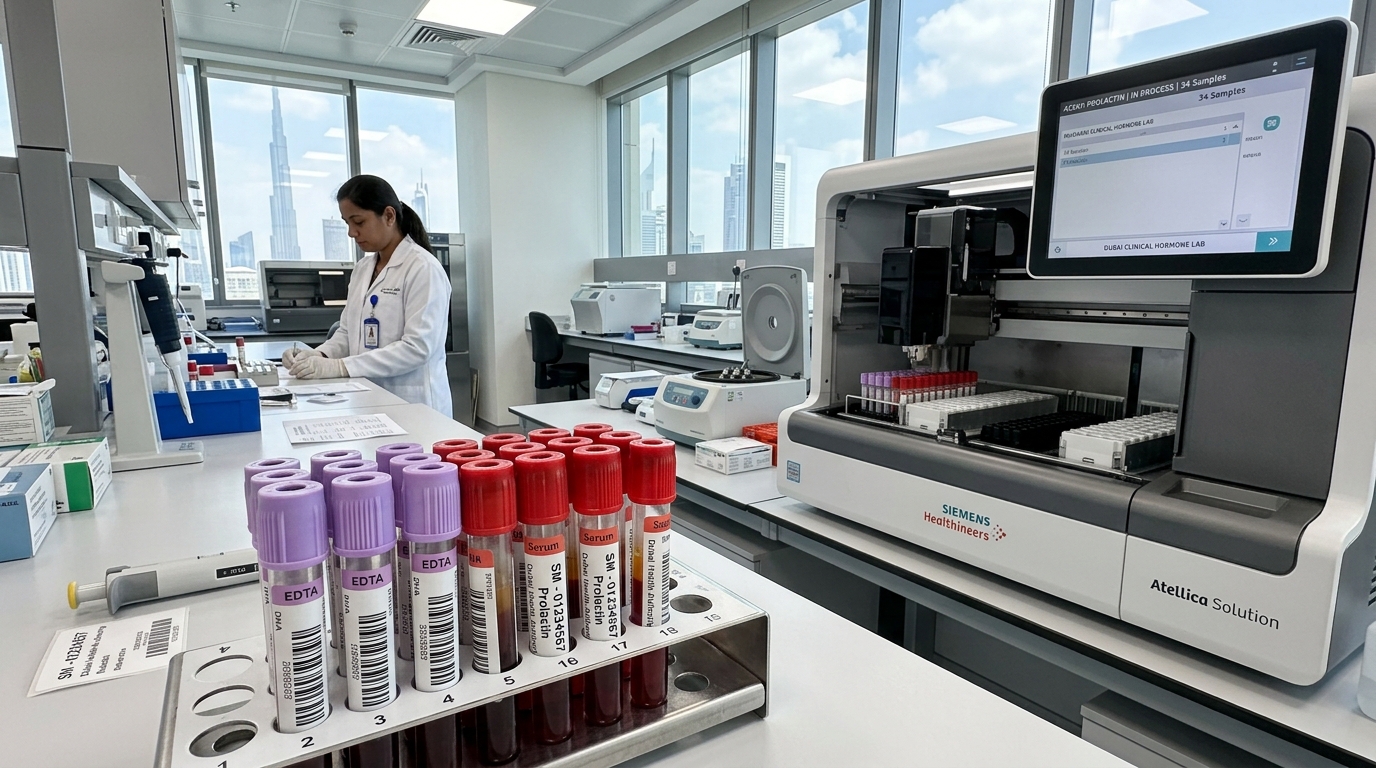
Women presenting with irregular menstrual cycles (oligomenorrhea), complete cessation of menses (amenorrhea), unexpected breast discharge (galactorrhea), or unexplained infertility across Dubai and the UAE routinely undergo baseline hormonal evaluation. Understanding how elevated prolactin disrupts the delicate hypothalamic-pituitary-gonadal (HPG) axis is vital. When combined with comprehensive ovarian reserve and reproductive hormone profiling through specialized fertility blood test packages in Dubai, identifying hyperprolactinemia allows rapid medical cure, restoring natural ovulatory cycles within weeks.
The Endocrine Mechanism: How Prolactin Halts Fertility
To understand why prolactin testing is a mandatory component of fertility workups, clinicians examine its central neuroendocrine cascade:
- Suppression of Hypothalamic GnRH: High circulating prolactin stimulates dopamine release in the arcuate nucleus while inhibiting kisspeptin neurons in the hypothalamus. This suppresses the pulsatile release of Gonadotropin-Releasing Hormone (GnRH).
- Blunted FSH and LH Secretion: Without coordinated GnRH pulses, the anterior pituitary fails to release adequate Follicle-Stimulating Hormone (FSH) and Luteinizing Hormone (LH). Consequently, ovarian antral follicles fail to mature, preventing follicular estrogen production and abolishing the pre-ovulatory LH surge.
- Luteal Phase Deficiency & Anovulation: In mild hyperprolactinemia, ovulation may still occur sporadically, but defective LH support causes premature regression of the corpus luteum (Luteal Phase Defect), producing inadequate progesterone and preventing blastocyst implantation.
- Impact on Male Fertility: In men, hyperprolactinemia directly suppresses Leydig cell testosterone biosynthesis and Sertoli cell spermatogenesis, leading to erectile dysfunction, reduced libido, gynecomastia, and severe oligozoospermia or azoospermia.
Serum Prolactin Reference Ranges & Clinical Stratification
Prolactin concentrations are measured in nanograms per milliliter (ng/mL) or milli-international units per liter (mIU/L):
| Clinical Category | Reference Range (ng/mL) | Reference Range (mIU/L) | Primary Clinical Interpretations & Etiologies |
|---|---|---|---|
| Normal Adult Female (Non-Pregnant) | 2.0 to 25.0 ng/mL | 40 to 530 mIU/L | Normal physiological baseline; healthy HPG axis regulation |
| Normal Adult Male | 2.0 to 18.0 ng/mL | 40 to 380 mIU/L | Normal male endocrine baseline; normal testicular function |
| Mild Hyperprolactinemia | 26.0 to 50.0 ng/mL | 550 to 1,060 mIU/L | Stress, venipuncture anxiety, subclinical hypothyroidism, medication-induced, macroprolactinemia |
| Moderate Hyperprolactinemia | 51.0 to 100.0 ng/mL | 1,080 to 2,120 mIU/L | Primary hypothyroidism, chronic kidney disease, pituitary microadenoma (<10 mm), stalk compression |
| Marked Hyperprolactinemia | 101.0 to 200.0 ng/mL | 2,140 to 4,240 mIU/L | Prolactin-secreting pituitary microadenoma; marked ovulatory suppression |
| Severe Hyperprolactinemia | > 200.0 ng/mL | > 4,240 mIU/L | Pituitary macroadenoma (>10 mm prolactinoma); requires urgent contrast-enhanced brain MRI |
Common Etiologies: Why Does Prolactin Become Elevated?
Diagnosing hyperprolactinemia requires systematic investigation of physiological, pharmacological, and pathological drivers:
1. Physiological & Stress Factors
Prolactin is an acute-phase neuroendocrine stress hormone. Strenuous exercise, sleep deprivation, sexual intercourse within 24 hours prior to testing, nipple stimulation, breast examinations, and acute anxiety from needle venipuncture can cause transient physiological spikes up to 40 to 60 ng/mL.
2. Pharmacological Causes (Drug-Induced)
Pituitary prolactin secretion is tonically inhibited by hypothalamic dopamine. Any medication that blocks dopamine receptors or depletes central dopamine reserves causes secondary hyperprolactinemia:
- Antipsychotics: Risperidone, haloperidol, olanzapine (can cause levels >100 ng/mL).
- Antidepressants: SSRIs (sertraline, paroxetine) and tricyclic antidepressants.
- Gastrointestinal Prokinetics: Metoclopramide and domperidone.
- Antihypertensives: Methyldopa and verapamil.
3. Primary Hypothyroidism
In patients with an underactive thyroid, low circulating thyroxine (T4) triggers high compensatory secretion of hypothalamic Thyrotropin-Releasing Hormone (TRH). TRH acts as a direct, potent secretagogue for pituitary prolactin. Correcting hypothyroidism with levothyroxine normalizes prolactin levels without requiring dopamine agonists.
4. Pituitary Tumors (Prolactinomas)
Benign adenomas of the anterior pituitary gland are classified into microprolactinomas (<10 mm) and macroprolactinomas (≥10 mm). Larger tumors can also compress the optic chiasm, causing bilateral temporal hemianopia (peripheral vision loss) and severe headaches.
The High-Dose Hook Effect: Avoiding Catastrophic Under-Diagnosis
In patients with giant pituitary prolactinomas (tumors >3 cm), clinicians must remain vigilant against the “High-Dose Hook Effect” in two-site sandwich immunometric assays:
- Biochemical Mechanism: Extremely high antigen concentrations (prolactin levels exceeding 10,000 to 50,000 ng/mL) saturate both the solid-phase capture antibodies and soluble signal antibodies simultaneously without forming sandwich complexes.
- False Low Reading: The analyzer erroneously reports a mildly elevated or even normal prolactin level (e.g., 30 to 50 ng/mL) despite a massive macroadenoma visible on MRI, leading physicians to misdiagnose a non-functioning pituitary tumor and recommend unnecessary neurosurgery.
- Serial Serum Dilution Protocol: When a substantial pituitary mass is detected on neuroimaging but prolactin returns only mildly elevated, clinical endocrinologists instruct the laboratory to perform a 1:100 serial serum dilution. Dilution unmasks the true astronomical prolactin concentration (often >5,000 ng/mL), confirming a prolactinoma and allowing curative medical therapy.
Medical Management Protocols: Restoring Ovulation & Fertility
Unlike most intracranial neoplasms, prolactinomas are treated primarily with medical pharmacotherapy rather than surgical resection:
- Cabergoline (First-Line Therapy): An ergot-derivative selective dopamine D2-receptor agonist administered once or twice weekly (0.25 to 0.5 mg). Cabergoline normalizes prolactin levels in 85% to 92% of patients, induces significant tumor shrinkage in over 80%, and exhibits significantly fewer gastrointestinal and postural adverse effects compared to older agents.
- Bromocriptine: A short-acting dopamine agonist taken daily with meals. While slightly less potent than cabergoline, bromocriptine has an extensive safety track record spanning over four decades in women seeking immediate pregnancy.
- Return of Ovulatory Function: Following initiation of cabergoline, normal pulsatile GnRH and gonadotropin secretion typically recovers within 4 to 8 weeks. Women are advised to use barrier contraception until regular menstrual cycles re-establish to allow accurate dating of subsequent conception.
Management During Pregnancy and Lactation
During normal gestation, physiological pituitary lactotroph hyperplasia causes circulating prolactin to rise tenfold to support mammary gland preparation. In women with treated prolactinomas who achieve pregnancy:
- Discontinuation of Dopamine Agonists: Upon biochemical pregnancy confirmation (positive hCG test), dopamine agonists are usually discontinued in patients with microadenomas because the risk of clinically significant tumor expansion during pregnancy is under 2% to 3%.
- Macroadenoma Surveillance: Women with large macroadenomas require regular visual field testing each trimester. Routine prolactin blood monitoring is not recommended during gestation because physiological pregnancy elevations make tumor tracking uninterpretable.
Best Practice Pre-Analytical Testing Protocols
Because prolactin is exquisitely sensitive to pre-analytical variables, strict laboratory protocols must be maintained:
- Fasting Morning Draw: Blood must be collected in the morning, 2 to 3 hours after waking, as prolactin peaks during sleep.
- Rest Before Venipuncture: Patients should rest quietly in a chair for 15 to 20 minutes prior to blood draw to eliminate physical stress spikes.
- Refrain from Breast/Nipple Stimulation: Avoid breast self-exams and intercourse for 48 hours before testing.
- Macroprolactin Screening (PEG Precipitation): In asymptomatic patients with mild-to-moderate elevations, labs perform polyethylene glycol (PEG) precipitation to rule out “macroprolactin”—biologically inactive high-molecular-weight antibody complexes that cause falsely elevated laboratory readings without affecting fertility. Point-of-care triaging with advanced hormonal rapid diagnostic kits helps streamline baseline testing.
Frequently Asked Questions (FAQs)
Can I get pregnant if I have high prolactin?
High prolactin suppresses ovulation, making natural conception difficult or impossible. However, once hyperprolactinemia is diagnosed and treated with dopamine agonist medications (such as cabergoline), prolactin levels normalize rapidly, ovulation resumes in over 85% of women, and pregnancy rates are excellent.
What is the treatment for a prolactinoma?
Unlike most brain tumors, prolactinomas are treated primarily with oral medical therapy rather than surgery. Dopamine agonists like cabergoline or bromocriptine effectively shrink the tumor and normalize prolactin levels in over 90% of patients.
Why does my doctor check thyroid levels alongside prolactin?
An underactive thyroid gland (hypothyroidism) stimulates excessive production of TRH from the brain, which directly triggers pituitary prolactin secretion. Often, treating the thyroid gland with levothyroxine completely cures the high prolactin and restores fertility.
Scientific References & Clinical Guidelines
- The Endocrine Society. Diagnosis and Treatment of Hyperprolactinemia: An Endocrine Society Clinical Practice Guideline. J Clin Endocrinol Metab. 2011;96(2):273-288.
- Fertility and Sterility. Current Evaluation of Amenorrhea and Hyperprolactinemic Infertility in Reproductive Age Women. Fertil Steril. 2021;115(1):18-29.
- Lancet Diabetes & Endocrinology. Management of Prolactinomas During Pregnancy and Conception: Evidence-Based Clinical Recommendations. Lancet Diabetes Endocrinol. 2020;8(7):610-622.