
Culture-Negative Urinary Symptoms: Testing Options for Chronic Dysuria, Interstitial Cystitis & Stealth Pathogens
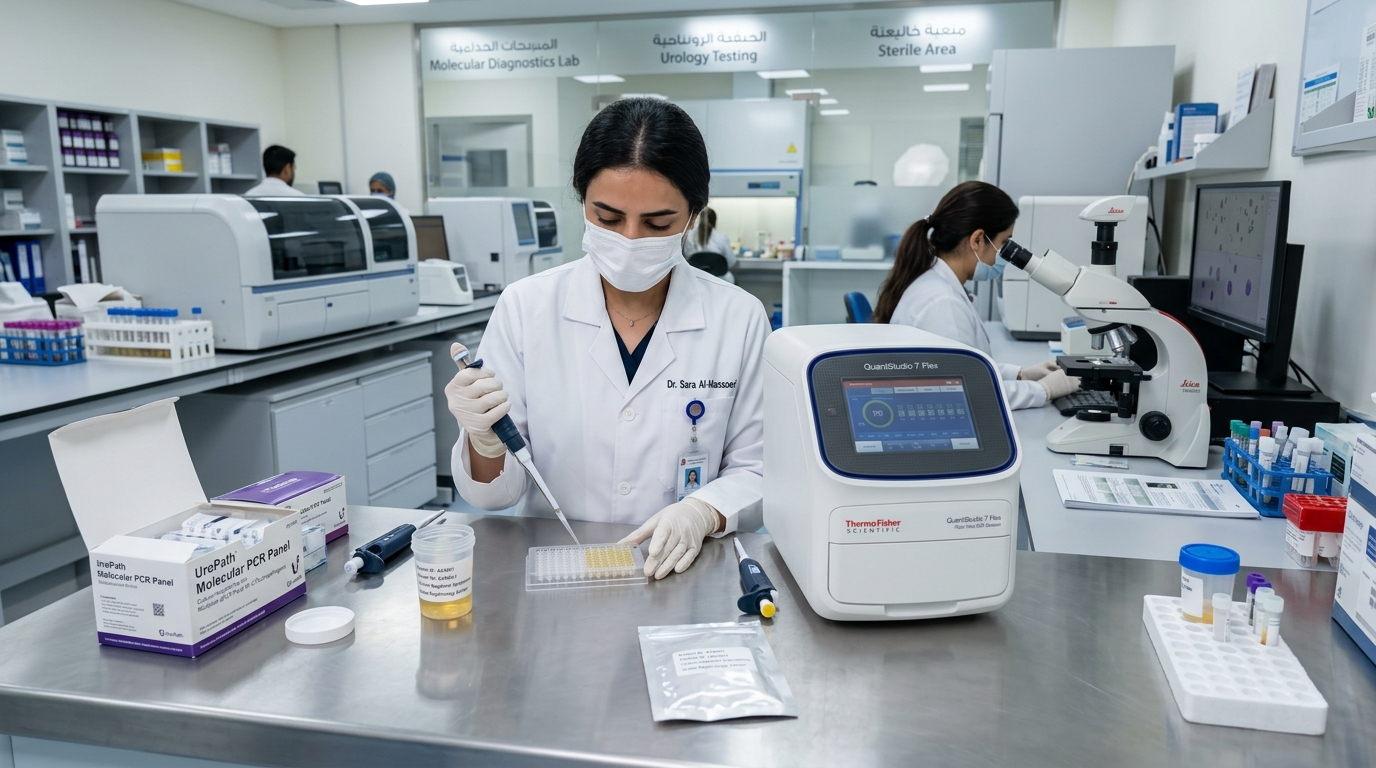
In clinics across Dubai, Abu Dhabi, and the wider UAE, patients suffering from persistent dysuria are frequently prescribed empirical courses of ciprofloxacin, amoxicillin, or nitrofurantoin without microbiological confirmation. When symptoms rebound immediately after completing antibiotics, patients find themselves trapped in a cycle of diagnostic invalidation. Choosing specialized advanced urogenital health test packages in Dubai moves beyond obsolete 1950s culturing constraints, identifying fastidious pathogens and restoring bladder comfort.
Why Do Standard Urine Cultures Return Negative?
To understand why standard laboratory urine cultures fail symptomatic patients, clinicians evaluate the historical limitations of clinical microbiology:
- The Arbitrary Kass 10^5 Colony Count Threshold: Standard laboratory protocols adopted in the 1950s (Kass criteria) define a positive UTI as growth of ≥100,000 colony-forming units (CFU)/mL of a single uropathogen. However, clinical studies show that up to 30% of acutely symptomatic women have bacterial colony counts between 10^2 and 10^4 CFU/mL—which routine laboratories discard as “insignificant growth” or “contamination.”
- Aerobic 24-Hour Agar Constraints: Standard cultures plate urine onto blood agar and MacConkey agar incubated in ambient air at 35°C for 24 to 48 hours. This environment exclusively favors fast-growing aerobic enteric rods like Escherichia coli and Klebsiella, while completely suppressing slow-growing, fastidious, microaerophilic, or anaerobic uropathogens.
- Intracellular Biofilm Sequestration: Uropathogenic bacteria can invade bladder umbrella epithelial cells, forming quiescent intracellular bacterial communities (IBCs) shielded beneath protective glycosaminoglycan (GAG) biofilm layers. During clinical quiescence or shedding, free planktonic bacteria in urine may remain below standard culturing detection floors.
Differential Diagnosis: What Causes Culture-Negative Symptoms?
Persistent culture-negative dysuria and pelvic pressure arise from distinct infectious and non-infectious etiologies:
| Etiological Category | Specific Pathogens / Conditions | Underlying Mechanism | Recommended Advanced Diagnostic Modality |
|---|---|---|---|
| Fastidious Stealth Pathogens | Mycoplasma genitalium, Ureaplasma urealyticum, Ureaplasma parvum | Wall-less bacteria that cannot grow on standard agar; cause chronic urethritis and trigonitis | Multiplex Molecular NAAT / Real-Time Urine PCR |
| Undetected Sexually Transmitted Pathogens | Chlamydia trachomatis, Trichomonas vaginalis, Herpes Simplex (HSV-1/2) | Mucosal epithelial inflammation of the urethra and bladder neck | Targeted First-Catch Urine PCR Panel |
| Urobiome Fastidious Bacteria | Corynebacterium urealyticum, Aerococcus urinae, Actinotignum schaalii, Alloscardovia | Slow-growing, CO2-dependent uropathogens that hydrolyze urea or produce chronic inflammation | Expanded Quantitative Urine Culture (EQUC) / 16S rRNA Sequencing |
| Interstitial Cystitis / Bladder Pain Syndrome (IC/BPS) | Non-infectious neuro-inflammatory syndrome | Disruption of bladder glycosaminoglycan (GAG) layer; mast cell activation; Hunner’s lesions | Diagnostic Cystoscopy with hydrodistension; exclusion of infection |
| Pelvic Floor Muscle Dysfunction (PFMD) | Hypertonic pelvic floor myofascial spasm | Spastic pelvic floor muscles compress the urethra, mimicking bladder infection burning | Physical Pelvic Floor Myofascial Examination |
| Genitourinary Syndrome of Menopause (GSM) | Severe hypoestrogenism in perimenopause / postmenopause | Thinning of urogenital epithelium, loss of protective Lactobacillus, elevated pH | Clinical Pelvic Exam, Vaginal Maturation Index (VMI) |
Modern Diagnostic Testing Options
Patients with ongoing urinary distress and negative standard cultures should pursue structured secondary diagnostic evaluations:
1. Multiplex Molecular Urine PCR Panels
Molecular PCR panels bypass culturing entirely by amplifying pathogen-specific DNA and RNA directly from urine. A single first-catch urine specimen can detect 15 to 30 fastidious targets—including Mycoplasma, Ureaplasma, Enterococcus faecalis, and fungal pathogens like Candida albicans/glabrata—within 24 hours with >98% clinical sensitivity.
2. Expanded Quantitative Urine Culture (EQUC)
Pioneered by academic urology centers, EQUC plates larger volumes of urine (10 µL to 100 µL) across diverse media (chocolate agar, colistin-nalidixic acid agar) incubated in 5% CO2 and anaerobic environments for 48 to 72 hours. EQUC detects beneficial commensal urobiome bacteria as well as fastidious pathogens missed by standard protocols in up to 80% of symptomatic patients.
3. First-Catch vs. Midstream Clean-Catch Strategy
Sample collection timing is critical:
- First-Catch Urine (Initial 15–20 mL): Required for molecular PCR to capture urethral pathogens (Chlamydia, Mycoplasma, Ureaplasma) washed out by the initial stream.
- Midstream Clean-Catch: Required for bladder-origin cultures and EQUC after thoroughly cleansing the external meatus.
4. Diagnostic Cystoscopy & Urodynamics
In patients with persistent negative molecular panels and refractory suprapubic pain, urologists perform flexible cystoscopy under local or general anesthesia to evaluate the bladder lining directly for Hunner’s lesions (distinctive bleeding ulcerations diagnostic of classic interstitial cystitis), bladder stones, or urothelial carcinoma in situ.
Structured Management Protocol for Culture-Negative Dysuria
- Stop Blind Empirical Antibiotics: Repeatedly taking broad-spectrum antibiotics without an identified pathogen destroys the protective gastrointestinal and vaginal Lactobacillus flora, creating microbial dysbiosis that exacerbates symptoms.
- Target Identified Stealth Organisms: If molecular PCR confirms Ureaplasma or Mycoplasma, treat with targeted regimens (e.g., doxycycline followed by azithromycin or moxifloxacin) rather than ineffective beta-lactams.
- GAG Layer Restoration for Interstitial Cystitis: If non-infectious IC/BPS is diagnosed, clinicians utilize bladder instillations (hyaluronic acid, chondroitin sulfate), oral pentosan polysulfate, and antihistamines to rebuild the mucosal barrier.
- Pelvic Floor Physical Therapy: Specialized internal myofascial release physical therapy resolves up to 70% of culture-negative urinary burning in patients whose symptoms are driven by hypertonic pelvic muscle spasms. Point-of-care triaging with certified rapid diagnostic testing cassettes helps systematically rule out acute infections.
Frequently Asked Questions (FAQs)
Why does my urine burn if my culture is completely negative?
Urinary burning with a negative culture is commonly caused by fastidious organisms not detected by standard tests (such as Ureaplasma or Mycoplasma), low-count bacterial colonization below the laboratory’s detection threshold, pelvic floor muscle tension, or non-infectious bladder inflammation (interstitial cystitis).
Can Ureaplasma cause chronic urinary symptoms?
Yes. Ureaplasma urealyticum and Ureaplasma parvum produce an enzyme called urease that breaks down urea into ammonia, causing mucosal irritation, burning, and frequency. They lack a cell wall and cannot grow on standard agar, requiring molecular PCR testing for detection.
What is Expanded Quantitative Urine Culture (EQUC)?
EQUC is an advanced laboratory technique that plates larger urine volumes on multiple specialty culture agars incubated under varied atmospheric conditions (including CO2 and anaerobic chambers) for up to 72 hours, successfully identifying slow-growing uropathogens missed by routine 24-hour cultures.
Scientific References & Clinical Guidelines
- American Urological Association (AUA). Diagnosis and Treatment of Interstitial Cystitis/Bladder Pain Syndrome: AUA Guideline. J Urol. 2022;208(1):34-42.
- Journal of Clinical Microbiology. The Female Urinary Microbiome: A Comparison of Standard Urine Culture and Expanded Quantitative Urine Culture (EQUC) in Symptomatic Women. J Clin Microbiol. 2018;56(3):e01452-17.
- International Urogynecology Journal. Recurrent and Chronic Urinary Tract Infections in Women: Why Routine Urine Cultures Fail and How Molecular Diagnostics Transform Care. Int Urogynecol J. 2020;31(10):1993-2003.