
Total Testosterone Fertility Testing Meaning: Free Testosterone, SHBG & Male Reproductive Health
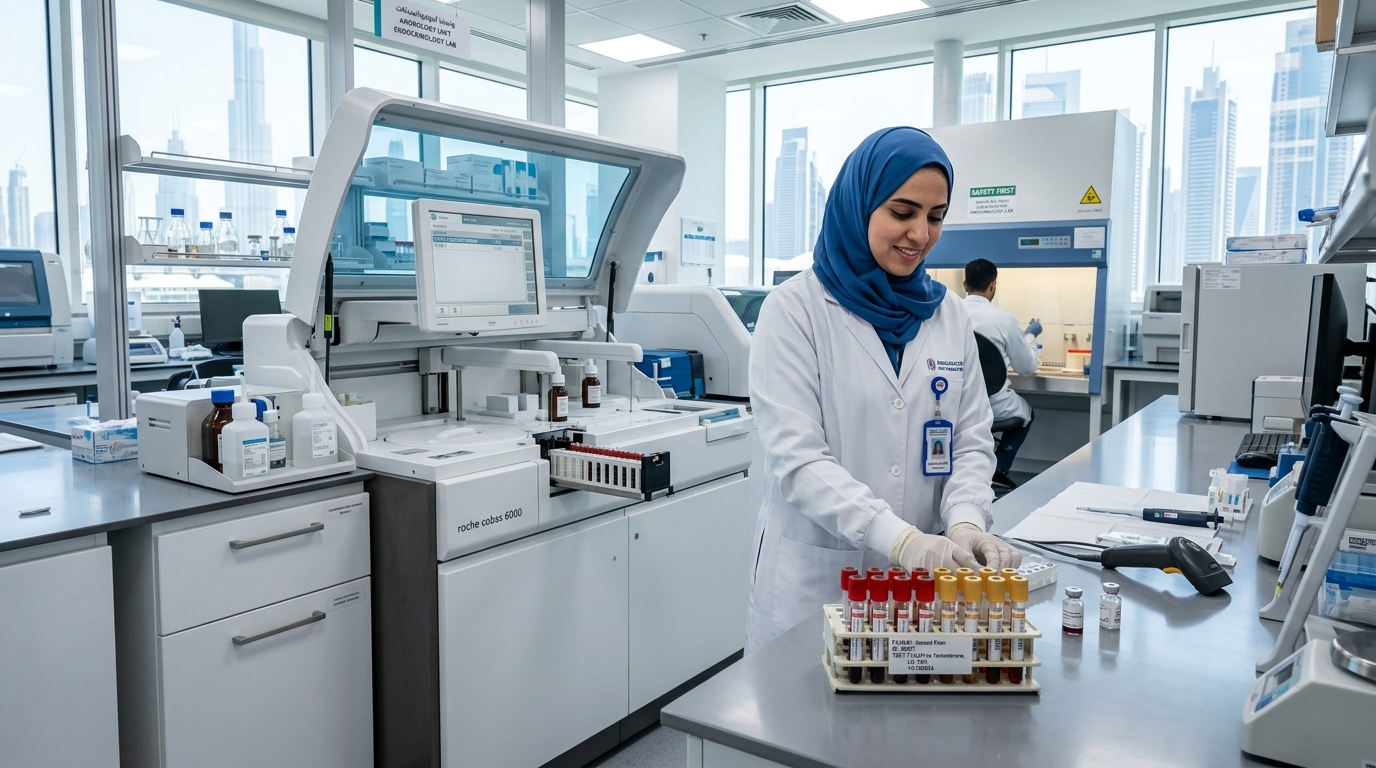
Couples seeking fertility support in Dubai and across the UAE frequently focus initial evaluations exclusively on female ovulatory factors. However, male factor abnormalities contribute to approximately 40% to 50% of all infertility cases. Men presenting with low sperm count (oligozoospermia), poor sperm motility (asthenozoospermia), or complete absence of sperm (azoospermia) require rigorous endocrine evaluation. Paired with comprehensive semen analysis through specialized advanced fertility blood testing panels in Dubai, precise testosterone profiling distinguishes primary testicular failure from reversible hypothalamic-pituitary disorders.
The Biological Triad: Total, Free, and Bioavailable Testosterone
Circulating testosterone in adult male plasma exists in three distinct physiological fractions that must be evaluated together:
- SHBG-Bound Testosterone (60% to 70%): Tightly bound with high affinity to Sex Hormone-Binding Globulin (SHBG). This fraction is biologically inactive and cannot penetrate target cellular membranes or enter testicular tissue.
- Albumin-Bound Testosterone (30% to 38%): Loosely bound with low affinity to circulating serum albumin. This bond readily dissociates in capillary beds, making it biologically available to tissues.
- Free Testosterone (1% to 2%): Completely unbound, biologically active circulating steroid hormone that freely diffuses across cellular lipid bilayers to bind intracellular androgen receptors.
- Bioavailable Testosterone: The mathematical sum of Free Testosterone plus Albumin-bound testosterone, representing the total active androgen pool impacting physiology.
Clinical Reference Ranges & Stratification
According to American Urological Association (AUA) and European Association of Urology (EAU) guidelines, diagnostic thresholds are structured as follows:
| Hormone Fraction | Standard Adult Male Reference Range | Clinical Hypogonadism Threshold | Impact on Spermatogenesis & Fertility |
|---|---|---|---|
| Serum Total Testosterone | 300 to 1,000 ng/dL (10.4 to 34.7 nmol/L) | < 300 ng/dL (<10.4 nmol/L) (confirmed on two morning fasting draws) | Levels <300 ng/dL impair intratesticular androgen concentration, leading to oligozoospermia or maturation arrest |
| Calculated Free Testosterone | 5.0 to 21.0 ng/dL (170 to 730 pmol/L) | < 5.0 ng/dL (<170 pmol/L) | Essential when SHBG is abnormal (obesity, liver disease, aging); directly correlates with clinical symptoms |
| Sex Hormone-Binding Globulin (SHBG) | 10 to 57 nmol/L | Low (<10) in obesity/diabetes; High (>57) in hyperthyroidism/aging | Alters the ratio of free-to-bound testosterone; vital for accurate mathematical indexing |
Differentiating Primary vs. Secondary Hypogonadism
When low total testosterone is confirmed, clinicians measure pituitary gonadotropins (FSH and LH) to determine the anatomical site of dysfunction:
1. Primary Hypogonadism (Hypergonadotropic Hypogonadism)
Profile: Low Testosterone + High LH & High FSH.
The testes themselves have suffered intrinsic structural failure (e.g., Klinefelter syndrome 47,XXY, history of mumps orchitis, testicular trauma, cryptorchidism, or chemotherapy damage). The pituitary gland pumps high levels of FSH and LH in an attempt to stimulate the damaged testes. Intrinsic spermatogenic damage in primary hypogonadism is typically irreversible; treatment focuses on surgical sperm retrieval (micro-TESE) for IVF/ICSI.
2. Secondary Hypogonadism (Hypogonadotropic Hypogonadism)
Profile: Low Testosterone + Low or Inappropriately Normal LH & FSH.
The problem originates in the hypothalamus (GnRH deficiency) or pituitary gland (hyperprolactinemia, pituitary adenoma, severe metabolic stress, sleep apnea, or anabolic steroid abuse). Because the testes are structurally healthy but lack upstream hormonal signaling, secondary hypogonadism is highly treatable and reversible.
The Dangerous Paradox: Exogenous Testosterone Kills Male Fertility
One of the most tragic clinical errors in male reproductive medicine is prescribing exogenous Testosterone Replacement Therapy (TRT)—via injections, gels, or pellets—to men who wish to father children:
- Negative Feedback Shutdown: Exogenous testosterone circulating in the bloodstream exerts potent negative feedback on the hypothalamus and pituitary gland, completely shutting down endogenous secretion of GnRH, LH, and FSH.
- Depletion of Intratesticular Testosterone: Without LH stimulation, testicular Leydig cells halt local testosterone synthesis. Intratesticular testosterone levels collapse by 98%, bringing spermatogenesis to a complete halt.
- Iatrogenic Azoospermia: Over 65% of men taking testosterone therapy develop total azoospermia (zero sperm in semen) within 3 to 6 months, rendering them functionally sterile.
- Fertility-Preserving Alternatives: In men seeking fertility, clinicians prescribe Human Chorionic Gonadotropin (hCG) (which mimics LH to stimulate native testicular testosterone) and Clomiphene Citrate or Letrozole (which block estrogen receptors in the pituitary, stimulating natural FSH and LH surges).
Pre-Analytical Testing Rules: Ensuring Test Accuracy
Because serum testosterone exhibits strict circadian biological rhythms, strict testing protocols are mandatory:
- Strict Early Morning Blood Collection (7:00 AM to 10:00 AM): Serum testosterone peaks during early morning hours and declines by 20% to 35% by mid-afternoon. Blood drawn after 11:00 AM will produce a falsely low reading.
- Fasting State Required: Ingesting a carbohydrate- or lipid-heavy meal acutely lowers circulating serum testosterone by 25% for up to two hours post-prandially. Testing must be performed fasting.
- Two Independent Confirmatory Draws: Clinical guidelines mandate that an initial low testosterone result must be confirmed by a second morning fasting draw on a separate day before establishing a diagnosis of hypogonadism. Point-of-care triaging with advanced hormonal rapid diagnostic testing tools assists comprehensive clinical workups.
Frequently Asked Questions (FAQs)
Can low testosterone cause male infertility?
Yes. Testosterone is essential for stimulating the maturation of sperm cells within the testes. Low intratesticular testosterone levels lead to low sperm production (oligozoospermia), poor sperm motility, and increased sperm DNA fragmentation.
Should a man take testosterone injections if he is trying to conceive?
Absolutely not. Taking testosterone injections or gels acts as a male contraceptive. Exogenous testosterone signals the brain to stop producing LH and FSH, causing the testes to shut down sperm production completely, often resulting in zero sperm (azoospermia).
What time of day should testosterone blood tests be taken?
Testosterone levels must be drawn between 7:00 AM and 10:00 AM while fasting, because testosterone follows a daily circadian rhythm that peaks in the early morning and declines significantly throughout the afternoon.
Scientific References & Clinical Guidelines
- American Urological Association (AUA). Diagnosis and Treatment of Infertility in Men: AUA/ASRM Guideline. J Urol. 2021;205(1):14-21.
- The Journal of Clinical Endocrinology & Metabolism. Evaluation and Management of Testosterone Deficiency: An Endocrine Society Clinical Practice Guideline. J Clin Endocrinol Metab. 2018;103(5):1715-1744.
- European Urology. European Association of Urology Guidelines on Sexual and Reproductive Health: 2021 Update on Male Hypogonadism. Eur Urol. 2021;80(5):540-551.