
Internal Quality Control Checklist for UAE Clinical Labs: ISO 15189 Compliance, Westgard Rules & Daily Verification SOPs
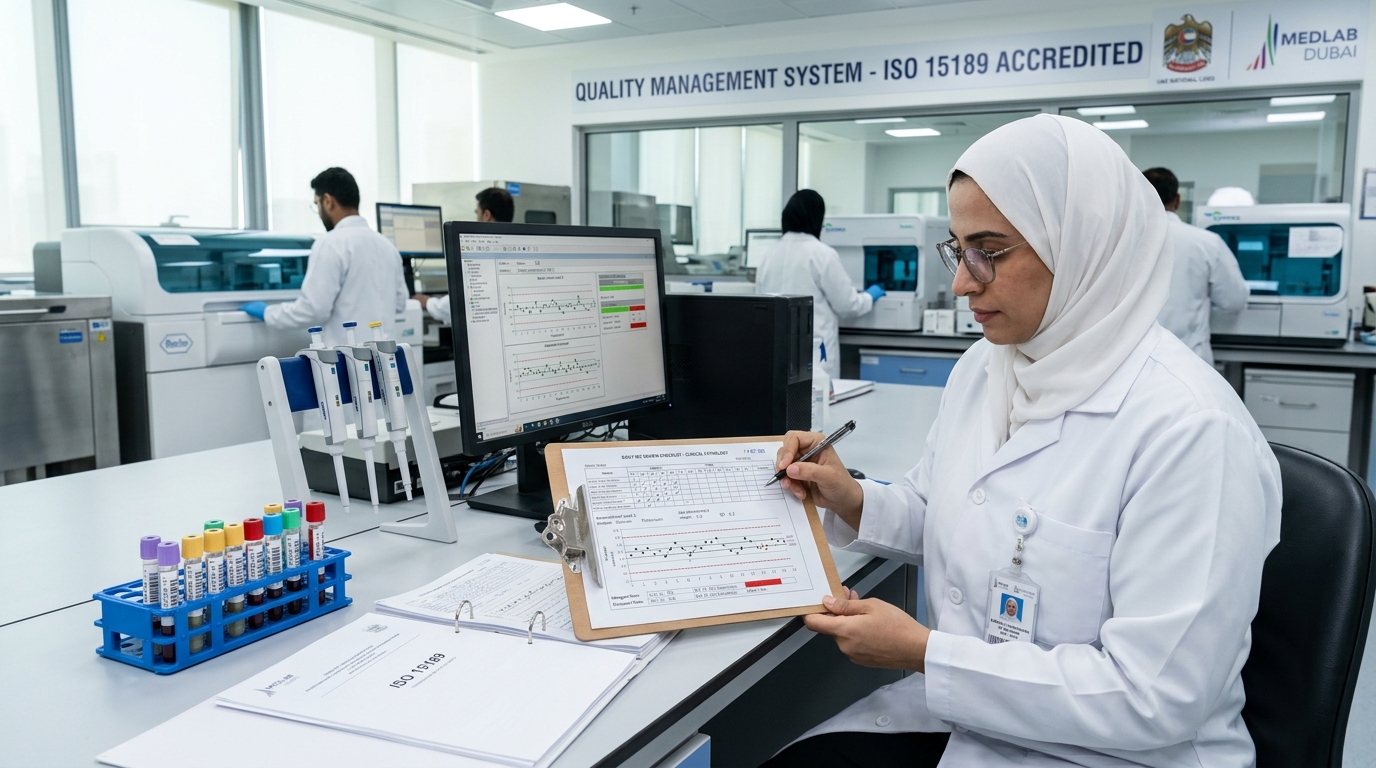
In the highly competitive and rigorously monitored healthcare ecosystem of Dubai, Abu Dhabi, and the Northern Emirates, diagnostic precision is both a legal mandate and a foundational patient safety pillar. Medical laboratories accredited by EIAC (Emirates International Accreditation Centre) and CAP (College of American Pathologists) rely on uncompromising quality workflows. Integrating certified diagnostic platforms from trusted partners such as QuRapid professional lab quality and diagnostic systems guarantees rigorous batch-to-batch consistency and total traceability.
Regulatory Framework: ISO 15189:2022 & UAE Health Authorities
Under Clause 7.3.7 of ISO 15189:2022 (Medical Laboratories — Requirements for Quality and Competence), clinical laboratories must establish robust internal quality control systems capable of detecting both systematic bias and random analytical variations. In the UAE, compliance is overseen through coordinated regulatory bodies:
- Dubai Health Authority (DHA): Health Regulation Sector guidelines mandate daily documented IQC for all licensed pathology and point-of-care instruments prior to patient specimen processing.
- Department of Health Abu Dhabi (DOH): Requires electronic logging of IQC metrics, participation in recognized External Quality Assurance (EQA/PT) programs, and annual method verification.
- Emirates International Accreditation Centre (EIAC): Assesses technical competence, traceability of calibrators, measurement uncertainty (MU), and adherence to standardized Westgard decision rules.
Comprehensive Daily Internal Quality Control Checklist
A standardized operational checklist executed across morning shifts in clinical laboratories ensures analytical readiness:
| Operational Phase | Verification Action Item | Acceptance Criteria | Responsible Personnel |
|---|---|---|---|
| Phase 1: Pre-Analytical & Environmental | Reagent cold storage temperature checks (2°C to 8°C; -20°C freezers) | Continuous calibrated sensor log within defined tolerance | Medical Laboratory Technician (MLT) |
| Phase 1: Pre-Analytical & Environmental | Deionized/Type 1 water resistivity and pH check | Resistivity >10 MΩ·cm at 25°C; bacterial filtration intact | Laboratory Assistant |
| Phase 2: Instrument Readiness | Daily automated optical, probe, and fluidic line wash cycle | Background absorbance zero baseline; no probe obstruction alarms | Senior Biomedical Scientist |
| Phase 2: Instrument Readiness | Reagent lot inventory, onboard expiration, and volume audit | Sufficient onboard volume; zero expired lots in active carousels | MLT |
| Phase 3: Control Material Handling | Thawing, reconstitution, and equilibration of multi-level controls | Volumetric pipette accuracy; zero vigorous foaming; equilibrated to 22°C | MLT |
| Phase 4: Analytical Run & Evaluation | Run Level 1 (Normal) and Level 2/3 (Pathological) control samples | Measured values fall within manufacturer & lab-established ±2 SD range | Senior Biomedical Scientist |
| Phase 4: Analytical Run & Evaluation | Evaluate Levey-Jennings control charts using Westgard Multi-Rules | Zero rejection rules violated; all warning rules documented | Quality Officer / Lab Supervisor |
| Phase 5: Release for Patient Testing | Electronic IQC sign-off and analyzer release in LIS | LIS locks disengaged; analyzer status green for patient samples | Laboratory Director / Technical Manager |
Mastering Westgard Multi-Rules: Warning vs. Rejection Rules
Interpreting Levey-Jennings control charts through Westgard statistical rules enables immediate discrimination between random error and systematic instrument drift:
- 1_2s Rule (Warning Rule): One control measurement exceeds the Mean ± 2 Standard Deviations (2 SD). This is a screening warning; do NOT reject the run automatically. Check preceding runs for emerging trends.
- 1_3s Rule (Rejection – Random or Systematic Error): One control measurement exceeds the Mean ± 3 SD. The analytical run is REJECTED immediately. Halt all patient specimen processing for this analyte.
- 2_2s Rule (Rejection – Systematic Error): Two consecutive control measurements exceed the Mean + 2 SD or both fall below the Mean – 2 SD. Indicates systematic calibration shift or reagent deterioration. Run REJECTED.
- R_4s Rule (Rejection – Random Error): One control measurement exceeds the Mean + 2 SD and another exceeds Mean – 2 SD within the same run (range difference >4 SD). Run REJECTED.
- 4_1s Rule (Rejection / Maintenance – Systematic Bias): Four consecutive control measurements exceed the Mean + 1 SD or Mean – 1 SD on the same side. Indicates persistent calibration drift. Run REJECTED until recalibration.
- 10_x Rule (Rejection / Trend – Systematic Bias): Ten consecutive control measurements fall on one side of the Mean. Indicates subtle systematic bias requiring immediate analyzer servicing.
Root Cause Analysis & CAPA Workflows for IQC Failures
When a rejection rule is triggered, laboratory personnel must follow a disciplined, non-punitive Corrective and Preventive Action (CAPA) protocol:
- Immediate Action (Containment): Lock the analytical channel in the Laboratory Information System (LIS) to prevent patient result transmission. Quarantined patient samples must remain unprocessed.
- Inspect Control Material: Check whether the control vial was left uncapped (evaporation artifact), subjected to freeze-thaw degradation, or reconstituted with incorrect diluent volume.
- Rerun Fresh Control: Prepare a fresh aliquot of control material. If the fresh aliquot passes within ±1 SD, the failure was localized to the control vial.
- Inspect Reagents and Optics: Check for bubble formation in reagent cartridges, optical lamp degradation, clogged fluidic aspiration needles, or expired lots.
- Perform Recalibration: Run certified multi-point calibration standards if systematic bias (2_2s, 4_1s) was observed. Re-run multi-level controls following calibration.
- CAPA Documentation: Log the incident in the Quality Management software detailing: Event Timestamp, Analyte, Rule Violated, Root Cause Identified, Corrective Action Executed, and Sign-off by the Quality Manager.
External Quality Assessment (EQA / PT) Integration
While daily IQC evaluates internal reproducibility (precision), accredited UAE laboratories must continuously benchmark their analytical trueness through external proficiency testing programs:
| Quality Dimension | Internal Quality Control (IQC) | External Quality Assessment (EQA / PT) |
|---|---|---|
| Primary Goal | Verify daily analytical precision and instrument stability | Evaluate diagnostic trueness, accuracy, and peer-group consensus |
| Frequency | Daily (or per batch/shift) | Monthly or Quarterly cycles |
| Sample Origin | Known target values provided by control manufacturer | Blinded specimens with undisclosed values (e.g., CAP, RIQAS) |
| Action on Failure | Immediate batch halt and corrective recalibration | Comprehensive retrospective investigation and regulatory reporting |
Frequently Asked Questions (FAQ)
Can patient samples be processed if a 1_2s rule is triggered?
Yes. The 1_2s rule is strictly a warning indicator under Westgard multi-rule algorithms. If no other rules (such as 2_2s or R_4s) are violated and historical control data demonstrates stability, patient testing may proceed while monitoring the analyte closely.
How frequently should new control lot numbers be parallel-tested?
ISO 15189 standards mandate that new control lots must be parallel-tested alongside the active lot for a minimum of 20 consecutive analytical runs over several days to establish laboratory-specific means and standard deviation limits before the old lot expires.
What are the consequences of failing an annual DHA or EIAC lab audit?
Failure to demonstrate complete, unmanipulated IQC logs, documented CAPA investigations, and valid EQA participation can result in immediate suspension of the laboratory’s operating license, administrative fines, or revocation of accreditation status.
Scientific References & Authoritative Clinical Guidelines
- International Organization for Standardization (ISO). ISO 15189:2022: Medical Laboratories — Requirements for Quality and Competence. ISO Standards, Geneva, 2022.
- Westgard JO, Westgard SA. Basic Quality Control Practices: Quality Control for Healthcare Laboratories. 4th Edition, Westgard Quality Corporation, 2023.
- Emirates International Accreditation Centre (EIAC). Specific Accreditation Requirements for Medical Laboratories: Quality Control & Proficiency Testing. UAE Government Standards, 2024.