
When is HPV High-Risk Genotyping Indicated? Cervical Cancer Screening, HPV 16/18 Stratification & Clinical Algorithms
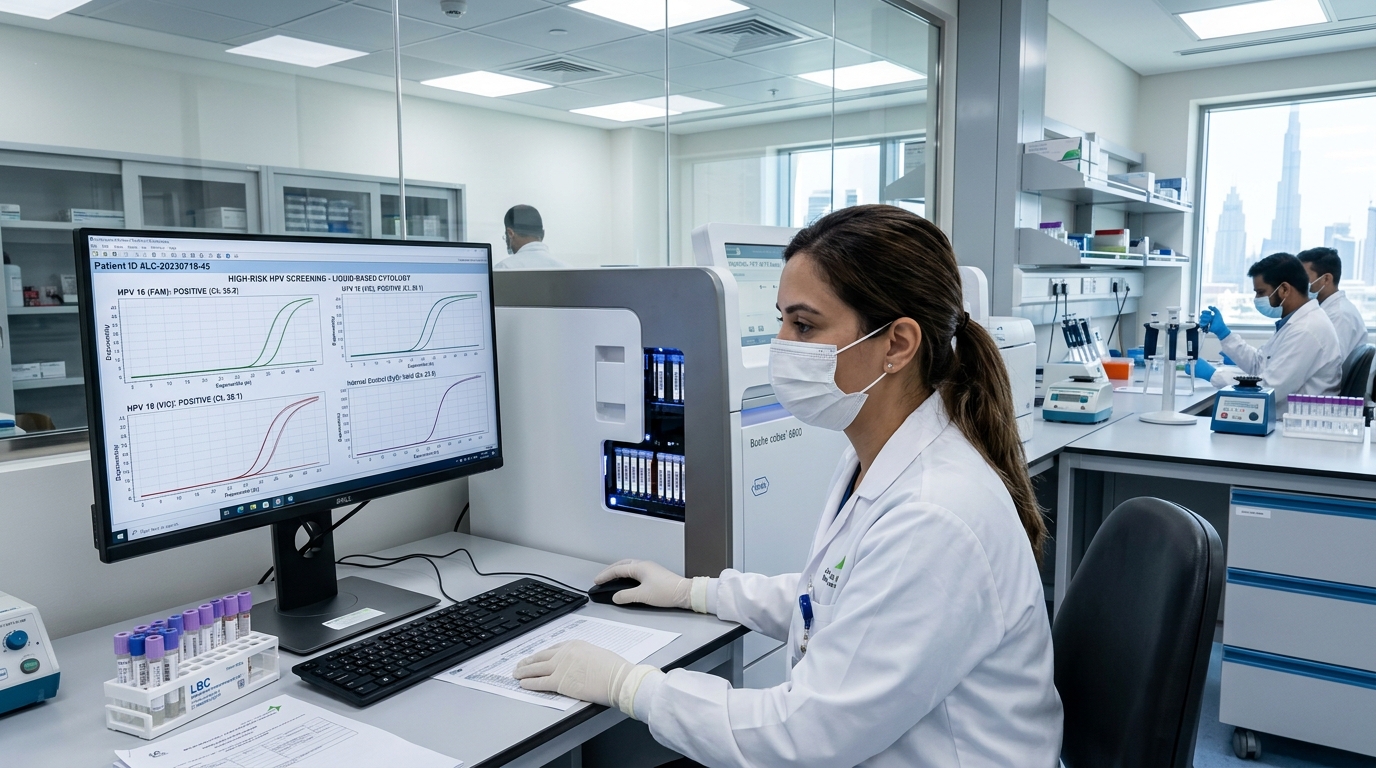
In women’s healthcare across Dubai, Abu Dhabi, and the wider UAE, early detection of cervical dysplasia represents a paramount clinical priority. With the implementation of standardized health authority cervical cancer screening programs, understanding the precise indications for molecular testing is essential for both patients and clinicians. Scheduling advanced comprehensive STD and HPV test packages in Dubai guarantees access to certified multiplex PCR platforms that identify high-risk genotypes years before precancerous cellular alterations manifest microscopically.
Oncogenic Stratification: High-Risk vs. Low-Risk HPV Genotypes
Human Papillomaviruses exhibit distinct tissue tropisms and oncogenic potentials that dictate clinical risk:
| Oncogenic Category | Specific Viral Genotypes | Primary Clinical Manifestations | Malignancy Potential |
|---|---|---|---|
| Tier 1 High-Risk (Highest Carcinogenicity) | HPV Genotypes 16 & 18 | Cervical intraepithelial neoplasia (CIN 2/3), invasive squamous cell carcinoma, cervical adenocarcinoma | Extreme; responsible for ~70% of all cervical cancers worldwide |
| Tier 2 High-Risk (Other hrHPV Types) | Genotypes 31, 33, 35, 39, 45, 51, 52, 56, 58, 59, 66, 68 | High-grade cervical dysplasia, vulvar, vaginal, penile, anal, and oropharyngeal precancers | Moderate-to-High; intermediate progression rate |
| Low-Risk Genotypes | Genotypes 6, 11, 42, 43, 44 | Condylomata acuminata (benign anogenital warts), recurrent respiratory papillomatosis | Near Zero; do not integrate into host genome to induce cancer |
Primary Clinical Indications for High-Risk HPV Genotyping
According to current guidelines from the American Society for Colposcopy and Cervical Pathology (ASCCP), World Health Organization (WHO), and UAE health authorities (DHA and DOH), hrHPV genotyping is indicated in four key clinical scenarios:
- Primary Cervical Cancer Screening (Ages 25 to 65): High-risk HPV testing performed as a standalone primary screen every 5 years. Clinical trials (such as ATHENA) demonstrated that primary hrHPV testing detects significantly more high-grade precancerous lesions (CIN 3+) than cytology alone.
- Co-Testing (hrHPV + Pap Cytology): Performed simultaneously every 5 years for women aged 30 to 65 seeking maximal diagnostic negative predictive value (>99%).
- Reflex Triage for Equivocal Cytology (ASC-US): When a routine Pap smear reveals Atypical Squamous Cells of Undetermined Significance (ASC-US), reflex hrHPV testing determines whether immediate colposcopy or routine surveillance is required.
- Post-Colposcopy & Post-Treatment Surveillance (“Test of Cure”): Monitoring women 6 and 12 months after loop electrosurgical excision procedures (LEEP) or cold-knife conization for CIN 2/3 to confirm complete viral clearance and prevent recurrence.
- Investigation of Oropharyngeal and Anogenital Lesions: Evaluating biopsy specimens from head and neck, vulvar, or anal dysplasias in high-risk immunocompromised cohorts.
Algorithmic Triage: Interpreting HPV 16/18 vs. Other hrHPV Positivity
The presence of specific genotypes drives distinct clinical actions due to substantial divergence in 3-year cancer progression risk:
| HPV Screening Result | Reflex Cytology Finding | Clinical Action Guideline | Rationale |
|---|---|---|---|
| HPV 16 or 18 Positive | Any cytology (Normal or Abnormal) | Immediate Colposcopy Referral | 1-in-10 risk of underlying CIN 3+ even when Pap smear cytology appears completely normal |
| Other 12 hrHPV Positive | Negative for Intraepithelial Lesion (NILM) | Repeat Co-Testing in 12 Months | Allows immune clearance; 60% of transient infections clear spontaneously within 1 year |
| Other 12 hrHPV Positive | ASC-US, LSIL, or HSIL | Immediate Colposcopy Referral | Persistent infection with cellular atypia requires direct histological punch biopsy |
| High-Risk HPV Negative | Cytology Negative (NILM) | Resume Routine Screening in 5 Years | Extremely high 5-year negative predictive value (>99.5%) against invasive carcinoma |
Molecular Testing Technologies: DNA vs. mRNA Assays
In accredited Dubai clinical pathology laboratories, two main classes of molecular assays are utilized:
- hrHPV DNA PCR Assays (e.g., Roche Cobas, Abbott RealTime): Amplify conserved regions of the L1 viral capsid gene or early genes. These assays offer unparalleled analytical sensitivity and specific genotype channels for HPV 16, HPV 18, and pooled non-16/18 high-risk types.
- hrHPV E6/E7 mRNA Assays (e.g., Hologic Aptima): Detect viral oncogene transcripts (E6 and E7). Because E6 and E7 mRNA are actively produced only during transcriptionally active, transforming infections, mRNA assays demonstrate higher clinical specificity, reducing unnecessary colposcopies for transient, self-resolving infections.
Pre-Analytical Rigor and Liquid-Based Cytology (LBC) Collection
Accurate molecular genotyping requires high-quality cellular sampling from the cervical transformation zone:
- Cervical Sampling Technique: A specialized cervical broom or cytobrush is inserted into the external os and rotated 360 degrees 5 times to harvest squamocolumnar junction epithelial cells.
- Preservative Media: The brush head is rinsed vigorously into a methanol-based liquid vial (ThinPrep) or ethanol-based vial (SurePath) to fix cellular structures and stabilize viral nucleic acids.
- Automated Extraction: Robotic workstations perform magnetic bead-based DNA extraction, eliminating human pipetting variability and optical cross-contamination.
Frequently Asked Questions (FAQ)
Does testing positive for high-risk HPV mean I have cervical cancer?
No. Testing positive indicates the presence of the virus, not cancer. Over 80% to 90% of sexually active individuals acquire HPV during their lifetime, and the vast majority of infections are cleared naturally by the immune system within 12 to 24 months without causing cancer.
Why is HPV testing not recommended for women under age 25?
In women under 25, transient HPV infections are extremely common (prevalence >30%) but nearly always clear spontaneously without progressing to invasive disease. Testing young women leads to overdiagnosis, overtreatment of self-limiting lesions, and unnecessary cervical excisional procedures that can increase future preterm birth risks.
Can high-risk HPV testing be performed on urine or self-collected swabs?
While clinician-collected cervical sampling in liquid-based medium remains the regulatory standard in the UAE, validated vaginal self-sampling kits and first-void urine PCR panels demonstrate high concordance (>95%) for hrHPV detection, representing a viable alternative for women hesitant to undergo pelvic examinations.
Scientific References & Authoritative Clinical Guidelines
- American Society for Colposcopy and Cervical Pathology (ASCCP). Consensus Guidelines for the Management of Cervical Cancer Screening Abnormalities and High-Risk HPV Genotyping. J Low Genit Tract Dis, 2024.
- World Health Organization (WHO). WHO Guidelines for Screening and Treatment of Cervical Pre-Cancer Lesions for Cervical Cancer Prevention. 2nd Edition, WHO Press, Geneva, 2023.
- Dubai Health Authority (DHA). Standards for Cervical Cancer Screening Programs and Clinical Gynecological Pathology. UAE Health Authority Guidelines, 2024.