
Semen Concentration Fertility Testing Meaning: WHO 6th Edition Reference Values, Oligospermia Stratification & Male Reproductive Evaluation
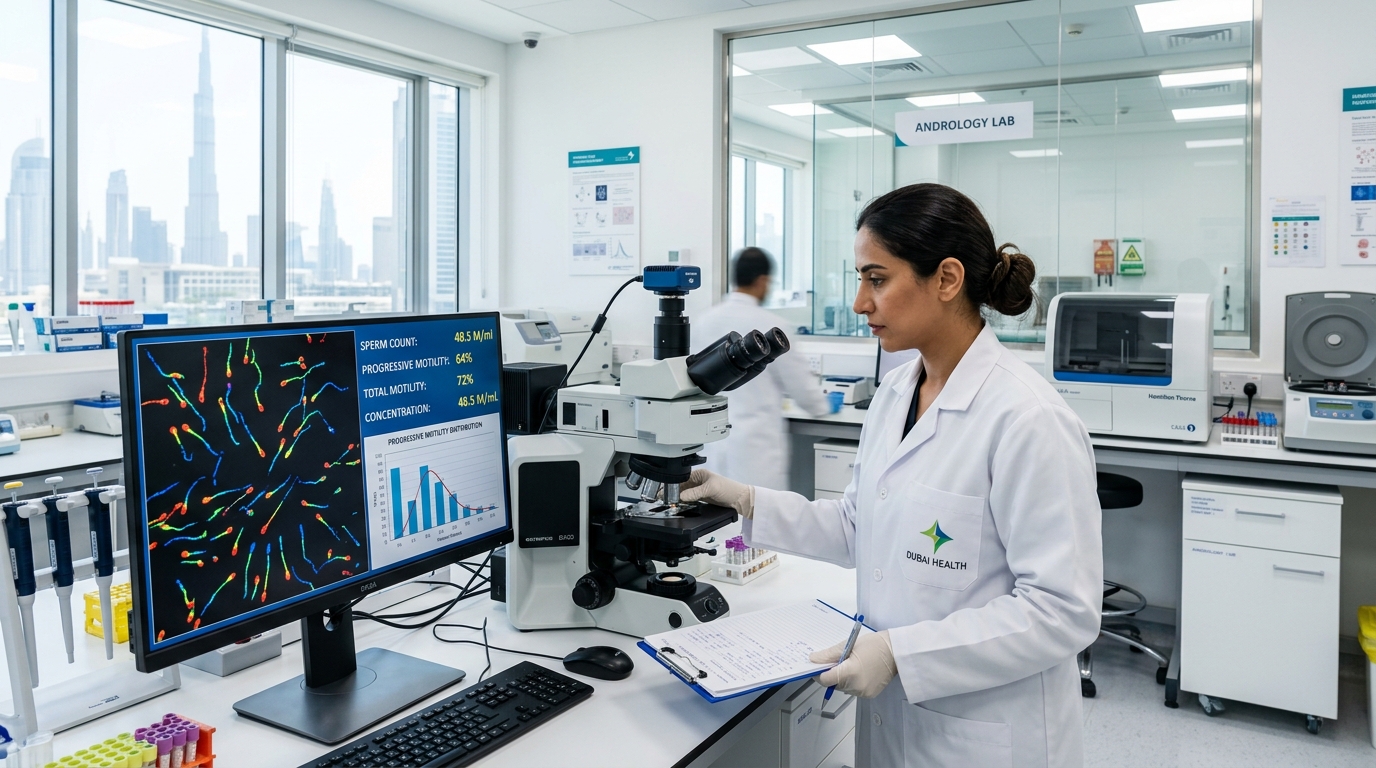
Throughout Dubai, Abu Dhabi, and the wider UAE, couples experiencing delays in achieving pregnancy increasingly recognize that male reproductive health accounts for nearly half of all conception challenges. Modern andrology testing has transcended basic manual counting, incorporating high-precision phase-contrast microscopy and Computer-Assisted Semen Analysis (CASA). Booking advanced specialized male fertility and semen testing in UAE ensures rigorous adherence to international standardized protocols, unlocking actionable insights into reproductive potential.
WHO 6th Edition Semen Analysis Reference Standards
The World Health Organization periodically benchmarks semen parameters derived from large cohorts of fertile men whose partners achieved pregnancy within 12 months. The current WHO 6th Edition (2021/2024 update) defines the following 5th percentile lower reference limits:
| Semen Parameter | WHO 6th Edition Lower Reference Limit (5th Percentile) | Clinical Significance |
|---|---|---|
| Semen Concentration | 16 Million Spermatozoa per mL | Primary benchmark of testicular sperm production density |
| Total Sperm Number per Ejaculate | 39 Million Spermatozoa | Total output (Concentration × Ejaculate Volume) |
| Ejaculate Volume | 1.4 mL | Evaluates seminal vesicle and prostate secretory function |
| Total Motility (PR + NP) | 42% Motile | Combined progressive and non-progressive sperm movement |
| Progressive Motility (PR) | 30% Rapid & Slow Progressive | Percentage of sperm actively moving forward in straight lines |
| Normal Sperm Morphology | 4.0% Normal Forms (Tygerberg Strict Criteria) | Evaluates normal head, midpiece, and tail ultrastructure |
| Sperm Vitality (Viability) | 54% Live Spermatozoa | Differentiates dead immotile sperm from live immotile sperm |
Clinical Stratification of Semen Concentration
In clinical andrology practice, sperm concentration results are categorized into distinct pathological classifications:
| Diagnostic Category | Sperm Concentration Range | Clinical Prognosis & Conception Pathways |
|---|---|---|
| Normozoospermia | ≥16 Million / mL | Normal baseline sperm count; natural spontaneous conception highly feasible |
| Mild Oligospermia | 10 to 15 Million / mL | Moderate subfertility; natural conception possible; candidate for lifestyle optimization or IUI |
| Moderate Oligospermia | 5 to 10 Million / mL | Significant subfertility; intrauterine insemination (IUI) or IVF indicated |
| Severe Oligospermia | <5 Million / mL | Natural conception highly improbable; primary candidate for IVF with ICSI |
| Cryptozoospermia | Occasional sperm seen only after centrifugation | Surgical sperm extraction or pellet micro-droplet ICSI required |
| Azoospermia | Zero spermatozoa in fresh and centrifuged pellet | Requires diagnostic differentiation between Obstructive vs. Non-Obstructive Azoospermia |
Etiological Drivers of Low Semen Concentration (Oligospermia)
A reduced sperm concentration reflects disruption at various levels of the male reproductive axis:
- Clinical Varicocele: Dilated pampiniform venous plexus causes elevated intratesticular temperature, hypoxic damage, and reactive oxygen species (ROS) accumulation that halts spermatogenesis.
- Endocrine & Hormonal Imbalances: Hypogonadotropic hypogonadism (low LH/FSH), hyperprolactinemia, thyroid dysfunction, or exogenous anabolic steroid usage shutting down the pituitary-gonadal axis.
- Genetics & Chromosomal Aberrations: Klinefelter Syndrome (47,XXY), Y-chromosome microdeletions (AZFa, AZFb, AZFc regions), and cystic fibrosis transmembrane conductance regulator (CFTR) gene mutations.
- Environmental & Lifestyle Factors: Prolonged exposure to sauna/heat, heavy cigarette or shisha smoking, obesity-related hyperestrogenism, chronic psychological stress, and occupational chemical exposure.
- Infections & Leukocytospermia: Chronic prostatitis, epididymo-orchitis, or untreated sexually transmitted infections (Chlamydia, Ureaplasma) inducing oxidative stress that impairs spermatogenic epithelium.
Pre-Analytical SOPs: Avoiding Artifactually Low Counts
Accurate semen concentration measurements require strict pre-analytical control:
- Strict Ejaculatory Abstinence Period: The patient must observe 2 to 7 days of sexual abstinence (ideally 3 to 4 days) before sample collection. Abstinence <48 hours causes falsely low concentration, while abstinence >7 days increases dead and poorly motile sperm.
- Complete Specimen Collection: Semen must be collected via masturbation directly into a sterile, wide-mouthed, toxic-free container. The initial few drops of ejaculate contain up to 70% of the total sperm count; spilling the initial fraction drastically skews concentration results.
- Prompt Delivery & Temperature Maintenance: If collected at home, the specimen must arrive at the andrology laboratory within 30 to 60 minutes, maintained at body temperature (20°C to 37°C, e.g., in an inside jacket pocket).
- Mandatory Liquefaction Evaluation: Semen normally liquefies within 15 to 30 minutes under the action of prostatic enzymes. Delayed liquefaction or hyperviscosity traps spermatozoa, requiring gentle enzymatic digestion before automated counting.
Computer-Assisted Semen Analysis (CASA) vs. Hemocytometer Counting
Accredited laboratories in Dubai utilize computerized motion-tracking algorithms alongside standardized Neubauer hemocytometers:
- Improved Standardization: CASA eliminates subjective technician counting errors, tracking hundreds of individual sperm trajectories simultaneously.
- Kinematic Parameter Profiling: Beyond concentration, CASA measures Curvilinear Velocity (VCL), Straight-Line Velocity (VSL), and Amplitude of Lateral Head Displacement (ALH), identifying hyperactivated motility necessary for oocyte penetration.
Frequently Asked Questions (FAQ)
Is a single semen analysis sufficient to diagnose male infertility?
No. Semen parameters fluctuate widely due to seasonal variations, recent fevers, stress, and abstinence duration. Clinical guidelines mandate a minimum of two semen analyses performed 2 to 4 weeks apart to establish an accurate baseline diagnosis.
Can a man with a low sperm count still father a child naturally?
Yes. Semen concentration reflects statistical probability rather than absolute fertility. Men with mild or moderate oligospermia father children naturally, particularly if sperm motility and normal morphology are exceptionally high, and female partner fertility is optimal.
How long does it take for medical or lifestyle treatments to improve sperm count?
Human spermatogenesis takes approximately 72 to 90 days from germ cell division to mature ejaculated spermatozoa. Therefore, any therapeutic intervention—such as varicocelectomy, antioxidant therapy, or hormonal balancing—requires at least 3 months before improvement is detectable on a repeat semen analysis.
Scientific References & Authoritative Clinical Guidelines
- World Health Organization (WHO). WHO Laboratory Manual for the Examination and Processing of Human Semen. 6th Edition, WHO Press, Geneva, 2024.
- American Urological Association (AUA) & American Society for Reproductive Medicine (ASRM). Diagnosis and Treatment of Infertility in Men: Clinical Guidance and Semen Analysis Interpretation. AUA Guidelines, 2024.
- Dubai Health Authority (DHA). Clinical Protocols for Andrology Laboratories and Assisted Reproductive Technologies (ART). UAE Health Regulations, 2024.