
When is HPV 16 and HPV 18 Indicated? Specific Genotype Risk, CIN 3 Progression & Direct Colposcopy Protocols
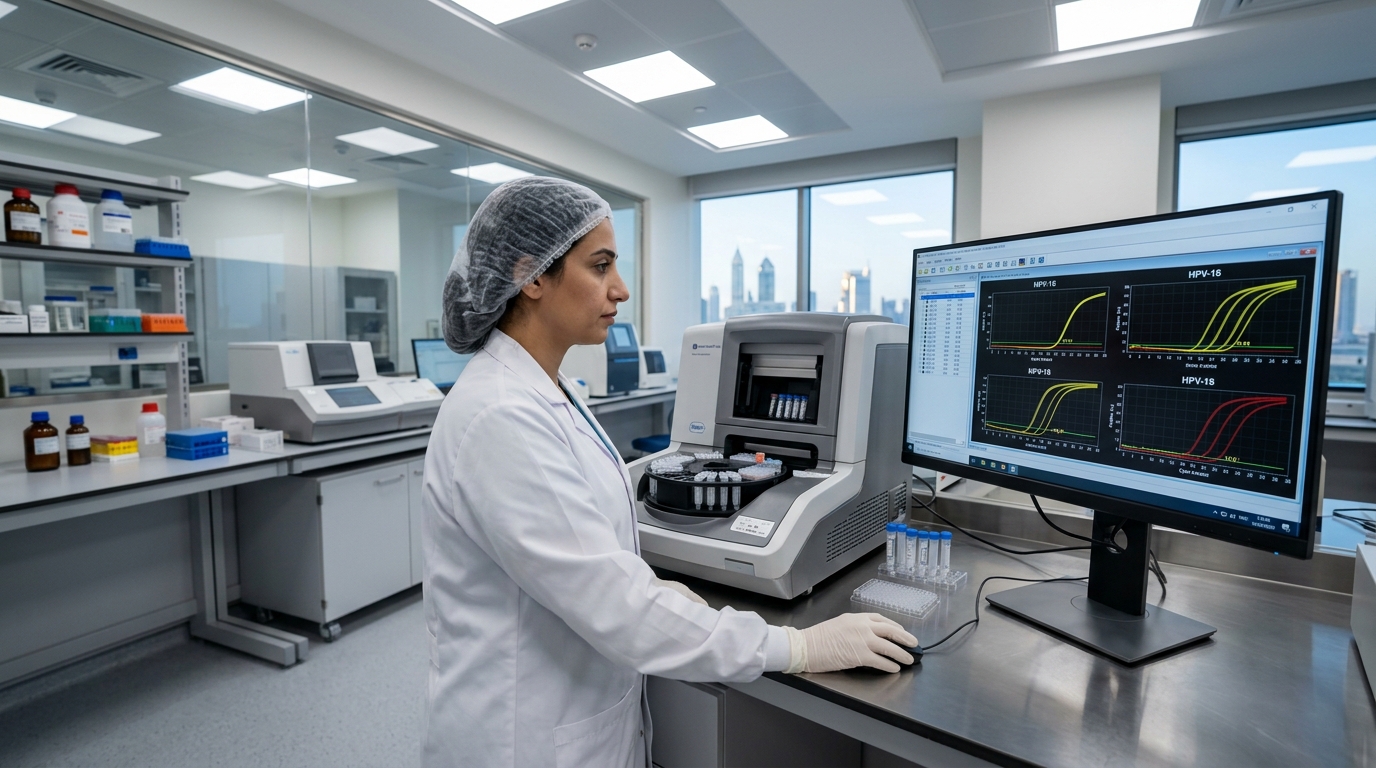
In women’s healthcare across Dubai, Abu Dhabi, and the wider UAE, national health authorities have modernized cervical cancer screening by prioritizing high-risk genotype discrimination. Early identification of persistent HPV 16 or 18 infection allows gynecologists to intervene before invasive transformation takes hold. Scheduling advanced confidential STD and HPV test packages in Dubai provides women with access to state-of-the-art real-time PCR platforms that specifically differentiate HPV 16 and 18 from pooled high-risk genotypes.
The Molecular Pathogenicity of HPV 16 and 18
Human Papillomavirus genotypes 16 and 18 integrate into the host epithelial cell genome with uniquely destructive efficiency, driving neoplastic transformation through two potent oncoproteins:
- Viral Oncoprotein E6: Recruits the host E6-associated protein (E6AP) ubiquitin ligase, causing rapid degradation of the tumor suppressor protein p53. Without p53, DNA repair mechanisms collapse and apoptosis cannot be initiated.
- Viral Oncoprotein E7: Binds and inactivates the retinoblastoma tumor suppressor protein (pRb), releasing transcription factor E2F to force uncontrolled cell cycle progression from G1 into S phase.
- Genomic Integration: Unlike low-risk genotypes that remain episomal, HPV 16 and 18 frequently integrate into host chromosomal DNA, disrupting the viral E2 repressor gene and causing permanent, unrestrained E6/E7 overexpression.
Comparative Risk: HPV 16/18 vs. Other High-Risk Types
The statistical divergence in precancerous lesion progression justifies specific genotyping:
| High-Risk HPV Category | Specific Viral Genotypes | 3-Year Risk of Underlying CIN 3+ | Primary Cervical Histological Subtype |
|---|---|---|---|
| HPV 16 Positive | Genotype 16 | 13.6% (Highest Lifetime Malignancy Risk) | Predominantly Squamous Cell Carcinoma (Ectocervix) |
| HPV 18 Positive | Genotype 18 | 5.7% (High Propensity for Rapid Invasion) | High Tropism for Adenocarcinoma (Endocervical Canal) |
| Pooled 12 Other hrHPV | Types 31, 33, 35, 39, 45, 51, 52, 56, 58, 59, 66, 68 | 3.0% to 4.5% | Squamous intraepithelial lesions (Slower progression) |
| hrHPV Negative | All high-risk types absent | <0.1% (5-Year Safety Benchmark) | Normal baseline epithelium |
Clinical Indications for Specific HPV 16/18 Genotyping
Under American Society for Colposcopy and Cervical Pathology (ASCCP) and UAE health authority guidelines, specific HPV 16 and 18 genotyping is indicated in the following clinical scenarios:
- Primary hrHPV Cervical Cancer Screening (Ages 25 to 65): If primary screening returns positive for HPV, automated genotype discrimination isolates 16 and 18 to determine whether immediate colposcopy is mandatory.
- Triage of Normal Cytology with hrHPV Positivity: In women whose Pap smear shows NILM (Negative for Intraepithelial Lesion or Malignancy) but hrHPV is positive, reflex 16/18 testing identifies those needing immediate colposcopy versus 12-month re-testing.
- Evaluation of Persistent hrHPV Infection: A patient testing positive for hrHPV for two consecutive annual screening rounds requires 16/18 genotyping to evaluate persistent high-virulence carriage.
- Post-LEEP Conization Surveillance: Documenting clearance of genotype 16 or 18 at 6 and 12 months following excisional therapy for high-grade dysplasia (CIN 2/3).
- Non-Cervical Anogenital & Oropharyngeal Biopsy Evaluation: Evaluating mucosal biopsies in patients with persistent oropharyngeal lesions, vulvar intraepithelial neoplasia (VIN), or anal dysplasias.
Clinical Management Algorithm: The ASCCP Direct Colposcopy Trigger
The clinical action flow following HPV screening follows standardized clinical pathways:
| Screening Result | Pap Cytology Finding | Immediate Clinical Action | Clinical Rationale |
|---|---|---|---|
| HPV 16 Positive | Normal Cytology (NILM) | Immediate Colposcopy with Biopsy | 1 in 10 women have occult CIN 3 missed by standard cytology surface sampling |
| HPV 18 Positive | Normal Cytology (NILM) | Immediate Colposcopy + Endocervical Curettage (ECC) | Adenocarcinomas originate deep within the endocervical canal, escaping ectocervical cytobrushes |
| Other 12 hrHPV Positive | Normal Cytology (NILM) | Repeat Co-Testing in 12 Months | Allows natural host immune clearance; prevents overtreatment of transient infections |
| Other 12 hrHPV Positive | ASC-US or LSIL | Colposcopy Referral | Combined viral persistence and cellular dyskaryosis warrants visual inspection |
Adenocarcinoma Challenge: Why HPV 18 Demands Endocervical Sampling
A crucial clinical pearl in gynecological pathology is the behavior of HPV 18. While HPV 16 predominantly infects the visible squamocolumnar transformation zone causing squamous lesions, HPV 18 frequently migrates deep into the endocervical glandular epithelium. Consequently, cervical adenocarcinomas and Adenocarcinoma in Situ (AIS) often present with completely normal ectocervical Pap smears. When a patient tests positive for HPV 18, performing an Endocervical Curettage (ECC) during colposcopy is mandatory to sample the hidden canal.
Vaccination Impact and Cross-Protection
The introduction of the 9-valent HPV vaccine (Gardasil 9) targets genotypes 6, 11, 16, 18, 31, 33, 45, 52, and 58. While vaccination before sexual debut confers >99% protection against HPV 16 and 18, vaccinated women must still participate in routine screening because vaccines do not treat pre-existing infections acquired prior to vaccination.
Frequently Asked Questions (FAQ)
If I have HPV 16, does it mean I will inevitably develop cervical cancer?
No. While HPV 16 carries the highest oncogenic risk among all genotypes, the vast majority of women with HPV 16 will never develop invasive cancer if they attend regular colposcopy surveillance and treat precancerous lesions (CIN 2/3) promptly before invasion occurs.
Can HPV 16 or 18 clear on its own without medical treatment?
Yes. Even with high-risk genotypes 16 and 18, a healthy human immune system can suppress and clear the virus within 12 to 24 months in approximately 60% to 70% of immunocompetent women. However, persistence beyond 2 years carries an elevated risk of neoplastic transformation.
What happens during a colposcopy examination?
Colposcopy is a painless, 15-minute in-office examination where a gynecologist uses an illuminated binocular microscope to examine the illuminated cervix after applying diluted acetic acid and Lugol’s iodine. Abnormal dysplastic areas turn acetowhite, allowing targeted micro-punch biopsies for definitive histopathological grading.
Scientific References & Authoritative Clinical Guidelines
- American Society for Colposcopy and Cervical Pathology (ASCCP). 2024 Management Guidelines for Abnormal Cervical Cancer Screening Tests and Cancer Precursors: HPV 16/18 Genotyping Recommendations. J Low Genit Tract Dis, 2024.
- World Health Organization (WHO). Comprehensive Cervical Cancer Control: A Guide to Essential Practice. WHO Guidelines Approved by the Guidelines Review Committee, Geneva, 2024.
- Dubai Health Authority (DHA). Clinical Protocols for Cervical Cancer Early Detection, High-Risk HPV Molecular Pathology, and Colposcopy Referrals. UAE Health Standards, 2024.