
Sperm Motility Fertility Testing Meaning: Progressive vs Non-Progressive Movement, Asthenozoospermia & Conception Viability
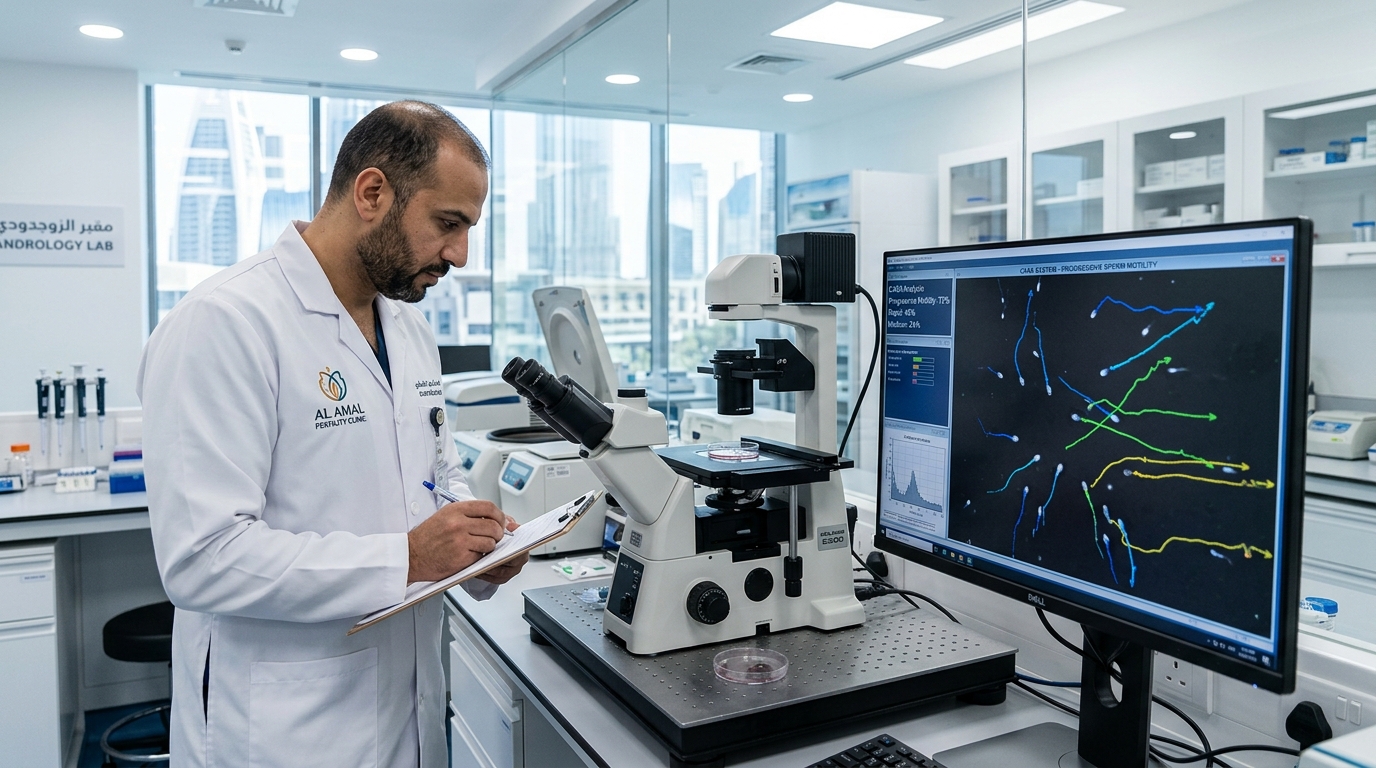
In the reproductive medicine landscape across Dubai, Abu Dhabi, and the wider UAE, comprehensive semen analysis has evolved into a sophisticated science. Clinicians evaluating male factor subfertility no longer rely solely on simple sperm counts; functional motility kinetics provide deep physiological insight into mitochondrial integrity and flagellar axoneme architecture. Scheduling advanced specialized fertility and semen testing in UAE ensures rigorous Computer-Assisted Semen Analysis (CASA) performed in accredited andrology centers.
WHO 6th Edition Motility Classification Standards
The World Health Organization 6th Edition Laboratory Manual establishes three standardized physiological motility categories:
| Motility Category | Biomechanical Description | WHO 6th Edition Lower Reference Limit (5th Percentile) | Fertility Impact |
|---|---|---|---|
| Progressive Motility (PR) | Spermatozoa actively moving forward in a straight line or in large circles, regardless of speed | ≥30% | Essential for Natural Conception; only progressive sperm can ascend the female reproductive tract |
| Non-Progressive Motility (NP) | All other patterns of movement with an absence of forward progression (twitching, spinning in tight circles, flagellar beating without forward movement) | N/A (Recorded as component of total motility) | Biochemically viable but mechanically incapable of traversing cervical mucus or oviductal isthmus |
| Total Motility (PR + NP) | Combined percentage of all motile spermatozoa showing any movement | ≥42% | Defines overall viable kinetic capacity of the ejaculate |
| Immotile Spermatozoa (IM) | Completely static cells with zero flagellar or head movement | <58% | Requires vitality staining to differentiate dead sperm from live, paralyzed sperm |
Clinical Classification: Asthenozoospermia
When sperm motility falls below international benchmarks, specific clinical terms define the pathology:
- Asthenozoospermia: Defined as progressive motility <30% or total motility <42%. This is one of the most common findings in male subfertility workups.
- Oligoasthenoteratozoospermia (OAT Syndrome): The simultaneous presence of low sperm concentration (oligo), poor motility (astheno), and abnormal morphology (terato), reflecting severe underlying testicular pathology.
- Total Asthenozoospermia (100% Immotile Sperm): A rare and severe condition where zero motile sperm are present. This mandates immediate viability staining (Eosin-Nigrosin or Hypo-Osmotic Swelling Test – HOST) to distinguish necrozoospermia (dead sperm) from structural flagellar defects such as Primary Ciliary Dyskinesia (PCD / Kartagener Syndrome) where sperm are alive but paralyzed.
Underlying Etiologies of Poor Sperm Motility
Sperm movement depends on intact mitochondrial sheath ATP production in the midpiece and coordinated sliding of microtubules in the flagellar axoneme (9+2 doublet structure). Common etiologies that disrupt this delicate mechanism include:
| Etiological Factor | Pathophysiological Mechanism | Clinical Management Approach |
|---|---|---|
| Clinical Varicocele | Elevated scrotal temperature and venous stasis generate excessive Reactive Oxygen Species (ROS) | Microscopic surgical varicocelectomy improves motility in 60% to 70% of treated men |
| Leukocytospermia & Urogenital Infections | Peroxidase-positive leukocytes (>1 million/mL) release massive hydrogen peroxide and lipid peroxidases | Targeted antibiotics (Doxycycline/Quinolones) and high-dose antioxidant therapy |
| Oxidative Stress & Lifestyle | Cigarette smoking, vaping, obesity, chronic exposure to laptop heat or hot saunas | Weight reduction, smoking cessation, coenzyme Q10, L-carnitine, and zinc supplementation |
| Anti-Sperm Antibodies (ASA) | Immunoglobulins (IgA and IgG) coat sperm flagella following vasectomy reversal, trauma, or infection | Semen washing, corticosteroid therapy, or proceeding directly to ICSI |
| Prolonged Sexual Abstinence | Abstinence >7 days leads to senescence, oxidation, and mitochondrial exhaustion in the epididymis | Normalize ejaculatory frequency to every 2 to 3 days |
Advanced Kinematic Profiling: Computer-Assisted Semen Analysis (CASA)
High-end andrology laboratories in Dubai evaluate specific kinematic parameters that predict fertilization beyond simple visual percentages:
- Curvilinear Velocity (VCL): Total velocity along the real meandering trajectory of the sperm head (Normal >45 µm/s).
- Straight-Line Velocity (VSL): Velocity along the straight line between initial and final position (Normal >25 µm/s).
- Linearity (LIN): The ratio of VSL/VCL, measuring swimming straightness (Normal >50%).
- Amplitude of Lateral Head Displacement (ALH): Magnitude of side-to-side head oscillations, which spikes during “hyperactivation” as the sperm prepares to penetrate the egg’s zona pellucida.
Treatment Pathways: Restoring Motility vs. Assisted Reproduction
The severity of asthenozoospermia dictates the clinical treatment pathway:
- Mild Asthenozoospermia (PR 20% to 29%): 3 to 6 months of targeted antioxidant therapy (L-Carnitine, CoQ10 200 mg/day, Vitamin E, Selenium, Zinc), correction of clinical varicocele, and lifestyle modifications. Natural conception or Intrauterine Insemination (IUI) is feasible.
- Moderate Asthenozoospermia (PR 10% to 19%): Intrauterine Insemination (IUI) requires at least 5 to 10 million total motile progressive sperm after density gradient washing. If post-wash motile count is insufficient, In Vitro Fertilization (IVF) is indicated.
- Severe Asthenozoospermia (PR <10%): Conventional IVF fails due to inability of sperm to penetrate the cumulus oophorus. Intracytoplasmic Sperm Injection (ICSI) is mandatory, where embryologists select individual viable spermatozoa and inject them directly into the oocyte cytoplasm.
Frequently Asked Questions (FAQ)
Can L-Carnitine and antioxidants genuinely improve sperm motility?
Yes. Systematic reviews and meta-analyses demonstrate that high concentrations of L-carnitine and acetyl-L-carnitine serve as critical energy substrates for sperm mitochondrial fatty acid oxidation. Oral supplementation for 3 to 6 months significantly elevates progressive motility and decreases oxidative DNA fragmentation.
How does temperature affect sperm motility during testing?
Sperm motility is highly temperature-dependent. Samples allowed to cool below 20°C exhibit sluggish, artifactually poor movement. Accredited laboratories maintain warming stages at 37°C during CASA microscopic evaluation to replicate physiological body temperature.
Can an immotile sperm still fertilize an egg via ICSI?
Yes, provided the immotile sperm is alive (viable). Embryologists utilize the Hypo-Osmotic Swelling (HOS) test or gentle laser pulsation on the tail to confirm membrane vitality before injecting the sperm into the egg.
Scientific References & Authoritative Clinical Guidelines
- World Health Organization (WHO). WHO Laboratory Manual for the Examination and Processing of Human Semen. 6th Edition, WHO Press, Geneva, 2024.
- American Urological Association (AUA) & American Society for Reproductive Medicine (ASRM). Diagnosis and Treatment of Infertility in Men: Motility Assessment and ICSI Indications. AUA Guidelines, 2024.
- Dubai Health Authority (DHA). Standards for Assisted Reproductive Technology (ART) Clinics and Clinical Andrology Laboratories. UAE Health Regulations, 2024.