
Sperm Morphology Fertility Testing Meaning: Kruger Strict Criteria, Teratozoospermia & ICSI Fertilization Rates
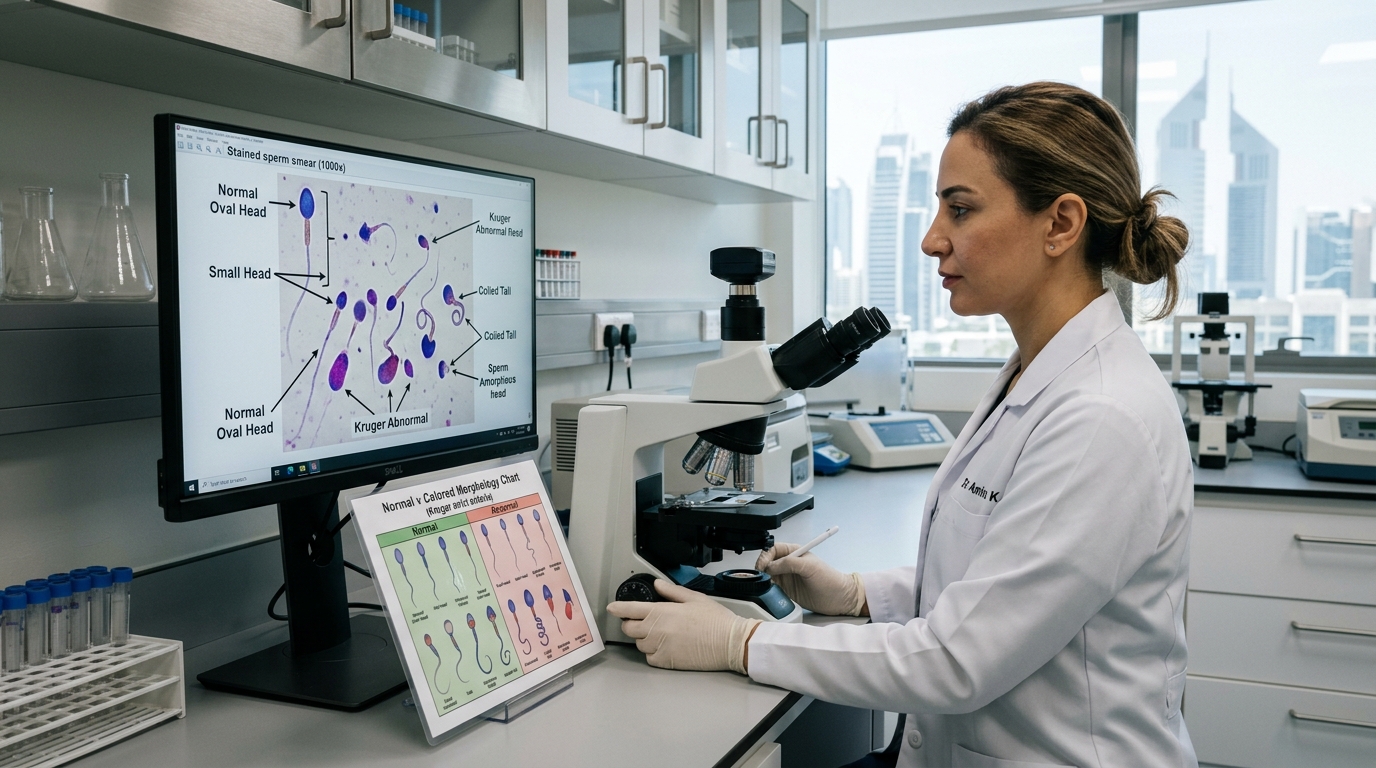
In modern reproductive medicine across Dubai, Abu Dhabi, and the wider UAE, couples evaluating male factor fertility are frequently alarmed to discover that 95% or more of sperm in a healthy fertile ejaculate are structurally abnormal. Understanding how andrologists evaluate morphology eliminates unnecessary anxiety and provides clear therapeutic direction. Scheduling advanced specialized andrology and male fertility testing in UAE ensures rigorous evaluation by certified embryologists utilizing standardized Papanicolaou or Giemsa staining.
The Kruger Strict (Tygerberg) Evaluation System
Historically, liberal morphology criteria classified sperm with minor irregularities as “normal,” leading to poor predictive correlation with in vitro fertilization. In the 1980s, Dr. Roelof Kruger established “Strict Criteria,” based on analyzing spermatozoa that had successfully migrated through human cervical mucus and bound to the zona pellucida of the human oocyte:
| Anatomical Component | Kruger Strict Normal Criteria Dimensions | Pathological Significance |
|---|---|---|
| Head Structure | Smooth, symmetrical oval shape; Length: 3.5 to 5.0 µm; Width: 2.5 to 3.5 µm | Houses paternal haploid DNA; abnormal shape reflects chromatin condensation failure or abnormal protamination |
| Acrosome Complex | Well-defined acrosomal cap covering 40% to 70% of the anterior head | Contains hyaluronidase and acrosin enzymes mandatory for digesting oocyte cumulus cells and penetrating the zona pellucida |
| Midpiece (Neck) | Slender, regular, straight; Length: 7.0 to 8.0 µm; Width: <1.0 µm; Axially aligned | Contains spiral mitochondrial sheath; thick midpieces or cytoplasmic droplets impair energy output and elevate ROS |
| Principal Tail | Uniform caliber, uncoiled, unbent; Length: ~45 µm | Houses 9+2 microtubule axoneme; coils, kinks, or fractures prevent coordinated wave generation and progressive motility |
Classification of Sperm Morphological Defects
Abnormal spermatozoa (teratozoospermia) are categorized based on the localized anatomical defect:
| Defect Category | Specific Morphological Aberrations | Functional Consequence |
|---|---|---|
| Head Defects | Tapered (cigar-shaped), pyriform, microcephalic (<3.5 µm), macrocephalic (>5.0 µm), round, vacuolated, double-headed | Elevated sperm DNA fragmentation, chromosomal aneuploidies, failure of syngamy |
| Acrosomal Defects | Globozoospermia (Complete round-headed sperm lacking acrosome) | Total inability to naturally penetrate or activate oocytes; 100% failure in natural conception and conventional IVF |
| Neck & Midpiece Defects | Bent neck (>90 degrees), asymmetrical insertion, thickened/irregular sheath, excess residual cytoplasm (>1/3 head size) | Premature mitochondrial exhaustion; generation of toxic reactive oxygen species (ROS) |
| Tail Defects | Short tail, hairpin tail, coiled tail, multiple tails, broken tail | Total immotility or non-progressive motility; inability to ascend female reproductive tract |
Clinical Stratification: The 4% Normal Cutoff
The World Health Organization 6th Edition sets the 5th percentile lower reference limit for normal forms at 4%:
| Morphology Percentage | Diagnostic Classification | Fertility Prognosis & Recommended Clinical Pathway |
|---|---|---|
| >14% Normal Forms | High Fertility Potential | Excellent prognosis; natural spontaneous conception highly likely |
| 5% to 14% Normal Forms | Normal Fertility (WHO Reference Range) | Normal baseline; natural conception and Intrauterine Insemination (IUI) viable |
| <4% Normal Forms | Teratozoospermia (Borderline / Severe) | Substantially reduced natural fertilization rate; standard IVF fertilization drops to <30%; ICSI is indicated |
| 0% Normal Forms | Severe Monomorphic Teratozoospermia (e.g., Globozoospermia) | Natural conception impossible; requires specialized ICSI with artificial oocyte activation (AOA) |
Spermiogenesis & Etiological Drivers of Teratozoospermia
Spermatogenesis is an intricate 74-day process taking place within the seminiferous tubules, followed by 14 days of epididymal maturation. During the final stage (spermiogenesis), round spermatids undergo dramatic restructuring: histones are replaced by transition proteins and then tightly compacted protamines (P1 and P2). Any perturbation in this sequence causes morphological anomalies:
- Elevated Testicular Temperature (Varicocele): Clinical varicoceles disrupt the counter-current heat exchange mechanism of the pampiniform plexus. Testicular hyperthermia impairs heat-shock proteins and protamine replacement, resulting in tapered and amorphous heads.
- Oxidative Stress & Reactive Oxygen Species (ROS): Excess ROS oxidizes polyunsaturated fatty acids in the sperm plasma membrane, causing membrane instability and cytoplasmic droplet retention.
- Environmental Toxins & Lifestyle: Heavy tobacco or shisha use, occupational exposure to heavy metals (lead, cadmium), high endocrine-disrupting plastics (phthalates, BPA), and anabolic steroid misuse.
- Genetic Mutations: Monomorphic defects (where 100% of sperm exhibit the exact same structural deformity) result from single gene mutations (e.g., DPY19L2 mutation causing globozoospermia, or AURKC causing macrocephaly).
Morphology vs. Sperm DNA Fragmentation: What Clinicians Must Know
While sperm morphology evaluates external cellular architecture under light microscopy, it does not guarantee internal genetic integrity. Studies show that up to 20% to 30% of structurally “normal-looking” spermatozoa can harbor high levels of single- and double-stranded DNA breaks. In couples experiencing recurrent early miscarriages, failed IUI cycles, or unexplained embryo arrest during IVF, ordering an advanced Sperm DNA Fragmentation Index (DFI) alongside strict morphology provides comprehensive evaluation.
Assisted Reproductive Technologies: From IUI to ICSI and IMSI
When teratozoospermia is diagnosed, assisted reproduction offers targeted technical solutions:
- Intrauterine Insemination (IUI): Suitable only if morphology is ≥4% and total motile sperm count (TMSC) post-wash exceeds 5 to 10 million. If morphology is <4%, IUI success rates plunge below 5% per cycle.
- Intracytoplasmic Sperm Injection (ICSI): Bypasses natural zona penetration. The embryologist physically selects a morphologically normal spermatozoon and injects it directly into the mature oocyte (MII). ICSI overcomes severe teratozoospermia, restoring fertilization rates to 70%–80%.
- IMSI (Intracytoplasmic Morphologically Selected Sperm Injection): Employs high-power digital inverted microscopy at 6,000x magnification to examine fine nuclear architecture and exclude sperm with subtle nuclear vacuoles.
Frequently Asked Questions (FAQ)
Does having abnormal sperm morphology increase the risk of birth defects in my child?
No. Abnormal sperm morphology does not increase the risk of congenital birth defects or genetic malformations in children. Abnormal sperm are simply mechanically incapable of fertilizing an egg. When Intracytoplasmic Sperm Injection (ICSI) is performed, embryologists select individual normal-shaped sperm under high magnification.
Can lifestyle modifications improve sperm morphology?
Yes. Correcting a clinical varicocele, quitting smoking, reducing body mass index, and taking high-dose antioxidant therapy (CoQ10, L-carnitine, zinc, selenium, vitamins C and E) for at least 3 to 6 months can improve normal forms by 2% to 5%, which is clinically significant when crossing the critical 4% threshold.
What is the difference between CASA morphology and manual staining?
While Computer-Assisted Semen Analysis (CASA) provides automated cell counting, manual evaluation of stained smears (Papanicolaou stain) by an experienced embryologist remains the accepted reference standard for Kruger strict morphology due to subjective nuances in acrosome definition.
How long should abstinence be before a morphology test?
Standard guidelines recommend strictly 2 to 5 days of sexual abstinence before providing a semen specimen. Abstinence shorter than 2 days may result in lower count, while abstinence longer than 7 days causes sperm senescence and elevated structural defects.
Scientific References & Authoritative Clinical Guidelines
- World Health Organization (WHO). WHO Laboratory Manual for the Examination and Processing of Human Semen. 6th Edition, WHO Press, Geneva, 2024.
- American Society for Reproductive Medicine (ASRM). The Clinical Utility of Sperm Morphology Evaluation in Male Subfertility and Assisted Reproduction. Fertil Steril, 2024.
- Dubai Health Authority (DHA). Standards for Reproductive Medicine Laboratories and Assisted Reproductive Technologies (ART). UAE Health Regulations, 2024.