
PCR Cartridge Shelf Life & Procurement Criteria: Cold-Chain Validation, Lyophilized Reagent Stability & Hospital Lab Audits
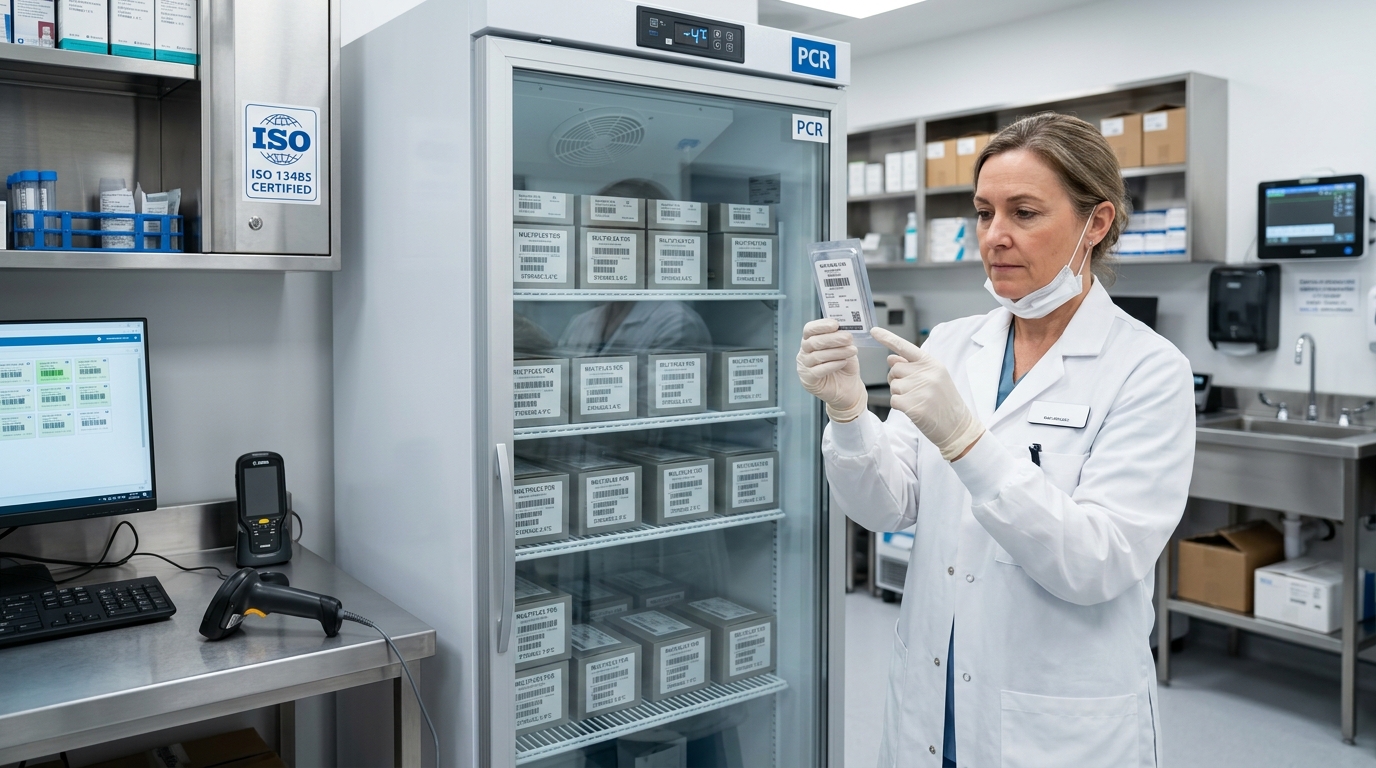
In high-complexity clinical pathology environments across Dubai Healthcare City, Abu Dhabi, and the Northern Emirates, procurement teams collaborate closely with laboratory directors to ensure supply chain integrity. Sourcing through certified partners and reviewing laboratory quality assurance and molecular diagnostic solutions in UAE guarantees that all automated cartridges arrive with verified stability profiles, uncompromised cold-chain audits, and complete regulatory dossiers.
Biochemical Degradation Mechanisms in Pre-Packaged PCR Cartridges
Automated PCR cartridges house all biochemical reagents necessary for cell lysis, magnetic-bead nucleic acid extraction, reverse transcription, and PCR amplification inside microfluidic chambers. These reagents are vulnerable to specific environmental stresses:
- Thermal Denaturation of DNA Polymerases & Reverse Transcriptases: Recombinant Taq polymerases and M-MLV reverse transcriptases are thermosensitive proteins. Exposure to elevated temperatures (>25°C for refrigerated formulations, or >35°C for lyophilized formulations) induces conformational denaturation, precipitating loss of catalytic amplification efficiency and delayed Cycle Threshold (Ct) values.
- Hydrolysis of Fluorogenic Probes & Primers: TaqMan probes conjugate oligonucleotide backbones to fluorescent reporter dyes (FAM, VIC, CY5) and quenchers (BHQ). Ambient moisture ingress hydrolyzes phosphodiester bonds, generating background fluorescence baseline elevation and false-positive baseline crossing.
- Moisture Ingress in Lyophilized Reagent Beads: Room-temperature stable cartridges utilize freeze-dried (lyophilized) enzyme beads encased in foil blisters with desiccant plugs. Punctured foil or compromised seal integrity results in hygroscopic moisture absorption, causing rapid enzymatic inactivation within hours.
Procurement Matrix: Formulations, Shelf Life & Storage Conditions
Procurement contracts must clearly distinguish between reagent formulation types and establish strict delivery thresholds:
| Reagent Formulation | Standard Manufacturer Shelf Life | Required Storage Temperature | Minimum Acceptable Shelf Life Upon Receipt in UAE |
|---|---|---|---|
| Liquid Reagents (Chilled) | 9 to 12 Months from Manufacturing | 2°C to 8°C (Cold-Chain) | ≥75% of Total Shelf Life (Minimum 6 to 8 Months) |
| Lyophilized (Freeze-Dried Beads) | 12 to 24 Months from Manufacturing | 2°C to 28°C (Ambient Controlled) | ≥70% of Total Shelf Life (Minimum 10 to 14 Months) |
| Frozen Control Materials (External Run Controls) | 18 to 24 Months from Manufacturing | -20°C to -80°C (Ultra-Low Freezer) | ≥80% of Total Shelf Life (Minimum 12 Months) |
Core Technical Procurement Criteria for UAE Hospital Tenders
Hospital laboratory procurement contracts must include the following enforceable technical clauses:
- Continuous Cold-Chain Temperature Data Logging: Every master shipping carton of 2°C to 8°C cartridges must contain a calibrated, single-use USB or Bluetooth temperature data logger. The receiving hospital reserves the right to reject the entire shipment if excursions outside the 2°C–8°C window exceed cumulative manufacturer limits (typically >48 hours at 8°C–15°C, or any excursion >25°C).
- Batch Lot Uniformity: Tenders must mandate shipment of a single uniform batch lot for high-volume orders (or a maximum of two lots) to minimize the staff labor and cost associated with mandatory lot-to-lot verification testing.
- On-Board Stability Specifications: Cartridge documentation must state validated on-board stability once removed from refrigerated storage or once the pouch is opened (e.g., stable for 4 hours at 15°C–30°C on the analyzer bench before sample loading).
- Manufacturer Certificate of Analysis (CoA): Every shipment must include an electronic and physical CoA certifying analytical sensitivity, limits of detection (LoD), and sterility for the specific lot number.
- Regulatory Registration: The diagnostic system and cartridges must hold valid UAE Ministry of Health and Prevention (MOHAP) medical device registration, alongside US FDA 510(k) clearance or European CE-IVD (IVDR) certification.
Lot-to-Lot Quality Control (QC) Verification Protocol (ISO 15189)
Before releasing a newly received shipment of PCR cartridges into patient testing, accredited laboratories must execute standardized lot-to-lot verification:
| Verification Step | Protocol Requirement | Acceptance Criteria |
|---|---|---|
| Negative Control Run | Run molecular-grade nuclease-free water or transport media | All target channels completely negative (No amplification / Ct undetermined) |
| Low-Positive Control Run | Run third-party reference standard at 2x to 3x Limit of Detection (LoD) | All expected targets detected within ±1.5 Ct of target nominal value |
| Parallel Clinical Testing | Test 3 to 5 previously characterized patient specimens on both the outgoing and incoming lot | 100% qualitative concordance; Ct delta ≤1.5 cycles |
| Internal Control (IC) Monitoring | Verify that the internal cellular or bacteriophage control amplifies within expected range | Internal control Ct within ±1.0 standard deviation of lot mean |
Inventory Management & Expiry Prevention Strategies
Because automated PCR cartridges represent one of the highest cost-per-test consumables in clinical pathology (ranging from $40 to $150 per multiplex test), proactive inventory management is crucial:
- FEFO Protocol (First Expired, First Out): Laboratory warehouse staff must organize refrigeration shelving strictly by expiry date rather than receipt date, ensuring near-expiry boxes are routed to analyzers first.
- Safety Stock Sizing based on Lead Time: Sizing safety stock buffers in the UAE requires factoring in air freight transit, customs clearance, and MOHAP inspection lead times (typically 4 to 8 weeks for imported molecular kits).
- Vendor Consignment Agreements: For ultra-specialized or low-volume syndromic panels (e.g., encephalitis/meningitis panels), laboratories negotiate consignment contracts where title transfer and payment only occur upon cassette utilization, with the vendor assuming responsibility for replacing expiring stock.
Frequently Asked Questions (FAQ)
Advance Point-of-Care Diagnostics Across the UAE
Equip your clinical practice, hospital, or laboratory with certified rapid test panels and multiplex diagnostic solutions delivering lab-grade results in minutes.
Explore QuRapid Test KitsCan expired PCR cartridges be used if internal and external controls pass?
No. Under ISO 15189, CAP (College of American Pathologists), and UAE regulatory guidelines, testing patient specimens using expired reagents or cartridges is strictly prohibited. Passing controls on an expired cartridge does not guarantee analytical sensitivity at the true limit of detection (LoD) for low-viral-load clinical specimens.
What should a laboratory do if a cold-chain temperature excursion occurs during shipping?
Quarantine the shipment immediately. Download the temperature logger PDF report. Contact the manufacturer’s technical support with the exact time-temperature profile. If the manufacturer does not provide a formal written engineering concession confirming reagent stability under the documented thermal excursion, the shipment must be formally rejected.
Are lyophilized cartridges completely immune to heat?
No. While lyophilized cartridges do not require refrigerated 2°C–8°C cold chains, they typically have an upper thermal limit of 28°C or 30°C. Storing lyophilized cartridges in unconditioned warehouses in the UAE where summer temperatures exceed 40°C can melt protective paraffin seals and degrade plastic microfluidic manifolds.
Scientific References & Authoritative Clinical Guidelines
- International Organization for Standardization (ISO). ISO 15189:2022 Medical Laboratories — Requirements for Quality and Competence: Reagent Management & Verification. ISO Standards, 2024.
- Clinical and Laboratory Standards Institute (CLSI). MM19: Establishing Molecular Diagnostic Methods and Lot-to-Lot Reagent Verification. CLSI Guidelines, 2024.
- Dubai Health Authority (DHA). Health Regulation Sector: Standards for Medical Laboratory Services and Cold-Chain Logistics. UAE Health Authority, 2024.