
House Dust Allergy Symptoms & Testing: Dermatophagoides Specific IgE Blood Panels, Skin Prick Protocols & Environmental Control in UAE
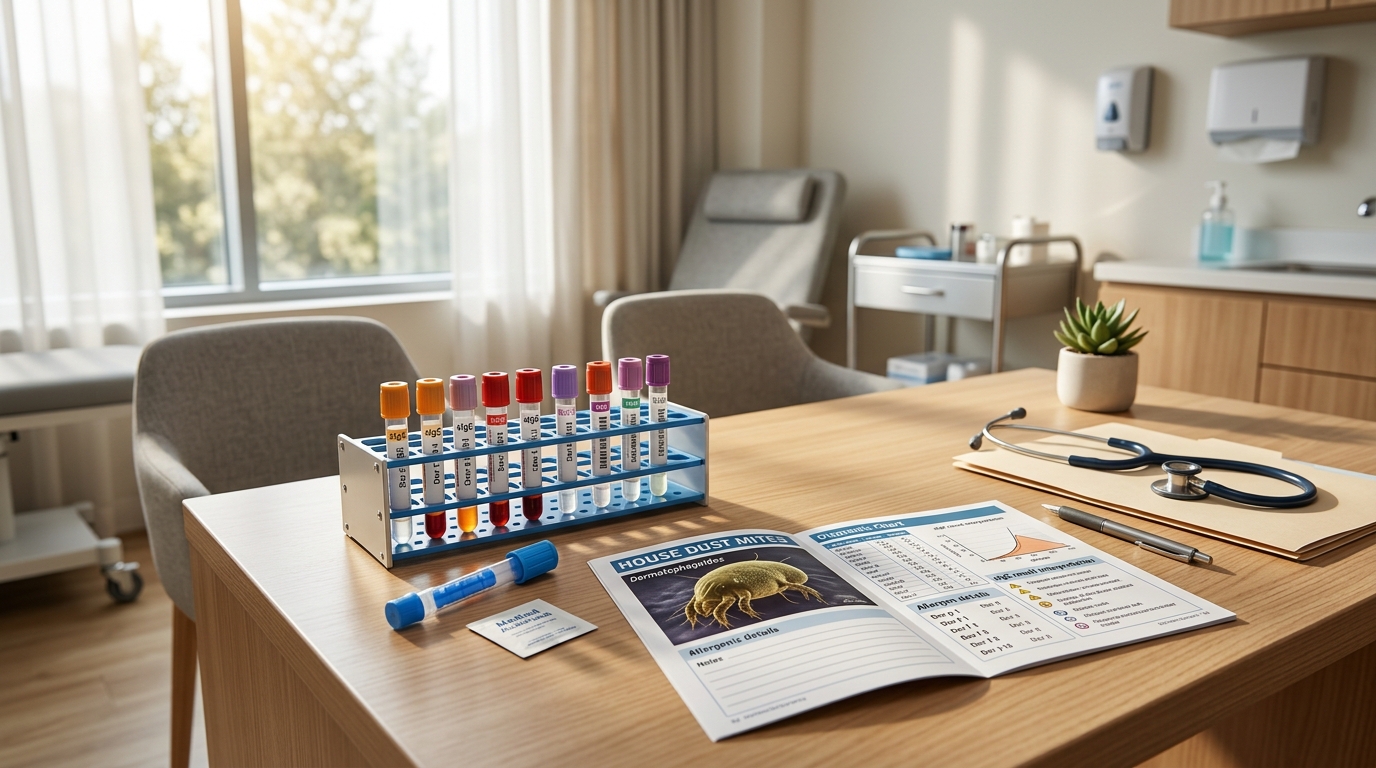
In high-standard medical facilities across Dubai, Abu Dhabi, and Sharjah, thousands of expatriates and local residents suffer from year-round nasal congestion, morning sneezing fits, and chronic coughing mistakenly attributed to recurring viral colds or outdoor desert sand. Scheduling certified comprehensive inhalant allergy and specific IgE testing in Dubai provides patients with precise molecular identification of causative aeroallergens, empowering clinicians to prescribe personalized curative immunotherapy.
Pathophysiology: What Are Dust Mite Allergens?
Contrary to common belief, individuals are not allergic to household inorganic dirt or desert sand; they are sensitized to microscopic proteolytic proteins excreted in the digestive fecal pellets of microscopic arachnids known as house dust mites:
- Major Causative Species: The European house dust mite (Dermatophagoides pteronyssinus) and the American house dust mite (Dermatophagoides farinae) are the primary sensitizers worldwide.
- Proteolytic Allergenic Epitopes (Der p 1 and Der f 1): Group 1 allergens are cysteine proteases excreted in mite fecal droppings. These enzymes actively digest the tight junction occludin and claudin proteins of the human respiratory and nasal epithelial barrier, facilitating direct allergen penetration to submucosal dendritic cells.
- Immune Response (Type I Hypersensitivity): Dendritic cells present allergen fragments to CD4+ T helper 2 (Th2) lymphocytes, driving B-cell class switching to Allergen-Specific Immunoglobulin E (sIgE). Subsequent exposure cross-links sIgE on tissue mast cells and basophils, triggering immediate degranulation of histamine, leukotrienes (LTC4, LTD4), and prostaglandins (PGD2).
- Microclimate Requirements: Dust mites thrive at temperatures of 20°C to 25°C and relative humidity of 65% to 80%. They feed on shed human epidermal dander (keratin squames), concentrating heavily in mattresses, pillows, upholstered sofas, and plush carpets.
Clinical Presentation: Symptoms of Perennial House Dust Allergy
Because dust mites reside indoors year-round, symptoms exhibit distinct temporal and environmental patterns:
| Organ System | Specific Clinical Symptoms | Temporal Trigger Pattern |
|---|---|---|
| Upper Respiratory (Allergic Rhinitis) | Severe early-morning paroxysmal sneezing, chronic bilateral nasal congestion, watery rhinorrhea, post-nasal drip, itchy palate | Worse upon waking in the morning (after 8 hours of close contact with mattress/pillows); exacerbated during bed-making or vacuuming |
| Lower Respiratory (Allergic Asthma) | Nocturnal dry coughing fits, chest tightness, wheezing, breathlessness during early morning hours | Nighttime exacerbations triggered by inhaling airborne mite fecal particles disturbed during sleep movement |
| Ocular (Allergic Rhinoconjunctivitis) | Bilateral conjunctival hyperemia, intense pruritus, watery tearing, “allergic shiners” (periorbital venous pooling) | Continuous year-round ocular irritation, worsening indoors in heavily carpeted or fabric-furnished spaces |
| Dermatological (Atopic Dermatitis) | Severe pruritus, eczematous lichenified plaques on flexural creases (antecubital and popliteal fossae), dry scaly skin | Exudative flare-ups when skin contacts infested upholstery, unwashed bed linens, or plush soft toys |
Diagnostic Testing: Specific IgE Blood Panel vs. Skin Prick Testing (SPT)
Allergy diagnostics utilize two validated modalities, each offering distinct clinical advantages:
| Evaluation Parameter | Serum Allergen-Specific IgE (ImmunoCAP Blood Test) | Skin Prick Testing (SPT) |
|---|---|---|
| Procedure Mechanics | Single routine venous blood draw; in vitro quantitative fluoroimmunoassay | Drop of commercial extract applied to forearm; epidermis pricked with 1-mm lancet; read wheal/flare at 15 min |
| Antihistamine Washout Required? | NO WASHOUT REQUIRED. Patient can continue taking antihistamines, H2 blockers, and systemic steroids without interference. | YES. Antihistamines must be discontinued for 5 to 7 days prior; tricyclic antidepressants for 2 weeks to avoid false negatives. |
| Severe Skin Disease (Eczema / Dermatographia) | Completely safe and unaffected by active skin lesions | Cannot be performed on excoriated skin or patients with dermatographia |
| Anaphylaxis Risk | Zero risk (in vitro test performed in tube) | Extremely low (<0.03%), but resuscitation equipment must be present |
| Quantitative Precision | Precise kU/L values; class 0 to class 6 grading; monitors immunotherapy response | Semi-quantitative wheal diameter measurement (mm) compared to histamine positive control |
ImmunoCAP Specific IgE Quantification Classes
Laboratory results for dust mite-specific IgE (d1: D. pteronyssinus, d2: D. farinae) are stratified into validated clinical classes:
- <0.35 kU/L (Class 0): Undetectable / Negative. Clinical dust mite allergy is unlikely.
- 0.35 to 0.70 kU/L (Class 1): Low sensitization level. May correlate with mild symptoms in hyper-reactive individuals.
- 0.71 to 3.50 kU/L (Class 2): Moderate level of specific IgE. Clinically significant sensitization.
- 3.51 to 17.5 kU/L (Class 3): High level of antibodies. Definite clinical correlation with allergic rhinitis/asthma.
- >17.5 to >100 kU/L (Class 4 to 6): Very high to extremely high sensitization. Strong indication for Allergen Immunotherapy (AIT).
Comprehensive Environmental Remediation Protocol for UAE Homes
Sensitized patients must implement a multi-tiered environmental control strategy to reduce indoor allergen load:
- Impermeable Mite-Proof Encasements: Encase mattresses, pillows, and box springs in certified micro-porous allergen barrier covers (<6 micron pore size). This traps existing mites and blocks new colonization.
- Hot Water Washing SOP: Wash all bed linens, pillowcases, and duvet covers weekly in water at ≥60°C (140°F). Standard cold water washing removes dust but fails to kill live mites.
- Indoor Humidity Control (<50% RH): Mites cannot drink liquid water; they absorb atmospheric water vapor through their cuticles. Maintaining indoor relative humidity below 50% using continuous AC dehumidification dehydrates and decimates mite colonies within weeks.
- High-Efficiency HEPA Filtration: Use vacuum cleaners equipped with true HEPA filters and run standalone HEPA air purifiers in bedrooms. Vacuuming with standard porous bags aerosolizes mite particles into the air, worsening acute symptoms.
- Flooring & Soft Furnishings: Replace wall-to-wall bedroom carpets with porcelain tile or hardwood flooring. Minimize plush fabric upholstery and remove soft toys from children’s beds (or freeze toys for 24 hours weekly to kill mites).
Allergen Immunotherapy (AIT): The Curative Pathway
While second-generation oral antihistamines (bilastine, desloratadine), intranasal corticosteroids (mometasone, fluticasone), and leukotriene receptor antagonists (montelukast) provide symptomatic control, Allergen Immunotherapy (AIT) is the only disease-modifying treatment capable of altering the natural course of allergic disease:
- Subcutaneous Immunotherapy (SCIT / Allergy Shots): Incremental injections of standardized dust mite extract over a 3- to 5-year course induce allergen-specific IgG4 blocking antibodies and regulatory T cells (Tregs), inducing long-term clinical tolerance.
- Sublingual Immunotherapy (SLIT Tablets / Drops): Daily fast-dissolving sublingual allergen extracts administered under the tongue at home, offering excellent safety and efficacy for both adults and pediatric patients in the UAE.
Frequently Asked Questions (FAQ)
Is house dust allergy related to outdoor desert sandstorms in the UAE?
No. Desert sand consists of coarse inorganic mineral particles (silica, quartz) that act as mechanical mucosal irritants. House dust allergy is a true immunological IgE-mediated response to organic dust mite fecal proteins found exclusively indoors in beds, carpets, and air-conditioned spaces.
Do chemical anti-mite sprays and foggers work?
Acaricide chemical sprays provide temporary mite reduction but leave allergenic fecal proteins intact in fabrics, meaning symptoms persist. Physical encasements, washing at 60°C, and keeping humidity below 50% are far more effective and non-toxic.
Can a child outgrow a house dust mite allergy?
Unlike milk or egg allergies which are frequently outgrown in early childhood, perennial inhalant allergies (dust mites, animal dander) rarely resolve spontaneously and often persist throughout adult life. In many children, untreated dust mite rhinitis progresses into allergic asthma (the “Atopic March”), which is why early diagnostic testing and immunotherapy are emphasized.
Scientific References & Authoritative Clinical Guidelines
- European Academy of Allergy and Clinical Immunology (EAACI). Guidelines on House Dust Mite Sensitization and Allergen Immunotherapy for Allergic Rhinitis. Allergy, 2024.
- American Academy of Allergy, Asthma & Immunology (AAAAI). Rhinitis 2024: A Practice Parameter Update on Aeroallergen Testing and Environmental Control. J Allergy Clin Immunol, 2024.
- Dubai Health Authority (DHA). Clinical Guidelines for the Diagnosis and Management of Allergic Rhinitis and Bronchial Asthma. UAE Health Regulations, 2024.