
Lyophilised PCR Reagents Procurement Criteria: Ambient Stability, Cold-Chain Elimination & Ambient Warehouse Audits in UAE
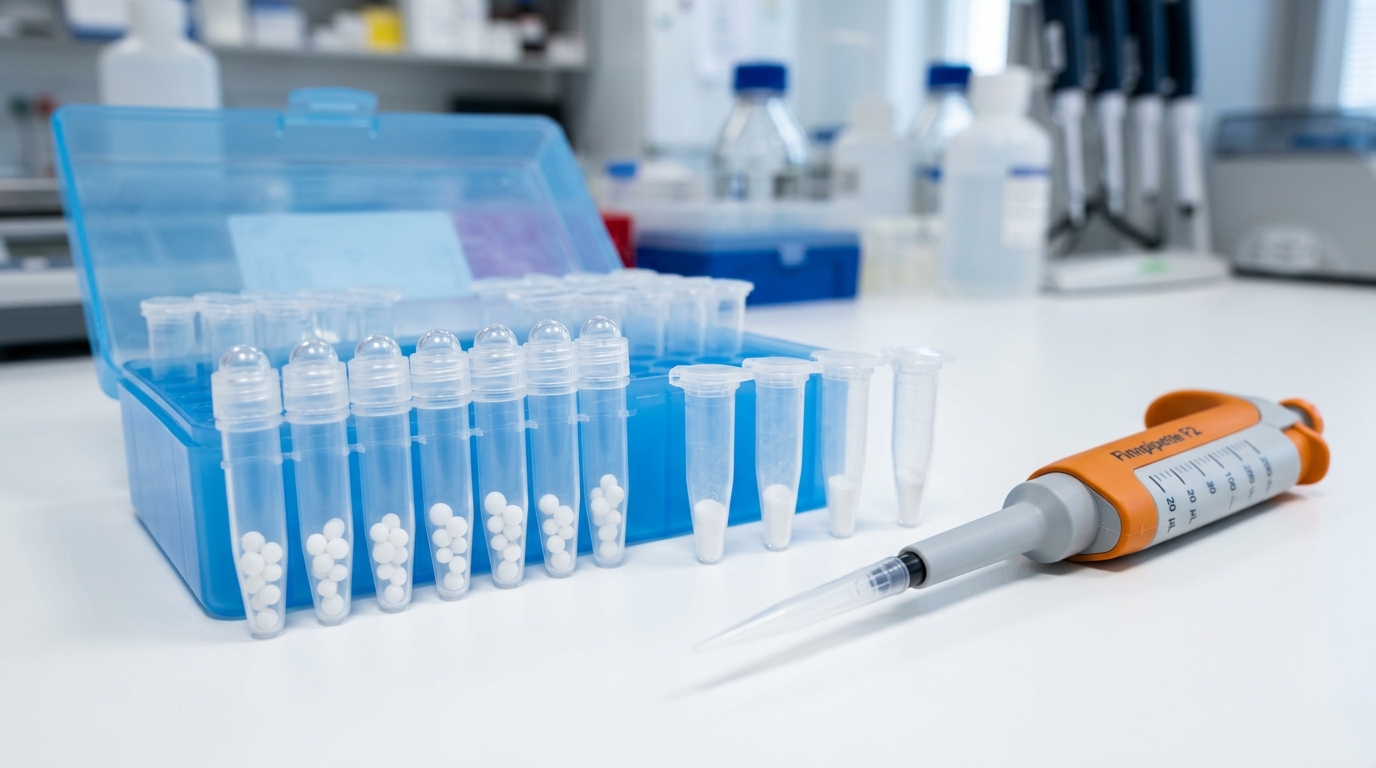
In high-complexity clinical pathology environments across Dubai Healthcare City, Abu Dhabi, and the Northern Emirates, procurement teams collaborate closely with laboratory directors to ensure supply chain integrity. Sourcing through certified partners and reviewing laboratory quality assurance and molecular diagnostic solutions in UAE guarantees that all automated cartridges arrive with verified stability profiles, uncompromised cold-chain audits, and complete regulatory dossiers.
The Science of Lyophilization: How Molecular Glass Prevents Denaturation
Lyophilization (freeze-drying) removes water from biological reagents via sublimation under high vacuum. In advanced molecular manufacturing, enzymes are stabilized in a protective amorphous carbohydrate matrix:
- Vitrification (Glass Formation): Cryoprotectants such as trehalose, ficoll, and sucrose form an amorphous, non-crystalline solid “sugar glass” around Taq DNA polymerase and reverse transcriptase molecules, physically immobilizing their protein tertiary structure and preventing conformational unfolding.
- Water Replacement Hypothesis: Hydroxyl groups of trehalose substitute for hydrogen-bonding water molecules around the enzyme’s hydrophilic surface residues, preserving enzymatic activity upon dry storage.
- Sublimation Drying: Primary and secondary vacuum drying cycles reduce residual moisture content to <1.5% to 2.0%, arresting all hydrolytic degradation pathways that degrade dNTPs and oligonucleotide probes in aqueous solutions.
Procurement Matrix: Lyophilized vs. Conventional Wet Reagents
Procurement directors must evaluate both the economic logistics and analytical parameters when writing tender specifications:
| Evaluation Metric | Conventional Wet Master Mix (-20°C) | Lyophilized PCR Reagent Spheres (Ambient) |
|---|---|---|
| Shipping Logistics & Cost | High airfreight costs; requires 10–20 kg dry ice per carton; high carbon footprint | Standard airfreight or courier; no dry ice required; saves 60%–80% in freight charges |
| Customs Hold Vulnerability | Catastrophic: Dry ice sublimates within 48–72 hours during airport customs delays in UAE summers | Zero Vulnerability: Stable at 2°C to 30°C for up to 18 to 24 months without refrigeration |
| Laboratory Storage Space | Consumes expensive -20°C freezer and cold-room capacity; requires backup diesel generators | Standard air-conditioned laboratory shelf storage (ambient controlled 20°C–25°C) |
| Hands-On Pipetting Labor | Requires thawing, vortexing, and dispensing multiple liquid components; prone to pipetting errors | Single-step rehydration: Add sample/eluate directly to the pre-aliquoted sphere; eliminates master mix prep |
| Contamination Risk | Multiple tube openings increase aerosol amplicon cross-contamination | Unitized single-reaction tubes minimize handling and prevent reagent waste |
Technical Procurement Specifications for UAE Molecular Laboratories
Tenders for lyophilized reagents must mandate the following verifiable technical criteria:
- Residual Moisture Content Certification: Every batch Certificate of Analysis (CoA) must certify residual moisture content determined via Karl Fischer titration at ≤2.0%. Higher moisture levels accelerate probe degradation.
- Instantaneous Reconstitution Kinetics: The lyophilized sphere or cake must achieve 100% complete dissolution in aqueous buffer or nucleic acid eluate in ≤10 seconds at room temperature without requiring vigorous vortexing or heating.
- Hygroscopic Packaging Standards: Reagents must be sealed in high-barrier individual blister packs or aluminum foil pouches containing molecular-grade silica gel desiccants with a color-indicating humidity card. Individual packaging ensures remaining tubes are not exposed to atmospheric humidity upon opening the outer box.
- Thermal Stress Tolerance: Manufacturer documentation must include accelerated stability data demonstrating functional equivalence after exposure to 37°C for at least 7 days, validating resilience against short-term temperature excursions during regional ground transport.
- Analytical Equivalence: Limits of Detection (LoD), dynamic linear range, and amplification efficiency (90%–110%) must match or exceed conventional liquid reference formulations across all multiplex target channels.
Warehouse Auditing and Quality Assurance SOPs
Procuring ambient-stable reagents does not mean storage is unregulated. UAE laboratory directors must audit distributor warehouses according to Good Distribution Practice (GDP) standards:
| Audit Parameter | Regulatory Standard | Verification Method |
|---|---|---|
| Ambient Temperature Control | Maintained strictly at 15°C to 25°C (Maximum excursion limit ≤30°C) | Continuous 24/7 automated temperature mapping with SMS/email alert logging |
| Relative Humidity (RH) | Controlled below 60% RH | Hygrometer logging; prevents moisture ingress if outer foil barriers have micro-perforations |
| Direct Sunlight Protection | No exposure to direct sunlight or UV sources | Enclosed racking; prevents photodegradation of light-sensitive fluorophores (FAM/HEX/ROX) |
| Pest & Contamination Control | ISO 9001 / GDP compliant clean warehouse | Documented pest control logs and sealed pallet racking |
Economic & Operational Impact: CapEx and OpEx Reductions in the UAE
Transitioning from frozen reagents to lyophilized formats delivers substantial operational savings for large hospital systems in Dubai, Abu Dhabi, and the Northern Emirates:
- Elimination of Dry Ice Logistics: Hazardous materials surcharges, specialized dry ice containment boxes, and carbon taxes represent up to 35% of total procurement expenditure for imported biologicals. Lyophilized kits eliminate these freight surcharges entirely.
- Reduced Freezer Footprint & Power Redundancy: Ultra-low temperature (-20°C and -80°C) freezers generate substantial electrical heat, requiring heavy facility HVAC conditioning and uninterruptible power supply (UPS) diesel generator backups. Ambient storage cuts hospital laboratory facility electrical consumption significantly.
- Zero Reagent Wastage from Repeated Freeze-Thaw Cycles: Conventional liquid master mixes lose up to 15% of amplification efficiency after 3 to 5 freeze-thaw cycles, forcing technicians to discard partially used multi-reaction vials. Pre-aliquoted unit-dose lyophilized spheres guarantee that 100% of procured tests are utilized for patient diagnostics.
Enzyme Stability & Reverse Transcription Kinetics
A frequent technical concern among molecular pathologists is whether freeze-drying impairs reverse transcriptase performance during RNA virus detection (such as Influenza, RSV, or Norovirus). Extensive benchmarking demonstrates that trehalose vitrification stabilizes the tertiary structure of M-MLV reverse transcriptase more effectively than glycerol-based liquid solutions, yielding identical or superior Cycle Threshold (Ct) values even after 12 months of ambient storage.
Frequently Asked Questions (FAQ)
Do lyophilized PCR reagents require special centrifuges?
No. After adding the rehydration buffer or patient nucleic acid eluate, a simple 5-second pulse spin in a standard mini-centrifuge collects the liquid at the tube bottom, ready for thermal cycling.
What happens if a lyophilized tube is left open on the bench?
Because freeze-dried enzyme matrices are highly hygroscopic, leaving an unsealed tube exposed to ambient air for several hours causes rapid moisture absorption, visible liquefaction, and enzymatic inactivation. Tubes must be rehydrated immediately upon opening.
Can lyophilized reagents be used on open-platform real-time PCR thermal cyclers?
Yes. Many leading manufacturers formulate lyophilized master mixes in standard 0.2 mL PCR tubes, 8-strip tubes, and 96-well plates compatible with major open-channel platforms (Bio-Rad CFX, Applied Biosystems QuantStudio, Roche LightCycler).
How does ambient stability perform during summer transport in Dubai?
While lyophilized reagents are ambient stable up to 28°C or 30°C, direct delivery vans without air conditioning can exceed 50°C during peak UAE summer months. Procurement tenders must mandate temperature-monitored climate-controlled transport vehicles (15°C–25°C) for final-mile delivery.
Scientific References & Authoritative Clinical Guidelines
- International Organization for Standardization (ISO). ISO 13485:2016 Medical Devices — Quality Management Systems: Reagent Stability & Preservation. ISO, 2024.
- Clinical and Laboratory Standards Institute (CLSI). MM19-A: Establishing Molecular Diagnostic Verification and Reagent Procurement. CLSI, 2024.
- Dubai Health Authority (DHA). Health Regulation Sector: Standards for Medical Laboratory Reagent Procurement and Supply Chain Integrity. UAE Regulations, 2024.