
Sperm Vitality Fertility Testing Meaning: Eosin-Nigrosin Staining, Necrozoospermia vs Immotility & ICSI Viability Assays
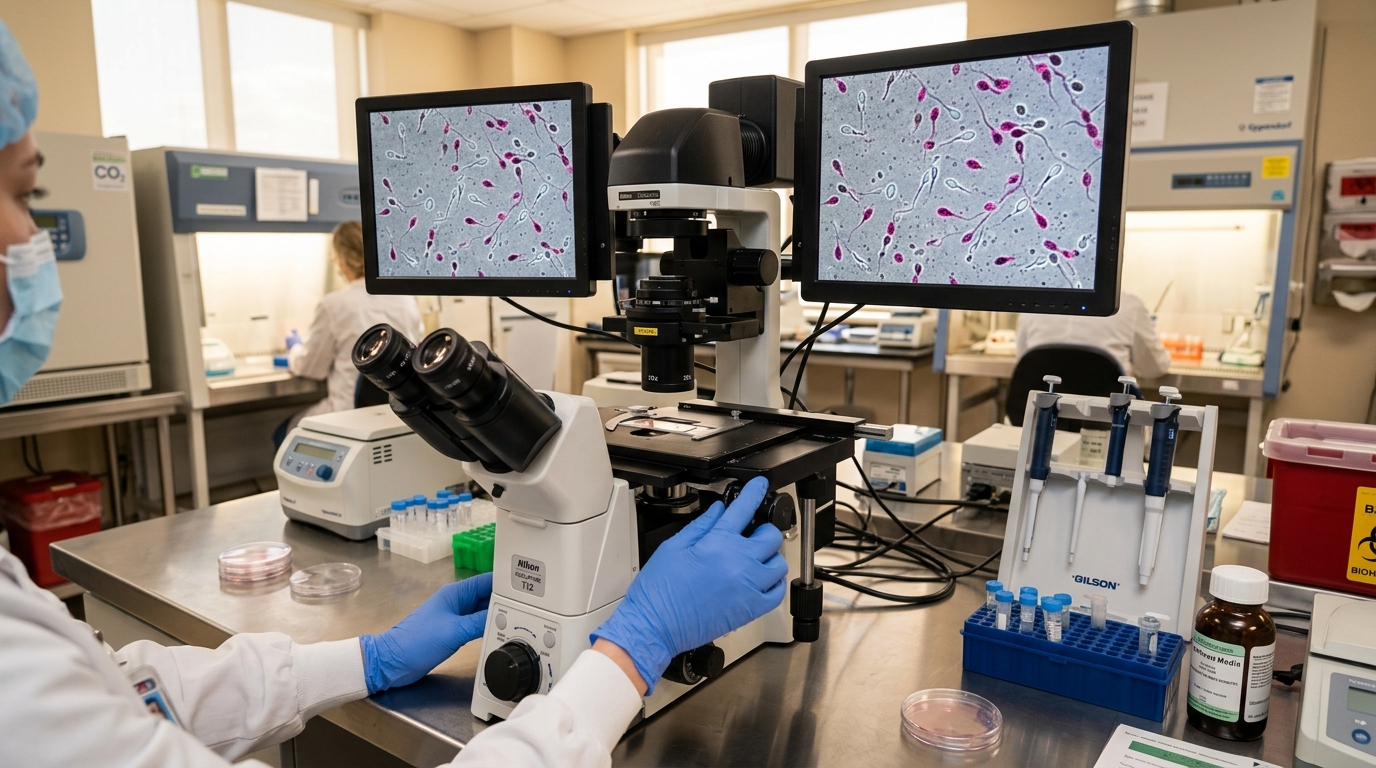
In specialized fertility and andrology centers across Dubai, Abu Dhabi, and Sharjah, couples struggling with severe male factor subfertility often face devastating reports showing 0% progressively motile sperm. However, finding zero motility does not mean pregnancy is impossible. Scheduling comprehensive advanced andrology and sperm vitality testing in UAE ensures rigorous evaluation using vital dye exclusion assays and hypo-osmotic swelling tests to identify living spermatozoa suitable for Intracytoplasmic Sperm Injection (ICSI).
The Physiological Principle: Plasma Membrane Permeability
Vitality testing relies on the fundamental biophysical integrity of the sperm plasma membrane:
- Living Spermatozoa (Intact Membrane): Healthy living sperm maintain active ionic transport and structural membrane impermeability. They actively exclude charged vital dyes such as eosin, appearing unstained white or faint bluish against a dark background.
- Dead Spermatozoa (Disrupted Membrane): Post-mortem degradation leads to plasma membrane permeabilization. Vital dyes pass freely into the cytoplasm, staining the sperm head a distinct pink or bright red.
- Nigrosin Contrast Agent: Nigrosin provides a dark, opaque purple-black background contrast, allowing crystal-clear microscopic differentiation between clear (viable) and pink (non-viable) sperm under 1,000x oil-immersion microscopy.
Core Diagnostic Modalities: Eosin-Nigrosin vs. HOS Test
Andrology laboratories utilize two standardized diagnostic methodologies to determine sperm vitality:
| Diagnostic Assay | Biochemical Principle | Clinical Procedure & Reading | Key Advantage / Application |
|---|---|---|---|
| Eosin-Nigrosin Dye Exclusion (Reference Standard) | Membrane dye exclusion | Mix equal parts semen and eosin-Y; incubate 30 sec; add nigrosin; smear on slide; count 200 sperm | Rapid, objective, and permanent stained record; best for baseline andrology diagnostic workups |
| Hypo-Osmotic Swelling (HOS) Test | Functional membrane osmoregulation | Incubate sperm in 150 mOsm/L hypo-osmotic fructose/sodium citrate solution for 30 min at 37°C | Non-Toxic: Sperm remain alive! Essential for selecting live immotile sperm for immediate ICSI injection |
Interpreting HOS Test Morphological Reactions
When exposed to hypo-osmotic fluid, living sperm transport water into the cytoplasm to equilibrate osmotic gradients, causing swelling and curling of the flexible flagellum:
- Type A (Non-Reactive): Tail remains completely straight and unbent. Membrane is dead or non-functional.
- Type B to G (Reactive / Viable): Tail exhibits tip swelling, hairpin curling, or complete spiral ballooning. Confirms intact, functionally active osmoregulation and viable paternal DNA.
Clinical Stratification: WHO 6th Edition Reference Thresholds
The World Health Organization 6th Edition establishes the lower 5th percentile reference limit for sperm vitality at 54% (and motile sperm should never exceed vital sperm):
| Vitality Percentage | Diagnostic Category | Underlying Etiology | Reproductive Clinical Pathway |
|---|---|---|---|
| ≥54% Vital Sperm | Normal Vitality | Physiologically healthy membrane preservation | Proceed based on motility and morphology metrics (Natural, IUI, or IVF) |
| <54% Vital Sperm | Necrozoospermia (Partial / Severe) | Testicular ischemia, severe oxidative stress, anti-sperm antibodies, infection | Identify treatable etiological drivers; anti-oxidant therapy; repeat testing in 3 months |
| 0% to <20% Vitality | Profound / Total Necrozoospermia | Prolonged epididymal transit time, spinal cord injury, adult polycystic kidney disease | High risk of ICSI failure; consider surgical testicular sperm aspiration (TESA) where vitality is higher |
| 0% Motile, but ≥54% Vital | Isolated Asthenozoospermia (Ciliopathy) | Axonemal dynein arm absence (Kartagener’s syndrome), structural flagellar defects | Excellent ICSI Prognosis: Select live immotile sperm via HOS test or laser pulsing; fertilization rates >70% |
Differentiating Asthenozoospermia from Necrozoospermia
A crucial clinical rule governs andrology reporting: Vitality percentage must ALWAYS equal or exceed motility percentage. Because a dead sperm cannot move, motile sperm are by definition alive. Resolving the relationship between motility and vitality directs therapy:
- High Vitality (>60%) with Low Motility (<10%): Indicates living sperm with a mechanical flagellar defect. Normal fertilization can be achieved via ICSI once living sperm are identified using the HOS test.
- Low Vitality (<30%) matching Low Motility (<30%): True necrozoospermia. Sperm are dying prematurely during spermatogenesis or epididymal storage due to toxic environmental factors, severe varicocele, or elevated reactive oxygen species.
Etiological Factors Driving Necrozoospermia
When low vitality is diagnosed, clinicians investigate specific reversible and irreversible causes:
- Epididymal Stasis & Infrequent Ejaculation: Extended abstinence periods (>10–14 days) lead to sperm senescence, oxidative membrane lipid peroxidation, and cell death within the cauda epididymis. Daily ejaculation for 3–5 days prior to re-testing often dramatically restores vitality.
- Genital Tract Infections (Ureaplasma, Chlamydia, E. coli): Bacterial lipopolysaccharides and leukocytes release massive bursts of reactive oxygen species (ROS), causing membrane lysis.
- Testicular Hyperthermia & High-Grade Varicocele: Impairs antioxidant enzymes (superoxide dismutase, catalase), precipitating early apoptosis.
Frequently Asked Questions (FAQ)
Can ICSI be performed if all sperm are immotile?
Yes. If all sperm in an ejaculate are completely immotile, embryologists perform the Hypo-Osmotic Swelling (HOS) test or use a non-contact diode laser shot on the tail tip. If the tail curls (HOS reactive) or curls upon laser impact, it proves the sperm is alive and contains intact DNA, achieving excellent ICSI fertilization rates.
Why is vitality testing unnecessary if motility is normal?
If progressive motility is normal (≥40%), vitality is guaranteed to exceed the 54% normal threshold, making vitality testing clinically redundant. Vitality is only performed when total motility is below 40%.
How can a man improve sperm vitality?
Shortening the abstinence period to 2 to 3 days, treating any subclinical prostate or epididymal infections, repairing large varicoceles, and supplementing with high-dose antioxidants (CoQ10, L-carnitine, zinc, vitamin E) for 3 to 6 months significantly improves membrane survival.
Scientific References & Authoritative Clinical Guidelines
- World Health Organization (WHO). WHO Laboratory Manual for the Examination and Processing of Human Semen. 6th Edition, WHO Press, Geneva, 2024.
- American Society for Reproductive Medicine (ASRM). Diagnostic Evaluation of the Infertile Male: The Essential Role of Vitality Assessment in Severe Asthenozoospermia. Fertil Steril, 2024.
- Dubai Health Authority (DHA). Standards for Reproductive Medicine Laboratories and Assisted Reproductive Technologies (ART). UAE Health Regulations, 2024.