
When is Gonorrhea NAAT Testing Indicated? Dual CT/NG Guidelines, Ceftriaxone Resistance, Extragenital Pharyngeal/Rectal Swabs & Disseminated Disease
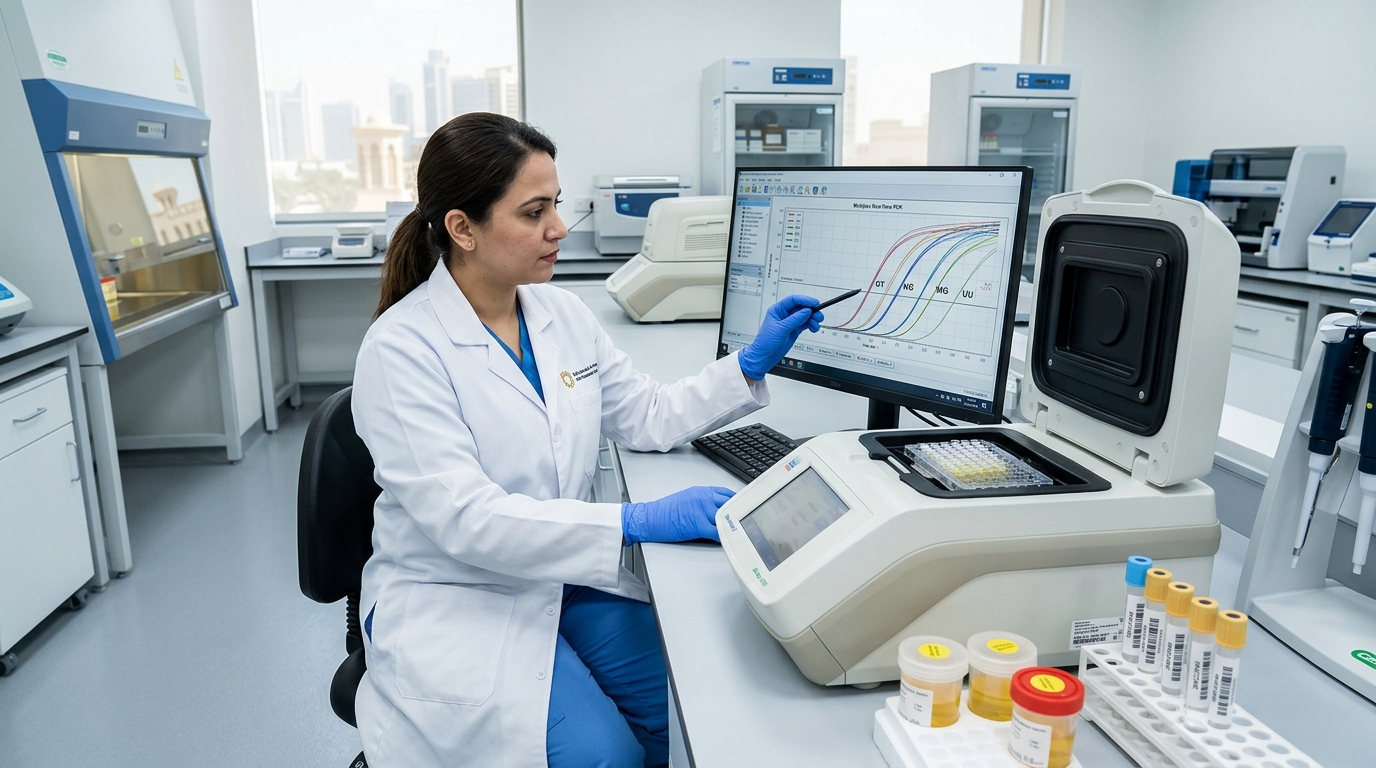
In outpatient polyclinics and diagnostic centers across Dubai, Abu Dhabi, and the wider UAE, access to rapid, automated molecular NAAT platforms ensures timely clinical management. Choosing comprehensive discrete sexual health and STI testing packages in Dubai guarantees rapid detection on certified platforms that monitor emerging antimicrobial resistance patterns.
Diagnostic Evolution: Why NAAT Supersedes Gram Stain and Culture
Historic diagnostic workflows relied on Gram stain microscopy and bacterial culture on selective media (such as modified Thayer-Martin agar). While Gram staining of urethral exudates in symptomatic men demonstrates high sensitivity (> 95%) by visualizing intracellular Gram-negative diplococci within polymorphonuclear leukocytes, its clinical utility collapses in other cohorts:
- Inadequacy in Female Cervical Specimens: Gram staining of endocervical swabs has a clinical sensitivity under 40% to 50% due to the morphological similarity of commensal vaginal microflora (such as non-pathogenic Neisseria species, Moraxella, or Acinetobacter).
- Fastidious Culture Demands: Neisseria gonorrhoeae is an exceptionally delicate organism that requires strict ambient 5% CO2 incubation at 35°C to 37°C. Ambient temperature drops or desiccation during transport causes organism autolysis, yielding up to a 40% false-negative culture rate in routine outpatient logistics.
- Molecular Precision of NAAT: Contemporary commercial NAAT platforms (amplifying porA, opa, or 16S rRNA genes) deliver clinical sensitivity and specificity exceeding 98% to 99%, completely independent of bacterial viability.
Comprehensive Clinical Indications for Gonorrhea NAAT
Clinical practice guidelines promulgated by the U.S. Centers for Disease Control and Prevention (CDC), the World Health Organization (WHO), the British Association for Sexual Health and HIV (BASHH), and the Dubai Health Authority (DHA) outline clear diagnostic mandates:
| Clinical Scenario | Target Patient Cohort | Optimal Anatomical Specimen | Guideline Mandate & Practice Benchmark |
|---|---|---|---|
| Acute Symptomatic Urethritis | Men presenting with copious purulent/mucopurulent discharge, severe dysuria | First-catch urine (initial 15–30 mL) | Differentiates gonococcal urethritis from non-gonococcal urethritis (NGU); guides targeted cephalosporin therapy. |
| Mucopurulent Cervicitis / Vaginitis | Women presenting with abnormal intermenstrual bleeding, postcoital spotting, or dyspareunia | Self-collected or clinician vaginal swab | Vaginal swabs show 2–4% higher sensitivity than endocervical swabs or female urine; excludes upper tract ascension. |
| Suspected Pelvic Inflammatory Disease | Women presenting with lower abdominal tenderness, cervical motion tenderness | Vaginal or endocervical NAAT | Empirical therapy must begin immediately; NAAT confirms etiology, facilitates partner notification, and guides prognosis. |
| Extragenital Exposure (Oral / Anal) | Individuals engaging in receptive oral or anal intercourse | Pharyngeal flocked swab, rectal mucosal swab | Over 80% of pharyngeal and anorectal gonococcal infections are completely asymptomatic; genital testing alone misses these reservoirs. |
| Disseminated Gonococcal Infection (DGI) | Patients presenting with triad of tenosynovitis, polyarthralgias, and pustular skin lesions | Urogenital + Extragenital NAAT + Blood/Synovial Culture | Urogenital NAAT is frequently positive even when joint aspirates are negative, identifying the occult mucosal entry point. |
| Antenatal Obstetric Screening | All pregnant women during first prenatal visit; repeat in 3rd trimester if at high risk | Vaginal swab or first-void urine | Prevents vertical transmission causing ophthalmia neonatorum (which leads to corneal ulceration and blindness) and chorioamnionitis. |
The Extragenital Blind Spot: Pharyngeal & Rectal Testing
A common error in clinical venereology is limiting STI screening to first-catch urine or genital swabs. Neisseria gonorrhoeae has high tropism for non-keratinized mucosal epithelium in the oropharynx and rectum:
- Pharyngeal Gonorrhea: Primarily acquired via receptive fellatio. Over 90% of pharyngeal infections are completely asymptomatic. Because the pharynx provides a rich genetic reservoir for horizontal gene transfer between commensal Neisseria species (such as Neisseria meningitidis or Neisseria lactamica), it is the primary anatomical incubator where cephalosporin antimicrobial resistance mutations emerge.
- Rectal Gonorrhea: Primarily acquired through receptive anal intercourse. While occasionally presenting with tenesmus, mucous discharge, or proctalgia, the majority of cases are clinically silent. Left untreated, it causes chronic mucosal inflammation that multiplies HIV transmission risk fivefold.
- FDA-Cleared Extragenital NAAT: Major diagnostic platforms (e.g., Roche cobas, Hologic Aptima, Abbott Alinity) hold formal regulatory clearance for extragenital swabs. Clinicians must collect flocked swabs from the posterior pharynx, bilateral tonsillar pillars, and 2–3 cm into the anal canal.
Antimicrobial Resistance & The Role of Reflex Bacterial Culture
While NAAT is the undisputed champion for detection, it does not assess antimicrobial susceptibility profiles. Neisseria gonorrhoeae has progressively developed resistance to sulfonamides, penicillins, tetracyclines, and fluoroquinolones. In recent years, strains with reduced susceptibility to extended-spectrum cephalosporins (specifically Ceftriaxone) have been reported globally.
Consequently, current international guidelines mandate that if a patient fails initial therapy or presents with suspected treatment failure, bacterial culture with antimicrobial susceptibility testing (AST) must be performed alongside NAAT. Preserving culture capabilities ensures healthcare systems maintain critical surveillance over minimum inhibitory concentrations (MICs) for ceftriaxone and azithromycin.
Test-of-Cure (TOC) Protocols
Unlike chlamydia, where routine TOC is unnecessary for uncomplicated non-pregnant cases, gonorrhea has specific TOC parameters:
- Pharyngeal Gonorrhea: Due to lower penetration of antibiotics into oropharyngeal lymphoid tissue and higher resistance rates, the CDC recommends a mandatory test-of-cure for all pharyngeal infections 14 days post-treatment using NAAT or culture.
- Persistent Urogenital Symptoms: If dysuria or discharge persists 3 to 5 days after completing standard ceftriaxone therapy, patients must be evaluated for treatment failure, reinfection, or antimicrobial resistance via simultaneous culture/AST and NAAT.
- Timing Considerations: Performing NAAT earlier than 14 days post-treatment can result in false-positive amplification of residual non-viable bacterial DNA fragments.
Frequently Asked Questions (FAQ)
What is the current first-line treatment for uncomplicated gonorrhea?
Under updated CDC and international guidelines, the preferred first-line treatment for uncomplicated urogenital, rectal, or pharyngeal gonorrhea is a single intramuscular injection of Ceftriaxone 500 mg (or 1,000 mg for individuals weighing ≥ 150 kg). Azithromycin co-administration is no longer routinely recommended unless chlamydial infection has not been excluded.
How soon after exposure will a gonorrhea NAAT test become positive?
The biological incubation period for gonorrhea is typically 2 to 7 days. NAAT can detect bacterial nucleic acids as early as 5 to 7 days post-exposure. Testing within 24 to 48 hours of an encounter carries a significant false-negative risk, and repeat testing at day 7 to 14 is advised if an initial test is negative.
Can standard urine tests differentiate between Chlamydia and Gonorrhea?
Yes. Commercial molecular NAAT assays use dual or multiplex targets that amplify distinct genetic regions for both Chlamydia trachomatis and Neisseria gonorrhoeae simultaneously from a single first-catch urine specimen, clearly differentiating which pathogen (or both) is present.
Authoritative Clinical References
- Centers for Disease Control and Prevention (CDC) – Gonococcal Infections in Adolescents and Adults: 2021 STI Treatment Guidelines
- World Health Organization (WHO) – Guidelines for the Treatment of Neisseria gonorrhoeae
- British Association for Sexual Health and HIV (BASHH) – United Kingdom National Guideline on the Management of Gonorrhoea