
Rapid Test Result Reporting in Hospital Laboratories: LIS Bidirectional Interfacing, Critical Value Escalation & Statutory Health Authority Compliance
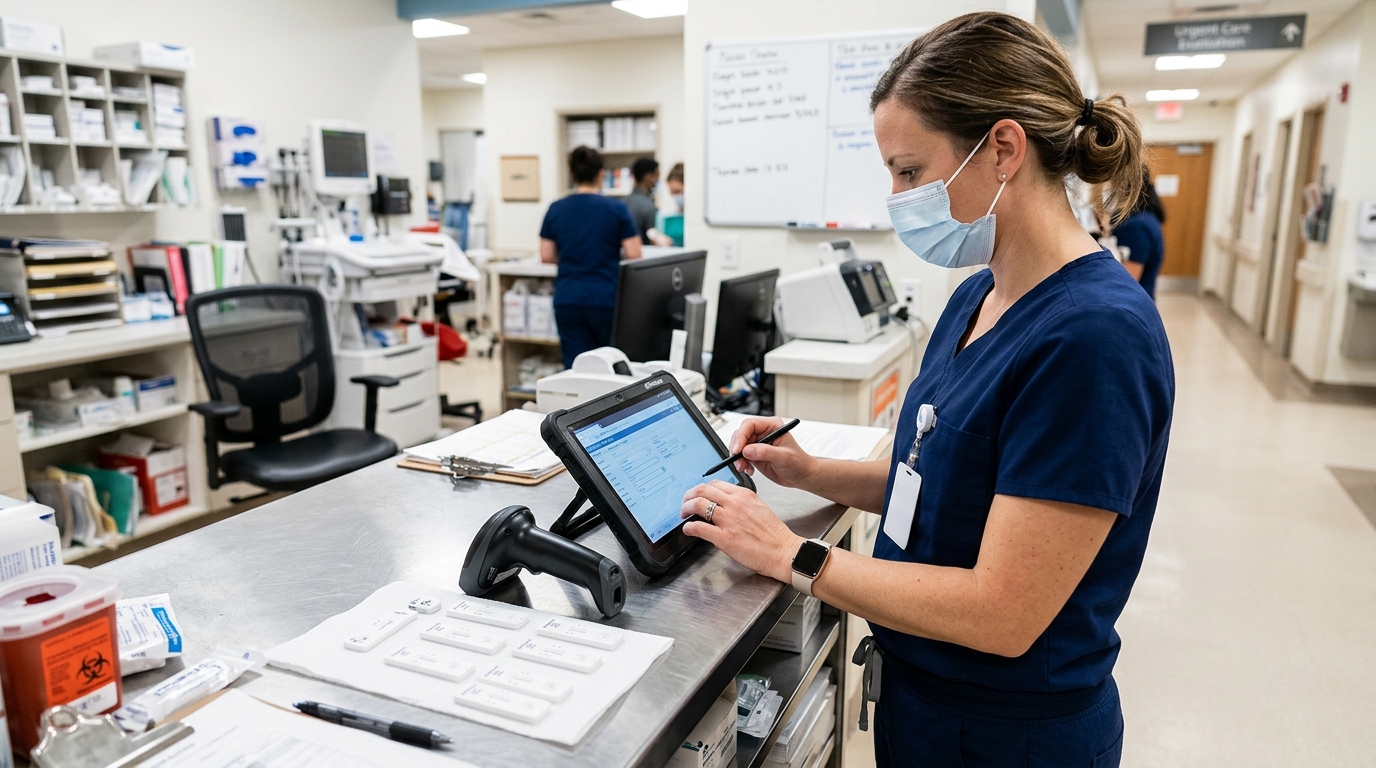
In acute hospital networks throughout Dubai and the UAE, modernizing laboratory information pipelines ensures that rapid diagnostic innovations translate directly into improved clinical patient outcomes. Sourcing certified hospital-grade diagnostic systems and rapid test solutions in the UAE ensures laboratory directors deploy analyzers engineered for direct digital middleware connectivity.
The Criticality of Automated LIS Bidirectional Interfacing
Historically, rapid lateral flow and benchtop point-of-care analyzers operated as standalone “islands of automation.” Laboratory technicians performed the test, visually inspected the result, and manually transcribed the findings into the LIS terminal. Extensive multi-center studies demonstrate that manual transcription carries an error rate of approximately 1% to 3%—an intolerable risk profile in acute hospital medicine.
- Bidirectional Communication Architecture: In an integrated hospital workflow, the analyzer receives patient demographics and test orders directly from the LIS upon scanning the specimen barcode (query mode). Upon test completion, the device transmits raw data, interpretation, operator ID, and reagent lot numbers back to the LIS without human transcription.
- Standard Communication Protocols: Transmission relies on standardized HL7 (Health Level Seven) or emerging HL7 FHIR (Fast Healthcare Interoperability Resources) data structures via ASTM or POCT1-A protocols, ensuring vendor-agnostic interoperability between diagnostic instruments, middleware, and the hospital Electronic Medical Record (EMR).
- Automated Autoverification: Pre-programmed laboratory rule engines automatically verify and release negative or uncomplicated rapid test results into the EMR within seconds, reserving pathologist and senior technologist manual review for abnormal, critical, or discrepant findings.
Critical Value Alert Escalation & Closed-Loop Communication
Certain rapid laboratory test results represent immediate, life-threatening physiological crises (“Panic” or “Critical” values). Hospital accreditation bodies—including the Joint Commission International (JCI) and the College of American Pathologists (CAP)—mandate strict, documented closed-loop reporting workflows:
| Diagnostic Category | Rapid Test Parameter | Critical Value Threshold | Mandated Hospital Notification Timeframe | Required Action & Clinical Audit |
|---|---|---|---|---|
| Acute Coronary Syndrome | High-Sensitivity Cardiac Troponin I/T | > 99th percentile upper reference limit with delta rise | Immediate electronic alert + verbal call < 15 minutes | Direct activation of cardiac catheterization laboratory; read-back verification logged in EMR. |
| Respiratory Emergency | Blood Gas / Rapid Co-Oximetry | pH < 7.20 or > 7.60; pO2 < 50 mmHg; pCO2 > 65 mmHg | Direct phone call to treating physician < 10 minutes | Emergency intubation / ventilation adjustment; verbal acknowledgment documented with recipient staff ID. |
| Infectious Outbreak | Statutory Respiratory Pathogen (SARS-CoV-2 / MERS-CoV / Flu A H5N1) | Positive rapid molecular or antigen result | Automated electronic isolation trigger < 15 minutes | Instantaneous bed management negative-pressure isolation order; automated transmission to public health portal. |
| Coagulation & Hemorrhage | Rapid Thromboelastometry (ROTEM) / TEG / INR | INR > 5.0; severe fibrinogen deficiency < 100 mg/dL | Verbal escalation to trauma/ICU team < 15 minutes | Massive transfusion protocol activation; reversal agent administration (prothrombin complex concentrate). |
The “Read-Back” Verification Mandate
Whenever a critical laboratory value is telephoned to a physician, nurse, or clinical unit, JCI International Patient Safety Goal 2 (IPSG 2) mandates strict verbal confirmation:
- Step 1: The laboratory professional clearly states the patient’s full two unique identifiers (Full Name and Medical Record Number).
- Step 2: The technologist reports the exact test name, numerical value, and reference range.
- Step 3: The receiving licensed clinician must write down the value and perform a complete verbal read-back of the information.
- Step 4: The laboratory information system captures the timestamp, the identity of the laboratory caller, and the full name/designation of the receiving clinician.
Middleware Rule Engines & Quality Control Overrides
Hospital laboratories utilize sophisticated middleware solutions (e.g., Roche cobas IT, Abbott AlinIQ, Radiometer QA Portal) acting as an intelligent firewall between ward-level rapid instruments and the hospital core EMR. Key operational safety features include:
1. Hard QC Lockouts: If an analyzer fails daily internal quality control or calibration drift thresholds, the middleware automatically rejects test results, displays an on-screen instrument lockout, and alerts the laboratory quality manager.
2. Delta Checking: Middleware compares a patient’s rapid test result against their previous central laboratory values. An abrupt, physiologically improbable shift (e.g., a patient’s hemoglobin dropping from 14 g/dL to 5 g/dL in 30 minutes) triggers an automated hold, prompting technologist inspection for IV fluid hemodilution or specimen hemolyzation.
3. Operator Certification Verification: Results generated by operators whose annual hospital POCT competency certification has expired are placed in an administrative quarantine queue, preventing release until validated by a certified medical laboratory technologist.
Regulatory Compliance & Public Health Integration in the UAE
Under Dubai Health Authority (DHA), Department of Health (DOH Abu Dhabi), and UAE Ministry of Health and Prevention (MOHAP) directives, hospital laboratories must ensure automated integration with national surveillance infrastructure:
- DHA Nabidh Integration: All inpatient and emergency rapid diagnostic test results must interface seamlessly with Nabidh to ensure unified longitudinal patient medical history across all healthcare facilities in Dubai.
- DOH Malaffi Surveillance: In Abu Dhabi, rapid test reporting interfaces with Malaffi, providing centralized epidemiological analytics and automated statutory notification for communicable pathogens.
- Automated Hasana Public Health Reporting: Communicable disease detection triggers instant, encrypted XML/JSON reporting into the national Hasana public health disease registry, satisfying federal statutory notification mandates without clerical delays.
Frequently Asked Questions (FAQ)
Can a hospital laboratory report a rapid test result verbally without an electronic order?
Only during extreme “Code Red” life-threatening emergencies. In such scenarios, emergency verbal orders may be accepted, but hospital policy strictly requires the treating clinician to enter a retroactive electronic order (CPOE) within 2 to 4 hours post-resuscitation to maintain legal and medical audit trails.
What is the difference between LIS interfacing and EMR documentation?
The LIS (Laboratory Information System) manages laboratory workflows, analyzer connectivity, raw data calibration, and quality control. The EMR (Electronic Medical Record) is the hospital-wide clinical record used by doctors and nurses. Analyzer results travel first to the LIS (or middleware) for validation and autoverification, and then interface into the patient’s EMR encounter.
Why are rapid lateral flow tests in hospitals increasingly read by optical scanners?
Optical scanners eliminate subjective human interpretation (especially for faint test lines), automatically record high-resolution photographic images of the test strip for diagnostic audit, capture lot numbers via barcode, and transmit objective digital results directly to the LIS.
Authoritative Clinical References
- International Organization for Standardization – ISO 15189:2022 Medical Laboratories Requirements for Quality and Competence
- Joint Commission International (JCI) – International Patient Safety Goals (IPSG 2: Improve Effective Communication)
- College of American Pathologists (CAP) – All Common Checklist: Critical Results Management and Laboratory Computer Services