
Respiratory AMR Gene Reporting Procurement Criteria: Pneumonia Syndromic Panels, Macrolide & Beta-Lactamase Resistance Markers & UAE Hospital Tenders
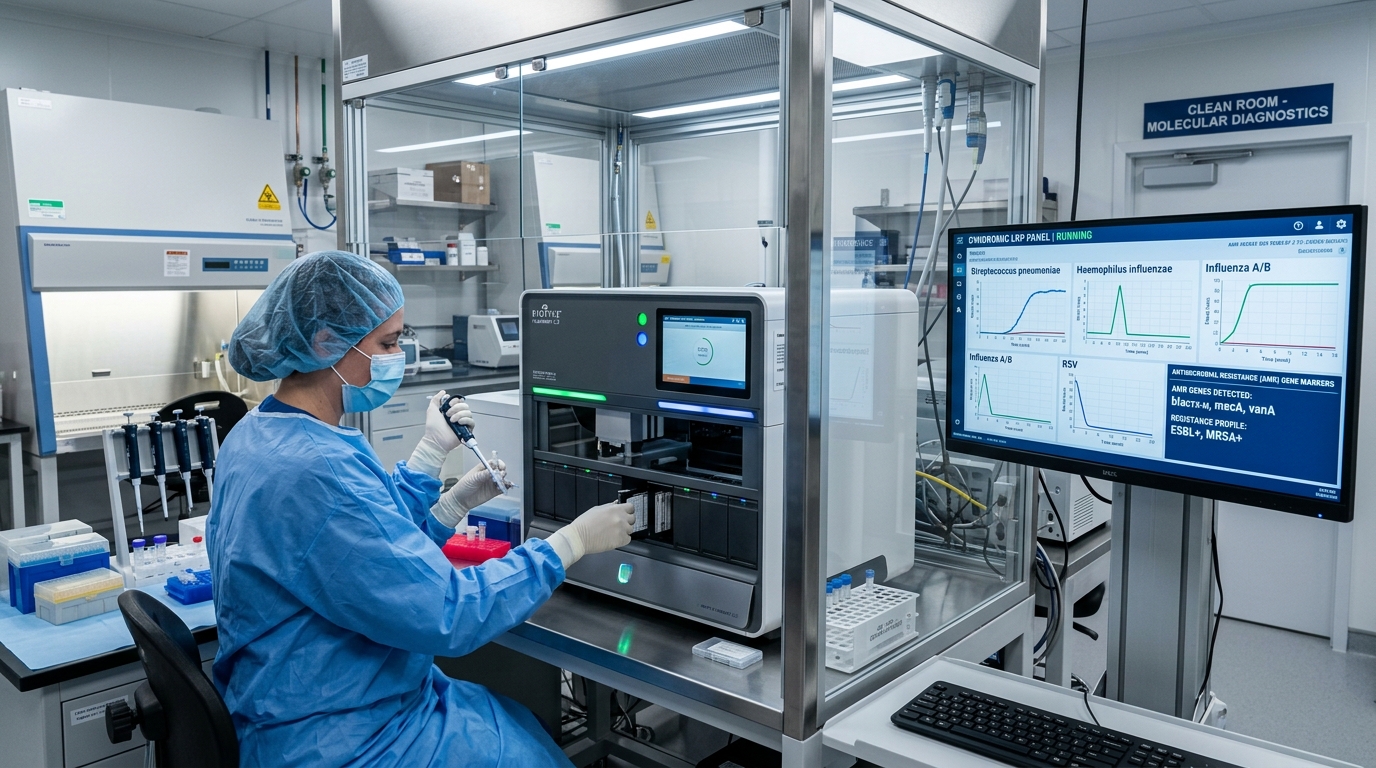
In hospital networks and intensive care departments throughout Dubai, Abu Dhabi, and the wider UAE, investing in advanced molecular AMR detection transforms sepsis management and reduces multidrug-resistant outbreaks. Sourcing certified professional molecular diagnostic and PCR solutions in Dubai ensures hospital laboratories deploy platforms meeting international accreditation standards.
The Critical Care Diagnostic Challenge: Time-to-Appropriate Therapy
In severe pneumonia and respiratory failure in the ICU, every hour of delay in administering effective antimicrobial therapy increases mortality by 7.6%. However, empiric broad-spectrum overprescription drives collateral damage:
- The Empiric Dilemma: Clinicians frequently prescribe Vancomycin plus a Carbapenem (Meropenem) to cover MRSA and extended-spectrum beta-lactamase (ESBL) organisms. Standard sputum culture requires 24 hours for organism growth and an additional 24 to 48 hours for phenotypic AST.
- The Rapid Molecular Solution: Comprehensive syndromic pneumonia panels (e.g., BioFire FilmArray Pneumonia Panel, Curetis Unyvero) directly analyze endotracheal aspirates, bronchoalveolar lavage (BAL), or sputum, reporting organism identity and key AMR genes within 60 to 75 minutes.
- Safe De-Escalation: If a syndromic panel detects Pseudomonas aeruginosa but demonstrates total absence of carbapenemases (KPC, NDM, VIM, OXA-48), clinicians can confidently de-escalate from expensive reserve drugs to standard cefepime or piperacillin-tazobactam days before traditional culture results are finalized.
Essential AMR Gene Portfolio: Mandatory Tender Specifications
When hospital tender committees evaluate syndromic pneumonia panels, the AMR gene target portfolio must address regional resistance epidemiology in the Middle East:
| AMR Genetic Marker | Associated Bacterial Pathogens | Clinical Phenotype Conferred | Mandatory Clinical Action & Stewardship Impact |
|---|---|---|---|
| mecA / mecC | Staphylococcus aureus | Methicillin Resistance (MRSA) | Positive: Continue Vancomycin/Linezolid; Negative: Immediately de-escalate to Cefazolin or Cloxacillin, preventing renal toxicity. |
| blaCTX-M | Enterobacterales (Klebsiella, E. coli, Enterobacter) | Extended-Spectrum Beta-Lactamase (ESBL) | Confers resistance to 3rd generation cephalosporins; indicates carbapenem therapy (Ertapenem or Meropenem). |
| blaKPC | Enterobacterales, Pseudomonas | Class A Carbapenemase | Resistance to all carbapenems; triggers novel beta-lactamase inhibitor combinations: Ceftazidime-Avibactam or Meropenem-Vaborbactam. |
| blaNDM / blaVIM / blaIMP | Enterobacterales, Pseudomonas, Acinetobacter | Class B Metallo-Beta-Lactamases (MBL) | Critical Middle Eastern epidemiology; Ceftazidime-Avibactam is ineffective; requires Aztreonam combined with Ceftazidime-Avibactam or Cefiderocol. |
| blaOXA-48-like | Klebsiella pneumoniae | Class D Carbapenemase | Highly prevalent in Mediterranean and Gulf regions; efficiently inhibited by Ceftazidime-Avibactam. |
The Genotype-Phenotype Disconnect: Critical Stewardship Rules
Procurement committees and laboratory directors must ensure hospital clinicians understand the fundamental distinction between genotypic PCR detection and phenotypic culture:
- Presence of Gene Confirms Resistance: If a syndromic panel detects blaKPC or mecA, the organism is genetically armed and phenotypic resistance is virtually certain. Clinicians must avoid the corresponding antibiotic classes.
- Absence of Gene Does Not Guarantee 100% Susceptibility: In non-fermenting Gram-negative bacilli (such as Pseudomonas aeruginosa and Acinetobacter baumannii), carbapenem resistance can be driven by non-enzymatic mechanisms: outer membrane porin loss (e.g., OprD down-regulation) and active multidrug efflux pump upregulation. These mechanisms are not detected by AMR gene PCR. Traditional phenotypic culture remains indispensable as a confirmatory baseline.
- The Attribution Challenge: In polymicrobial specimens where two Gram-negative organisms are detected alongside one AMR gene (e.g., Klebsiella pneumoniae + Pseudomonas aeruginosa + blaNDM), the molecular panel cannot distinguish which specific bacterium harbors the resistance plasmid. Clinicians must treat both organisms as potentially resistant until culture confirmation.
Semi-Quantitative Genomic Binning: Colonization vs True Infection
A persistent limitation of traditional qualitative respiratory PCR was detecting trace bacterial DNA representing harmless upper airway colonization. Modern pneumonia panels overcome this hurdle through semi-quantitative reporting:
The analyzer reports bacterial target concentrations in logarithmic bins: 104, 105, 106, or ≥ 107 genomic copies/mL. Under clinical microbiology guidelines, lower respiratory tract bacterial concentrations ≥ 106 copies/mL correlate strongly with true clinical pneumonia and purulent tissue invasion, whereas low-titer detections (≤ 104 copies/mL) frequently reflect airway colonization, discouraging unnecessary antibiotic escalation.
Tender Specifications Checklist for UAE Healthcare Tenders
Hospital procurement officers in the UAE should require competing vendors to meet these four non-negotiable specifications:
- “The syndromic assay must be fully automated, closed-cartridge, requiring < 5 minutes hands-on time with complete turnaround < 75 minutes.”
- “The AMR portfolio must co-detect Class A, Class B (MBL: NDM, VIM, IMP), and Class D (OXA-48) carbapenemases alongside ESBL CTX-M and MRSA mecA/C.”
- “The platform must hold CE-IVD (EU IVDR) and/or US FDA clearance specifically for lower respiratory tract specimens (BAL, endotracheal aspirates, and sputum).”
- “The system must offer seamless bidirectional LIS integration via HL7/FHIR with automatic flagging of critical AMR resistance genes directly into the ICU electronic chart.”
Frequently Asked Questions (FAQ)
Can a syndromic pneumonia PCR panel replace traditional sputum culture?
No. While the syndromic panel provides rapid guidance within 1 hour, standard bacterial culture and phenotypic AST remain mandatory to: (1) verify minimum inhibitory concentrations (MICs), (2) detect rare bacterial pathogens not covered on the panel, and (3) identify non-enzymatic resistance mechanisms.
Why are metallo-beta-lactamases (NDM) so critical in UAE hospital tenders?
Due to extensive international travel and medical tourism, the Middle East represents a key epidemiological region for NDM (New Delhi metallo-beta-lactamase) producers. Standard first-line carbapenemase inhibitors fail against NDM, making rapid identification critical for patient survival and hospital infection control isolation.
What specimen type provides the highest diagnostic accuracy for pneumonia panels?
Bronchoalveolar lavage (BAL) and mini-BAL provide the cleanest specimen with the lowest salivary contamination. Endotracheal aspirates (ETA) in mechanically ventilated patients also exhibit high clinical concordance.
Authoritative Clinical References
- Infectious Diseases Society of America (IDSA) & ATS – Diagnosis and Treatment of Adults with Community-Acquired Pneumonia
- World Health Organization – Diagnostic Stewardship: A Guide to Implementation in Antimicrobial Resistance
- European Union – Regulation (EU) 2017/746 on In Vitro Diagnostic Medical Devices (IVDR)