
HIV Fourth Generation Test Explained: p24 Antigen vs Antibodies, 14–45 Day Window Periods & Dubai Confidential Testing Protocols
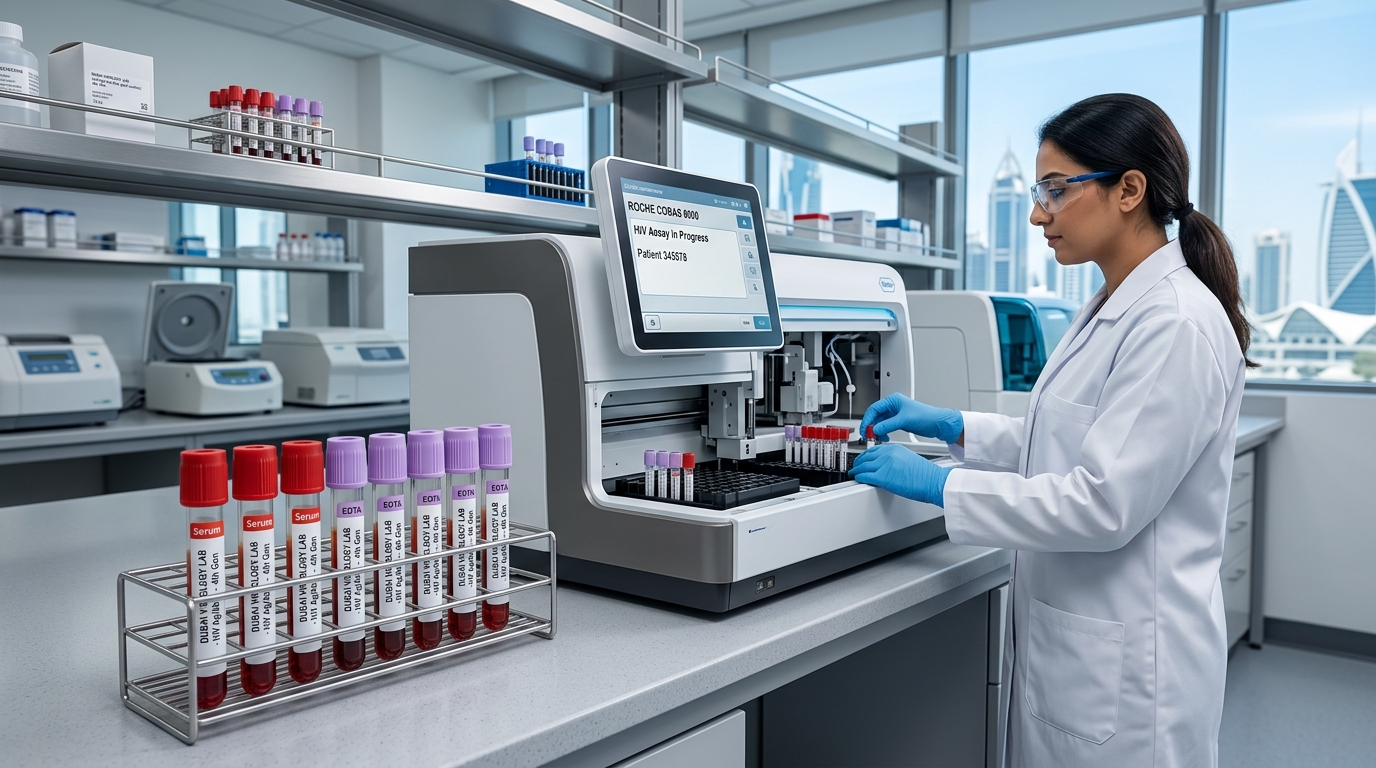
In modern polyclinics and diagnostic centers across Dubai, Abu Dhabi, and the wider UAE, early retroviral testing preserves immune health. Booking confidential and comprehensive sexual health testing packages in Dubai ensures patients access certified 4th generation laboratory immunoassays interpreted by licensed clinicians with complete privacy.
The Biological Breakthrough: Why p24 Antigen Matters
To appreciate how 4th generation testing transformed diagnostics, clinicians must contrast viral kinetics with the host immune response:
- The Acute Eclipse Phase (Day 0 to 10): Following mucosal exposure, HIV binds to dendritic cells and CD4+ T-lymphocytes, establishing systemic replication in regional lymph nodes. During this first 10 days, no viral markers (RNA, antigen, or antibody) are detectable in peripheral blood.
- p24 Antigen Surge (Day 14 to 28): As HIV replication explodes exponentially, billions of viral particles bud from CD4+ cells into the bloodstream. The viral cylindrical capsid shell is composed of thousands of copies of the p24 structural protein. Blood concentrations of soluble free p24 antigen spike dramatically, reaching easily detectable levels between 14 and 20 days post-exposure.
- Seroconversion & Antibody Emergence (Day 21 to 45): The host adaptive immune system responds to massive viremia by producing specific IgM (around Day 21) followed by high-affinity IgG antibodies (around Day 28–35). As antibodies proliferate, they bind directly to free p24 antigens, forming antigen-antibody immune complexes that clear free p24 from the serum.
- The 4th Generation Advantage: Because 4th generation assays detect both the early viral protein (p24) before antibodies exist AND the permanent antibodies (IgM/IgG) after p24 is cleared, they ensure continuous, uninterrupted diagnostic detection across all post-exposure phases!
Generational Evolution of HIV Diagnostic Technology
Understanding assay generations clarifies why older tests generated false reassurance:
| Assay Generation | Biological Target Detected | Diagnostic Window Period | Clinical Practice Assessment |
|---|---|---|---|
| 1st Generation (1985) | Crude viral lysate IgG antibodies | 8 to 12 Weeks (60–90 days) | Obsolete. High false-positive rates due to impure cellular proteins. |
| 2nd Generation (Early 1990s) | Recombinant / Synthetic peptide IgG antibodies | 6 to 8 Weeks (42–56 days) | Obsolete. Improved specificity, but missed early acute infection. |
| 3rd Generation (Late 1990s) | HIV-1/2 IgM and IgG antibodies (Sandwich EIA) | 3 to 4 Weeks (21–28 days) | Detects early IgM; still utilized in some rapid fingerstick lateral flow tests. |
| 4th Generation (2010–Present) | HIV-1 p24 Antigen + HIV-1/2 IgM & IgG Antibodies | 14 to 45 Days (Lab draw conclusive at 45 days) | International Gold Standard. Detects acute primary HIV weeks before 3rd gen tests. |
| 5th Generation (Multiplex) | Separate, discrete reporting of p24, HIV-1 Ab, and HIV-2 Ab | 14 to 45 Days | Multiplex bead-based; provides differential readouts from a single tube. |
The Diagnostic Window Period & Conclusive Timing Rules
Clinicians must provide clear, scientifically grounded counseling regarding post-exposure testing timelines:
- The 14-Day Earliest Screening Threshold: A 4th generation venous blood test performed at 14 days will detect approximately 50% to 60% of all acute HIV infections due to the early p24 antigen surge. If negative, it provides early reassurance but is not conclusive.
- The 28-Day High Confidence Milestone: By Day 28 (4 weeks post-exposure), over 95% of infected individuals will test reactive on 4th generation venous blood testing.
- The 45-Day Definitive Conclusive Rule: Under CDC and BHIVA guidelines, a negative 4th generation laboratory venous blood test performed 45 days or more post-exposure is clinically 100% conclusive, ruling out HIV infection completely. No further testing is required unless subsequent exposures occurred.
- Rapid Fingerstick vs Venous Blood: Point-of-care rapid fingerstick 4th generation tests require a slightly longer window (up to 90 days for absolute conclusiveness) because fingerstick capillary blood has a lower analytical limit of detection for p24 antigen than central laboratory venous serum analyzers.
The CDC Recommended HIV Diagnostic Algorithm
When an initial 4th generation screen is reactive, laboratories must execute a standardized reflexive confirmatory cascade:
- Step 1: Initial 4th Gen Screen is Reactive:
The analyzer detects p24 antigen, HIV antibodies, or both. The specimen is immediately routed to Step 2.
- Step 2: HIV-1/HIV-2 Antibody Differentiation Immunoassay:
A rapid supplemental cartridge (e.g., Geenius HIV 1/2) differentiates whether antibodies are specific to HIV-1 or HIV-2. (a) If reactive for HIV-1, HIV-1 infection is confirmed. (b) If reactive for HIV-2, HIV-2 infection is confirmed. (c) If reactive for both, dual infection is diagnosed.
- Step 3: Reflex Qualitative/Quantitative HIV-1 RNA PCR:
If the antibody differentiation test is Negative or Indeterminate, an immediate reflex HIV-1 RNA PCR must be performed. (a) If RNA is Detected, this confirms Acute Primary HIV-1 Infection (where p24 antigen was positive but the patient has not yet developed detectable mature antibodies). (b) If RNA is Not Detected, the initial 4th generation screen was a biological false-positive screen.
Post-Exposure Prophylaxis (PEP) & Testing Protocols
For individuals presenting within 72 hours of potential HIV exposure, emergency Post-Exposure Prophylaxis (PEP) is vital:
- 72-Hour Golden Window: PEP consists of a 28-day course of three antiretroviral medications (e.g., Tenofovir/Emtricitabine + Dolutegravir or Raltegravir), which must be initiated within 72 hours of exposure to prevent viral integration into the host genome.
- Testing Schedule During and After PEP: Baseline 4th gen test at Day 0 → repeat 4th gen test at completion of PEP (Day 28) → definitive conclusive 4th gen test at 12 weeks (90 days) post-exposure (since antiretrovirals can delay host antibody production).
Frequently Asked Questions (FAQ)
Can acute retroviral syndrome symptoms feel like a bad case of the flu?
Yes. Approximately 50% to 80% of individuals develop Acute Retroviral Syndrome (ARS) within 2 to 4 weeks of infection. Hallmarks include high fever, diffuse maculopapular rash, swollen lymph nodes, severe sore throat, oral ulcers, and night sweats. A 4th generation test during ARS will readily detect soaring p24 antigen.
What causes a false-positive 4th generation HIV test?
False positives are rare (< 0.5%) and can be triggered by: acute autoimmune disease flare-ups (Lupus, rheumatoid factor), multiparity/pregnancy, recent vaccination (influenza, hepatitis B), or severe viral infections (Epstein-Barr virus). The reflex antibody differentiation test and RNA PCR definitively rule out false positives.
What does U=U (Undetectable = Untransmittable) mean in modern HIV care?
Overwhelming clinical evidence from global trials (PARTNER 1 and PARTNER 2) proves that a person living with HIV who takes antiretroviral therapy (ART) and maintains an undetectable viral load (< 50 copies/mL) cannot sexually transmit the virus to HIV-negative partners under any circumstances.