
Point of Care PCR Testing Explained: Microfluidic Cartridges, Rapid Amplification Kinetics & UAE Clinical Triage Applications
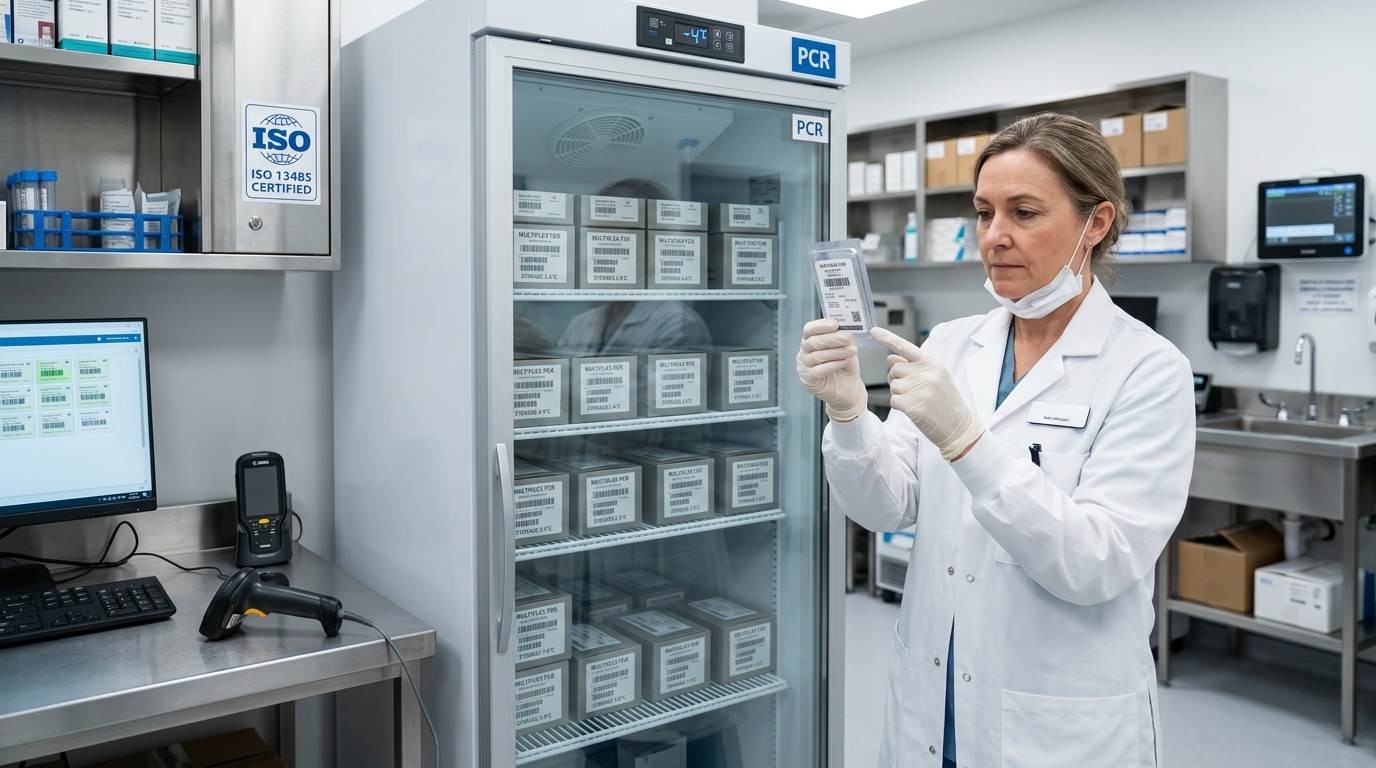
In emergency trauma centers, outpatient clinics, and surgical hubs across Dubai, Abu Dhabi, and the wider UAE, decentralized molecular testing transforms patient care. Procuring certified professional point-of-care PCR and molecular systems in Dubai ensures healthcare providers access validated diagnostic instruments conforming to international performance guidelines.
The Technological Anatomy of a POC PCR Cartridge
How does a compact benchtop analyzer perform complex molecular biology in 20 minutes? The answer lies in microfluidic lab-on-a-chip engineering:
- All-in-One Lyophilized Reagents: The single-use plastic cartridge contains pre-dispensed, freeze-dried (lyophilized) enzyme pellets: reverse transcriptase, Taq DNA polymerase, deoxynucleotide triphosphates (dNTPs), target-specific primers, and fluorescent hydrolysis probes. Lyophilization eliminates the need for -20°C freezer storage, allowing room-temperature kit stability (2°C–28°C).
- Integrated Automated Nucleic Acid Extraction: Upon sample addition (e.g., swab in viral transport medium), internal micro-valves release lysis buffer and ultrasonic sonication waves that physically lyse bacterial cell walls and viral capsids. Nucleic acids bind to magnetic silica beads, are washed to remove enzymatic PCR inhibitors (hemoglobin, mucin), and are eluted in seconds.
- Microfluidic Ultra-Fast Thermal Cycling: Instead of heating and cooling large 50 μL liquid volumes, POC PCR analyzers shuttle microscopic fluid droplets (1 to 5 μL) across micro-fabricated Peltier heating blocks, cycling denaturation (95°C), annealing (55°C), and extension (72°C) in seconds rather than minutes.
- Closed-System Amplicon Containment: Amplification and optical reading occur entirely inside the hermetically sealed cartridge. The cartridge is never opened after cycling, completely eliminating post-PCR aerosol contamination—the traditional bane of central molecular laboratories.
POC PCR vs Rapid Antigen vs Central Laboratory PCR
Clinicians must understand the distinct operational niche occupied by point-of-care molecular platforms:
| Performance Feature | Point-of-Care (POC) PCR | Rapid Antigen Lateral Flow | Central Laboratory Batch PCR |
|---|---|---|---|
| Analytical Sensitivity | Very High (> 98% – 100%) | Moderate (60% – 85%) | Very High (> 98% – 100%) |
| Analytical Specificity | > 99% | > 98% | > 99.5% |
| Turnaround Time (TAT) | 15 to 45 Minutes | 15 Minutes | 6 to 24 Hours (due to batching) |
| Operator Complexity | CLIA-waived / Simple (1 min hands-on) | CLIA-waived / Minimal | High Complexity (licensed molecular staff) |
| Sample Multiplexing | 1 to 22 targets per cartridge | 1 to 2 targets per cassette | Broad syndromic panels (> 30 targets) |
| Instrument Footprint | Compact benchtop toaster-size | Zero (Visual) or small reader | Floor-standing automated robotic track |
Core Clinical Indications & High-Impact Applications
Point-of-care PCR delivers its greatest clinical and economic value in high-acuity time-sensitive clinical scenarios:
- Emergency Department Sepsis & Bloodstream Triage: Sampling directly from newly flagged blood culture bottles to identify Gram-positive/negative bacteria and MRSA (mecA) in 1 hour, enabling immediate targeted antibiotic de-escalation 40 hours before culture AST.
- Pre-Operative Urgent Surgical Clearance: In trauma or emergency cesarean sections, obtaining 20-minute molecular clearance for MRSA, COVID-19, or Group B Streptococcus (GBS) prevents catastrophic hospital transmission and surgical site infections.
- Respiratory Viral Multiplexing in Winter Triage: Differentiating Influenza A, Influenza B, RSV, and SARS-CoV-2 from a single nasal swab within 20 minutes in the pediatric emergency room allows clinicians to start oral Tamiflu or withhold unnecessary antibiotics on the spot.
- Urgent Care Sexually Transmitted Infections: Same-visit diagnosis and curative treatment of Chlamydia trachomatis, Neisseria gonorrhoeae, and Trichomonas vaginalis eliminates patient loss-to-follow-up and prevents community transmission.
Quality Governance & Digital Connectivity
Operating decentralized molecular analyzers requires robust quality management systems:
- Internal Process Controls (IPC): Every commercial cartridge includes an internal control (e.g., human beta-globin gene or armored RNA target) that co-amplifies with the patient sample. If the sample contains PCR inhibitors or inadequate epithelial cells, the analyzer automatically flags the test as “Invalid,” preventing false-negative reporting.
- Bidirectional EMR Interfacing: Modern POC PCR platforms connect via HL7/FHIR interfaces to hospital LIS and regional exchanges (Nabidh in Dubai and Malaffi in Abu Dhabi), ensuring instant critical value alerting and automated communicable disease public health reporting.
Multiplexing Capacities & Syndromic Diagnostic Stewardship
The true power of modern point-of-care PCR lies in its ability to execute nested syndromic panels directly at the clinical bedside:
- Broad Syndromic Panel Interrogation: In complex clinical presentations—such as an infant with acute fever and wheezing, or an elderly patient with acute delirium and dyspnea—ordering sequential single-pathogen tests wastes irreplaceable diagnostic time. Nested multiplex POC PCR interrogates up to 20 to 22 pathogens (viral, atypical bacterial, and resistance genes) simultaneously within 45 to 60 minutes from a single sample aliquot.
- Antimicrobial De-Escalation & Pharmacy Savings: Detecting a definitive viral etiology (such as Human Metapneumovirus, Rhinovirus, or RSV) empowers emergency physicians to immediately withhold empiric broad-spectrum intravenous antibiotics. Multicenter hospital trials demonstrate that implementing POC PCR reduces unnecessary antibiotic exposure by 25% to 35% in emergency rooms.
- Emergency Bed Turnaround & Economic ROI: By delivering confirmed molecular results before hospital admission orders are written, POC PCR decreases emergency room dwell time by an average of 1.5 to 2.5 hours, decompressing overcrowded waiting rooms and preventing costly unnecessary hospital admissions.
Frequently Asked Questions (FAQ)
Is point-of-care PCR as accurate as central laboratory RT-PCR?
Yes. Numerous peer-reviewed clinical validation studies confirm that modern POC PCR platforms achieve concordant sensitivity and specificity exceeding 98% to 100% when compared head-to-head with high-throughput central laboratory molecular platforms.
What is the difference between Real-Time PCR and Isothermal Amplification (NEAR/LAMP)?
Real-Time PCR utilizes rapid thermal cycling (heating and cooling cycles) to replicate DNA. Isothermal amplification (such as Nicking Enzyme Amplification Reaction [NEAR] or Loop-Mediated Isothermal Amplification [LAMP]) amplifies nucleic acids at a single constant temperature (typically 55°C–65°C), delivering faster results (5 to 13 minutes) with slightly lower multiplexing capacity.
Can point-of-care PCR instruments be operated by non-laboratory personnel?
Yes. Most point-of-care PCR platforms are classified as “CLIA-waived” or low-complexity IVD devices, engineered with fool-proof cartridge loading and automated barcode scanning that allows certified emergency room nurses and clinical technicians to operate them safely following structured training.
Authoritative Clinical References
- Infectious Diseases Society of America (IDSA) – Guidelines for the Implementation of Rapid Molecular Point-of-Care Testing
- Clinical and Laboratory Standards Institute (CLSI) – POCT07: Quality Management in Point-of-Care Testing
- World Health Organization (WHO) – Diagnostic Landscape: Molecular Point-of-Care Assays for Infectious Disease