
HSV-1 vs HSV-2: What Is the Difference? Glycoprotein G Serology, Viral Shedding, Transmission & Dubai Clinical Guidelines
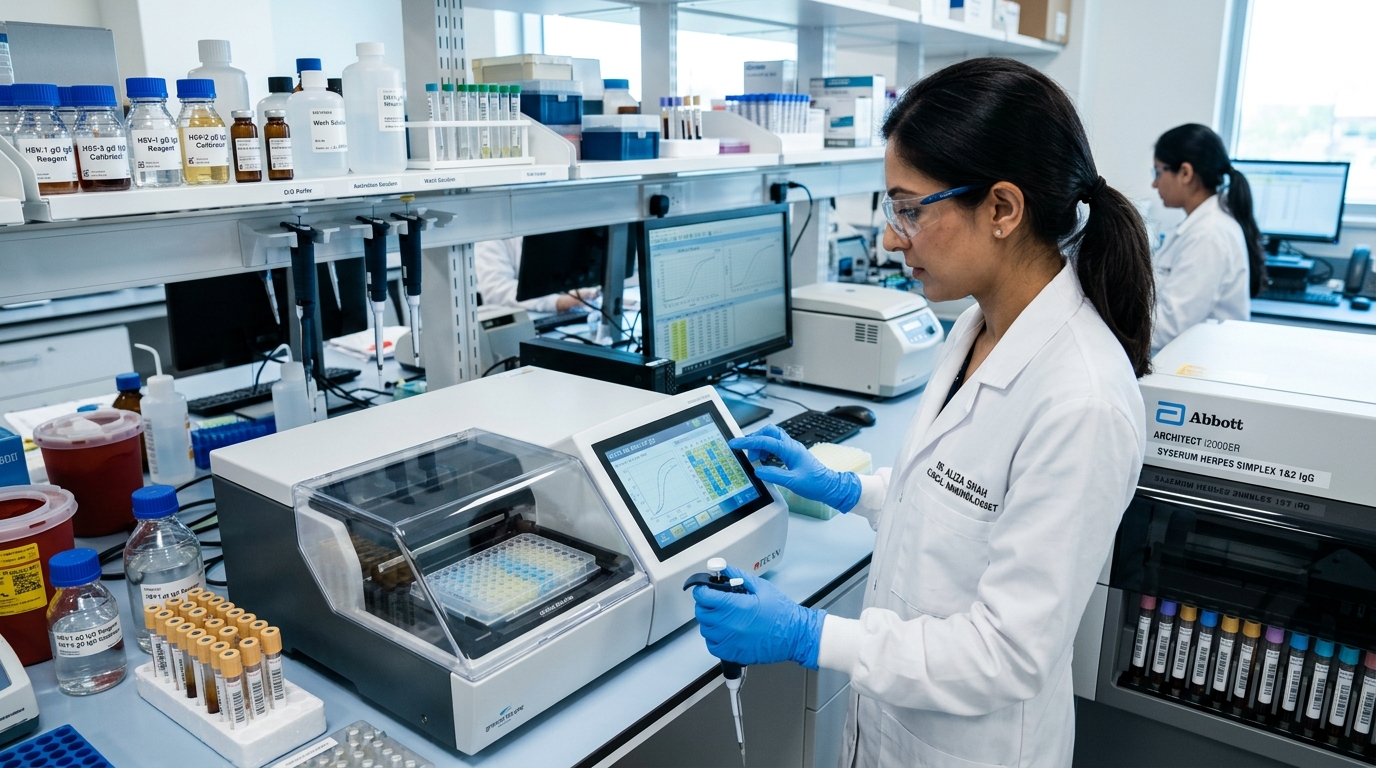
In modern multi-specialty polyclinics across Dubai and Abu Dhabi, accurate viral differentiation empowers informed lifestyle and reproductive decisions. Explore confidential sexual health and STI testing panels in Dubai offering certified Type-Specific Glycoprotein G (gG-1 and gG-2) chemiluminescent immunoassays and lesion real-time PCR swabs interpreted under strict medical privacy.
Viral Structure, Latency and Neurological Tropism
To understand why HSV-1 and HSV-2 behave differently in the human host, clinicians must examine their cellular life cycles and sites of latency:
- Viral Architecture: Both HSV-1 and HSV-2 consist of a large linear, double-stranded DNA genome encased within an icosahedral nucleocapsid, surrounded by an amorphous protein tegument and an outer lipid envelope embedded with at least 11 viral glycoproteins (gB, gC, gD, gE, gG, gH, gI, gK, gL, gM, gN).
- Primary Mucosal Inoculation: Infection begins when viral envelope glycoproteins bind to cell surface receptors (heparan sulfate and nectin-1) on mucosal or abraded epidermal surfaces. The virus replicates actively in squamous epithelial cells, producing ballooning degeneration, intraepithelial vesicle formation, and localized cellular necrosis.
- Retrograde Axonal Transport to Sensory Ganglia: Progeny virions enter unmyelinated sensory nerve endings and travel via retrograde axonal transport along microtubules to sensory neuronal cell bodies.
- HSV-1 Neurological Niche: Exhibits a strong affinity for the Trigeminal Nerve Ganglia (CN V), establishing permanent genomic latency in sensory nuclei that innervate the lips, oral cavity, face, and ocular tissues.
- HSV-2 Neurological Niche: Exhibits an overwhelming preference for the Sacral Nerve Ganglia (S2–S5), establishing lifelong latency in neuronal clusters that provide sensory innervation to the external genitalia, perineum, perianal region, and thighs.
- Episomal Latency & Anterograde Reactivation: Within sensory neurons, viral DNA circularizes into a non-integrated episome. The viral genome remains quiescent, expressing only Latency-Associated Transcripts (LATs). Under physical, emotional, or immunological triggers (fever, UV light exposure, tissue trauma, immunosuppression, hormonal shifts), the virus reactivates, synthesizes structural proteins, and travels via anterograde axonal transport back to the peripheral cutaneous site, resulting in recurrent lesions or asymptomatic viral shedding.
Comprehensive Comparison: HSV-1 vs HSV-2
The immunological, virological, anatomical, and epidemiological divergence between HSV-1 and HSV-2 is presented in the clinical reference table below:
| Biological & Clinical Parameter | Herpes Simplex Virus Type 1 (HSV-1) | Herpes Simplex Virus Type 2 (HSV-2) |
|---|---|---|
| Primary Site of Latency | Trigeminal Ganglion (CN V) | Sacral Ganglia (S2, S3, S4, S5) |
| Classical Clinical Manifestation | Herpes labialis (“cold sores” / fever blisters), gingivostomatitis, herpetic keratitis | Herpes genitalis (vesicular, ulcerative eruptions of the vulva, penis, cervix, perianal skin) |
| Genital Infection Frequency | Causes >50% to 60% of new primary genital herpes cases in young adults (acquired via oral-to-genital transmission) | Causes >90% of chronic, recurrent genital herpes worldwide |
| Genital Recurrence Frequency | Infrequent recurrence in genital tract (Average 0.5 to 1 episode per year); declines significantly over time | Frequent recurrence in genital tract (Average 4 to 6+ episodes per year); persistent over decades |
| Asymptomatic Genital Shedding | Low genital shedding rates (shedding occurs on <3% to 5% of days post-infection) | High genital shedding rates (shedding occurs on 15% to 25% of days in first year, even without visible lesions!) |
| Oral Recurrence Frequency | Frequent oral recurrences (reactivates readily from trigeminal home base) | Extremely rare in oral cavity; oral HSV-2 essentially never recurs clinically |
| Global Sero-Prevalence | Very High (>65% of global population aged 0–49 years) | Moderate (~13% of global population aged 15–49 years) |
| Diagnostic Type-Specific Target | Glycoprotein G-1 (gG-1) on serology; specific primer targets on real-time PCR | Glycoprotein G-2 (gG-2) on serology; specific primer targets on real-time PCR |
The Changing Epidemiology of Genital Herpes
In modern clinical practice across Dubai and international healthcare hubs, clinicians must recognize a profound epidemiological shift:
- The Rise of Genital HSV-1: Historically, genital herpes was attributed almost exclusively to HSV-2, while HSV-1 was considered a harmless childhood oral infection. Today, improved childhood hygiene in urban environments has reduced childhood HSV-1 acquisition. Consequently, young adults reach sexual maturity seronegative for HSV-1. When engaging in consensual oral-genital contact (fellatio, cunnilingus), oral shedding of HSV-1 from an asymptomatic partner inoculates the partner’s genital tract.
- Clinical Significance for Counseling: Determining whether a first-episode genital herpes outbreak is caused by HSV-1 or HSV-2 is of monumental clinical and psychological importance:
- If Genital HSV-1 is Confirmed: Clinicians can provide profound reassurance. Genital HSV-1 has a very low propensity to recur from sacral ganglia, shedding occurs rarely, and long-term transmission to future sexual partners is dramatically lower than HSV-2.
- If Genital HSV-2 is Confirmed: Patient requires comprehensive counseling regarding long-term recurrence patterns, higher rates of asymptomatic subclinical shedding, transmission prevention strategies, and daily suppressive antiviral therapy.
Diagnostic Modalities: Lesion PCR vs Type-Specific Serology
Accurate differentiation requires selecting the correct laboratory methodology based on clinical presentation:
- 1. Lesion Swab Real-Time PCR (The Gold Standard for Active Lesions):
- Indications: Any patient presenting with active vesicles, ulcers, pustules, or erosions.
- Performance: Real-time PCR boasts >98% sensitivity and near 100% specificity. It is 3 to 5 times more sensitive than traditional viral cell culture and readily distinguishes between HSV-1 and HSV-2 DNA down to single-digit viral copy numbers.
- Collection Technique: A sterile Dacron or flocked synthetic swab is firmly rubbed against the base of an unroofed vesicle or moist ulcer bed and placed in Universal/Viral Transport Medium (UTM/VTM).
- 2. Type-Specific Glycoprotein G (gG) Serology (The Blood Test):
- The Crucial Rule: Standard older “crude antigen” IgM/IgG tests cross-react extensively between HSV-1 and HSV-2, generating useless clinical results. Accurate serological testing requires Type-Specific Immunoassays (such as ImmunoCAP or Diasorin LIAISON) that detect antibodies to Glycoprotein G-1 (gG-1) and Glycoprotein G-2 (gG-2), which are structurally unique to each virus!
- The Window Period Constraint: Host IgG antibodies to glycoprotein G take 6 to 12 weeks (up to 16 weeks) to develop following primary infection. Testing blood in the first 2 to 3 weeks of a first outbreak will yield a negative IgG result!
- Why IgM Blood Testing is NOT Recommended: CDC, BHIVA, and international guidelines explicitly advise against ordering HSV IgM antibodies. HSV IgM tests have high false-positive rates, cannot distinguish between HSV-1 and HSV-2, and can turn positive during recurrent episodes or non-herpetic infections.
Therapeutic Management and Antiviral Strategies
While no pharmacological agent eradicates the latent viral episome from sensory ganglia, oral nucleoside analogs provide potent symptom and transmission control:
- Primary First-Episode Regimens:
- Valacyclovir (Valtrex): 1,000 mg orally twice daily for 7 to 10 days. (Preferred due to superior oral bioavailability and twice-daily dosing).
- Acyclovir (Zovirax): 400 mg orally three times daily (or 200 mg 5 times daily) for 7 to 10 days.
- Famciclovir (Famvir): 250 mg orally three times daily for 7 to 10 days.
- Episodic Recurrence Therapy: Initiated during the prodromal phase (tingling, pruritus, localized neuralgia) before blisters appear: Valacyclovir 500 mg BID for 3 days or 1,000 mg once daily for 5 days.
- Daily Suppressive Therapy (For HSV-2 or Frequent Recurrences):
- Patients experiencing ≥6 outbreaks per year, or those seeking to minimize transmission to seronegative sexual partners, benefit from daily suppressive therapy: Valacyclovir 500 mg to 1,000 mg once daily.
- Daily suppressive Valacyclovir reduces clinical recurrence frequency by >75% to 80% and reduces the risk of sexual transmission of HSV-2 by approximately 50%. When combined with consistent latex condom use, sexual transmission drops by >70%–80%.
Perinatal HSV Transmission & Neonatal Protection
In pregnant women across Dubai and the UAE, managing genital herpes prevents devastating neonatal herpes:
- Highest Risk (Primary Infection in Third Trimester): If a woman acquires primary genital HSV-1 or HSV-2 in the third trimester of pregnancy, she sheds high titers of virus at delivery and has not yet developed protective transplacental IgG antibodies. The risk of vertical transmission during vaginal delivery is 30% to 50%. A primary outbreak near term is a strict indication for cesarean delivery!
- Lowest Risk (Recurrent Historical HSV): In women with long-standing pre-pregnancy genital herpes, circulating maternal IgG antibodies cross the placenta to protect the fetus. Vertical transmission risk during recurrent delivery is <1% to 3%.
- Routine Obstetric Prophylaxis: All pregnant women with a documented history of genital herpes are initiated on oral Valacyclovir (500 mg BID) starting at 36 weeks gestation through delivery to suppress viral replication, eliminate subclinical shedding, and ensure a safe vaginal delivery without cesarean section.
Frequently Asked Questions (Clinical FAQ)
Can HSV-1 cause genital herpes?
Yes. Today, HSV-1 causes over 50% of all newly diagnosed genital herpes infections in young adults, primarily acquired through oral sex from a partner with oral HSV-1 (even if that partner has no active cold sore at the time of intimate contact). However, genital HSV-1 typically has significantly fewer recurrences and lower shedding rates compared to genital HSV-2.
If I have oral HSV-1, am I protected from getting genital HSV-2?
Having pre-existing antibodies to oral HSV-1 does not prevent you from acquiring HSV-2 if exposed. However, pre-existing HSV-1 immunity often modifies the severity of a newly acquired HSV-2 infection, making the initial outbreak milder or even completely asymptomatic.
Why did my doctor order a Type-Specific Glycoprotein G test instead of a basic herpes test?
Basic non-type-specific herpes blood tests cannot distinguish between antibodies against HSV-1 and HSV-2 because the two viruses share many surface proteins. Only type-specific tests that measure antibodies to Glycoprotein G-1 (for HSV-1) and Glycoprotein G-2 (for HSV-2) can accurately inform you which specific virus you have encountered.
Authoritative Clinical References
- Centers for Disease Control and Prevention (CDC) — Genital Herpes Simplex Virus: CDC STI Treatment Guidelines
- World Health Organization (WHO) — Herpes Simplex Virus: Global Epidemiological Data, Virology, and Diagnostics
- British Association for Sexual Health and HIV (BASHH) — National Guidelines for the Management of Genital Herpes