
Dengue NS1 Rapid Test: What Does It Detect? Non-Structural Protein 1 Kinetics, Combo IgM/IgG & Dubai Travel Medicine
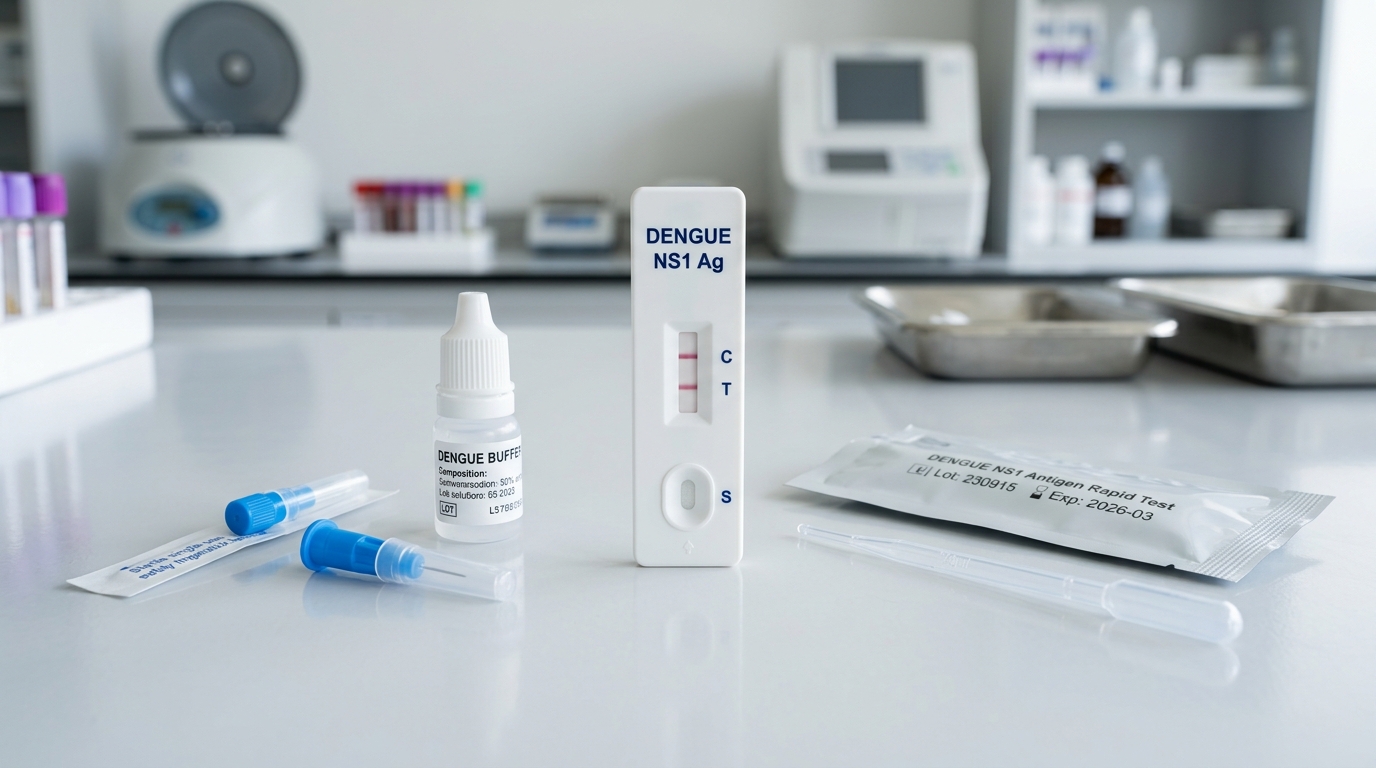
In ambulatory clinics throughout the UAE, immediate tropical pathogen differentiation guides fluid resuscitation and prevents complications. Review our certified CE-IVD rapid test kits and tropical infectious disease panels in Dubai designed for 15-minute point-of-care accuracy, sharp band resolution, and emergency room workflow integration.
The Biochemistry of NS1: What Is Non-Structural Protein 1?
To interpret diagnostic test lines accurately, clinicians must understand the molecular biology of the NS1 biomarker:
- Viral Non-Structural Protein 1 (NS1): Dengue genomic RNA encodes a polyprotein cleaved into three structural proteins (Capsid, Pre-Membrane, Envelope) and seven non-structural proteins (NS1, NS2A, NS2B, NS3, NS4A, NS4B, NS5). NS1 is a 46–50 kilodalton glycoprotein essential for viral RNA replication and immune evasion.
- Secreted Hexameric Form (sNS1): While intracellular NS1 dimerizes to support viral replication complexes within host endoplasmic reticulum, infected cells process and assemble NS1 into an open-barrel soluble hexamer (sNS1). Hexameric NS1 is secreted in massive concentrations directly into the host circulatory system, reaching serum levels up to 15 to 50 µg/mL during the acute viremic phase!
- Endothelial Dysfunction Driver: Secreted NS1 is not merely a passive diagnostic bystander; it binds directly to Toll-like receptor 4 (TLR4) on endothelial cells and disrupts the endothelial glycocalyx layer, driving capillary hyperpermeability, plasma leakage, and the pathophysiology of Severe Dengue / Dengue Hemorrhagic Fever (DHF).
- Circulation Kinetics: Because NS1 is released during active virion synthesis, it appears in peripheral venous blood concurrently with viral RNA on Day 1 of symptom onset and remains detectable throughout the acute febrile phase (Days 1 to 5–9).
Temporal Biomarker Window: NS1 vs IgM vs IgG
The diagnostic window periods of Dengue biomarkers are detailed in the clinical reference table below:
| Diagnostic Biomarker | Biological Target Detected | Optimal Detection Window | Clinical Practice Role |
|---|---|---|---|
| Dengue NS1 Antigen | Secreted viral non-structural glycoprotein hexamer | Days 1 to 5 of Fever (Declines sharply after Day 6–7 as antibodies bind antigen) | Early Acute Infection Confirmed. Detects dengue at first clinic visit; guides immediate platelet monitoring and fluid management. |
| Dengue IgM Antibody | Host primary humoral immune response | Day 5 to Day 60–90 Post-Onset (Peak titers around Day 10–14) | Subacute / Convalescent Infection. Negative in first 4 days of fever; indicates primary infection or recent convalescence. |
| Dengue IgG Antibody | Host secondary / long-term humoral memory | Primary: Appears after Day 14, lasts years. Secondary: Massive immediate spike by Day 2–4! |
Differentiates primary from secondary dengue. High early IgG titer indicates secondary dengue with high risk of severe plasma leakage! |
| Real-Time RT-PCR | Amplified viral genomic RNA | Days 1 to 5 of Fever | Reference gold standard; determines specific viral serotype (DENV-1, 2, 3, 4); requires central laboratory thermocyclers. |
Interpreting Dengue Duo (NS1 + IgM/IgG) Rapid Cassettes
Modern point-of-care kits integrate an NS1 antigen strip and a differential IgM/IgG antibody strip into a single cassette:
- Pattern 1: NS1 Positive (+), IgM Negative (-), IgG Negative (-): Confirms early acute primary Dengue infection (Days 1 to 4 of illness). High viremia is present. Patient must be monitored closely for warning signs of severe plasma leakage!
- Pattern 2: NS1 Positive (+), IgM Positive (+), IgG Negative (-): Indicates mid-acute primary Dengue infection (Days 4 to 8 of illness). Seroconversion is actively underway.
- Pattern 3: NS1 Positive (+) and IgG Positive (+): Indicates acute secondary Dengue infection in a patient previously infected with a different serotype. High Clinical Alert: Secondary infection carries a 15- to 20-fold higher risk of developing Dengue Hemorrhagic Fever (DHF) and Dengue Shock Syndrome (DSS) via Antibody-Dependent Enhancement (ADE)!
- Pattern 4: NS1 Negative (-), IgM Positive (+), IgG Positive/Negative: Indicates subacute or late infection (Day 6+ post-onset). NS1 has been cleared or neutralized by circulating antibodies.
- Pattern 5: All Markers Negative (-): In a patient tested on Day 1 to 2, test may be false-negative if viral load is low. If clinical suspicion remains high (severe fever following travel to Bali, Thailand, India, or Pakistan), repeat test in 48 hours or order viral RT-PCR.
Clinical Red Flags: Identifying Severe Dengue Early
In outpatient clinics in Dubai, early NS1 confirmation must trigger strict patient counseling on warning signs that herald severe disease:
- The Critical Phase (Days 3 to 7 / Defervescence): The greatest medical danger occurs not during high fever, but when the fever abruptly breaks (defervescence). This transition marks the onset of the 24- to 48-hour plasma leakage window.
- Mandatory Emergency Warning Signs:
- Severe, persistent abdominal pain or tenderness.
- Persistent vomiting (≥3 episodes in 24 hours) or inability to tolerate oral fluids.
- Mucosal bleeding (epistaxis, bleeding gums, hematemesis, melena, menorrhagia).
- Lethargy, extreme restlessness, confusion, or postural dizziness.
- Clinical fluid accumulation (pleural effusion on chest ultrasound, ascites).
- Rapid progressive decline in platelet count (<100,000/µL) concurrent with rising hematocrit (>20% increase above baseline), indicating hemoconcentration.
- Outpatient Medication Precaution: Strictly avoid NSAIDs (Ibuprofen, Naproxen, Diclofenac) and Aspirin due to platelet dysfunction and severe gastric hemorrhage risks. Prescribe Paracetamol / Acetaminophen (maximum 3 g/day) for analgesia and antipyresis!
Frequently Asked Questions (Clinical FAQ)
Can the Dengue NS1 test cross-react with other mosquito-borne viruses?
The NS1 antigen test demonstrates outstanding analytical specificity (>98%–99%) and virtually zero cross-reactivity with Malaria, Chikungunya, or Yellow Fever viruses. Minor cross-reactivity can occasionally occur with Zika virus NS1 due to structural homology within the Flavivirus genus; however, in travelers returning from Asia or Africa with acute high fever and thrombocytopenia, a positive NS1 is highly diagnostic of Dengue.
Why did my NS1 test turn negative on Day 8 while I am still feeling sick?
As the human adaptive immune system mounts high-affinity IgM and IgG antibodies (around Days 5 to 7), these antibodies bind to circulating free NS1 glycoproteins, forming immune complexes that mask the antigen from the test strip’s capture antibodies. By Day 8, NS1 becomes undetectable, but Dengue IgM will be strongly positive.
Does a positive NS1 test tell me which of the 4 dengue serotypes I have?
No. Rapid lateral flow NS1 antigen cassettes detect a conserved epitope shared across all four Dengue serotypes (DENV-1, DENV-2, DENV-3, and DENV-4). To identify the specific serotype, specialized molecular real-time RT-PCR testing in a reference laboratory is required.
Authoritative Clinical References
- World Health Organization (WHO) — Dengue and Severe Dengue: Diagnostic Guidelines and Clinical Management
- Centers for Disease Control and Prevention (CDC) — Dengue Clinical Guidance and Diagnostic Testing Strategies
- Infectious Diseases Society of America (IDSA) — Guidelines for the Diagnosis and Management of Vector-Borne Flaviviruses