
When to Test AMH for Fertility: Optimal Timing, Ovarian Reserve Assessment, Age-Stratified Reference Ranges & Dubai IVF Protocols
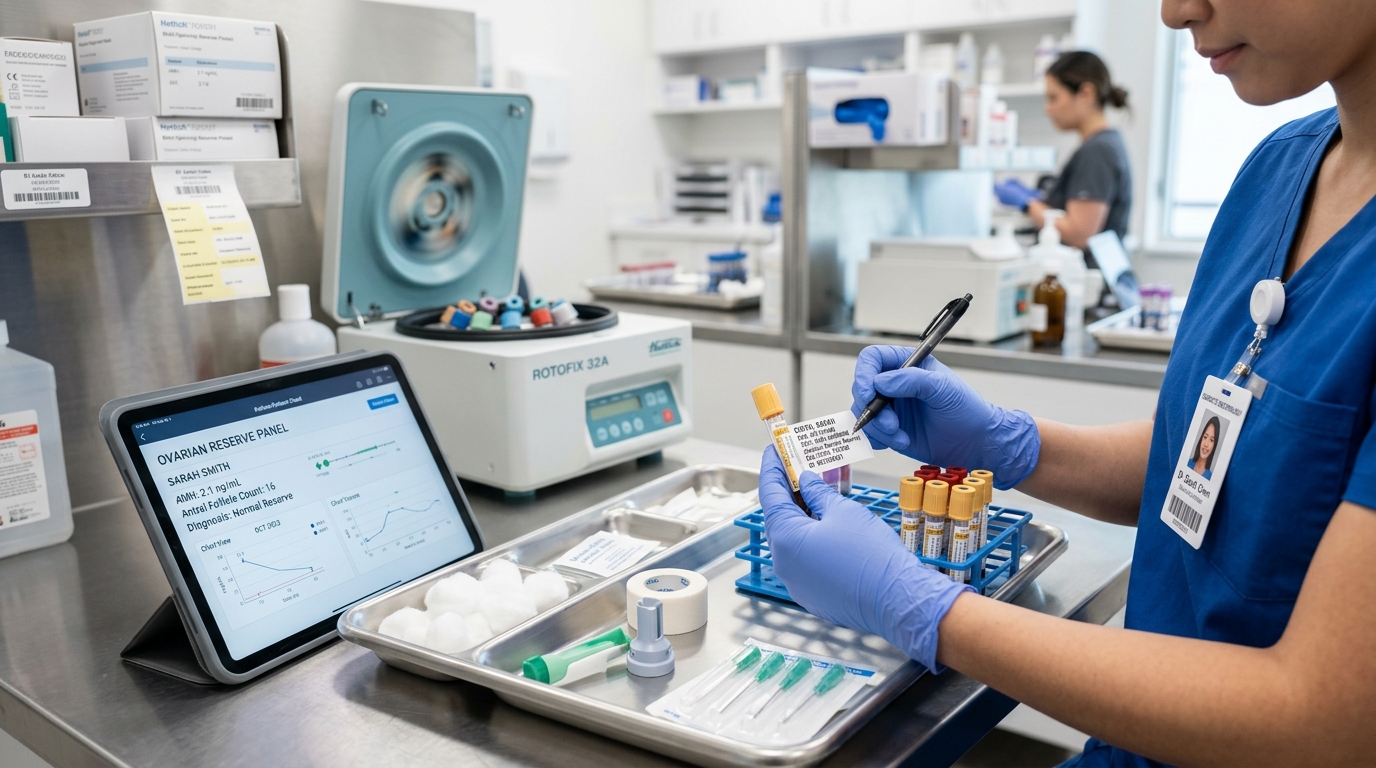
In women’s health centers throughout Dubai and Abu Dhabi, accurate reproductive hormone profiling guides proactive family planning. Explore our certified fertility diagnostic rapid tests and reproductive hormone profiles in Dubai designed for sensitive point-of-care evaluation and clinical endocrinology workflows.
The Primary Timing Rule: Can AMH Be Tested on Any Day of the Cycle?
The single most liberating characteristic of AMH testing for patients and reproductive endocrinologists is its menstrual cycle timing independence:
- Cycle Independence: Conventional ovarian reserve markers—such as basal FSH, Estradiol (E2), and Luteinizing Hormone (LH)—must be drawn strictly on Cycle Day 2, 3, or 4 of spontaneous menses. AMH, by contrast, is secreted continuously by the non-gonadotropin-dependent cohort of small follicles and can be drawn on any day of the menstrual cycle.
- Minor Intra-Cycle Variations: While minor fluctuations of approximately 5% to 10% can occur across the follicular and luteal phases in some women, these subtle shifts do not alter clinical categorization (e.g., from normal reserve to diminished ovarian reserve).
- Convenience and Immediate Scheduling: Patients do not need to wait for their next period or navigate irregular cycle dates; testing can be performed immediately during any routine clinic visit.
Key Clinical Indications: When Should You Order an AMH Blood Test?
Reproductive specialists recommend testing serum AMH under specific clinical circumstances:
| Clinical Indication | Target Patient Population | Diagnostic Goal | Clinical Decision Impact |
|---|---|---|---|
| Proactive Family Planning (>30 Years) | Nulliparous women in their 30s planning future pregnancy | Establish baseline ovarian biological clock vs chronological age | Guides timeline urgency for natural conception vs oocyte cryopreservation (egg freezing). |
| Infertility Evaluation (>6–12 Months) | Couples experiencing difficulty conceiving | Rule out Diminished Ovarian Reserve (DOR) | Prioritizes fast-track referral to assisted reproductive technologies (IUI vs IVF/ICSI). |
| Pre-IVF Controlled Ovarian Stimulation | Patients entering IVF/ICSI stimulation cycles | Predict follicular response and oocyte yield | Determines starting gonadotropin dosages; prevents poor response or Ovarian Hyperstimulation Syndrome (OHSS). |
| Suspected Polycystic Ovary Syndrome (PCOS) | Women with oligo/amenorrhea, hirsutism, or cystic ovaries | Detect pathological follicle pool expansion | High AMH (>4.0–5.0 ng/mL) supports Rotterdam criteria diagnosis and guides insulin-sensitizing therapy. |
| Pre-Oncology Fertility Preservation | Women facing chemotherapy, pelvic radiation, or oophorectomy | Assess baseline reserve prior to gonadotoxic therapy | Guides emergency oocyte or embryo vitrification protocols prior to oncological treatment. |
| Premature Ovarian Insufficiency (POI) | Women <40 years with secondary amenorrhea | Identify early follicular depletion / premature menopause | Confirms ovarian failure alongside elevated FSH (>25–40 mIU/mL); guides hormone replacement therapy (HRT). |
Age-Stratified Reference Ranges and Interpretation
Because AMH levels naturally decline as a woman’s primordial follicle pool depletes toward menopause, serum values must always be interpreted in the context of the patient’s chronological age:
| Patient Age Cohort | Median AMH (ng/mL) | Normal Reference Range (ng/mL) | Diminished Reserve Threshold | High / PCOS Suspicion Threshold |
|---|---|---|---|---|
| 20 – 24 Years | 3.80 ng/mL | 2.00 – 6.50 ng/mL | < 1.50 ng/mL | > 6.50 ng/mL |
| 25 – 29 Years | 3.20 ng/mL | 1.80 – 5.50 ng/mL | < 1.30 ng/mL | > 5.50 ng/mL |
| 30 – 34 Years | 2.50 ng/mL | 1.50 – 4.20 ng/mL | < 1.10 ng/mL | > 4.50 ng/mL |
| 35 – 37 Years | 1.80 ng/mL | 1.00 – 3.00 ng/mL | < 0.90 ng/mL | > 3.50 ng/mL |
| 38 – 40 Years | 1.20 ng/mL | 0.60 – 2.00 ng/mL | < 0.60 ng/mL | > 2.50 ng/mL |
| 41 – 44 Years | 0.50 ng/mL | 0.20 – 1.00 ng/mL | < 0.30 ng/mL | > 1.50 ng/mL |
| ≥ 45 Years | < 0.15 ng/mL | Undetectable – 0.40 ng/mL | < 0.15 ng/mL | N/A |
ng/mL × 7.14 = pmol/L (e.g., 2.0 ng/mL equals 14.28 pmol/L). Always verify the reporting units before clinical counseling.
Physiological Modulators: What Can Temporarily Suppress AMH?
Before diagnosing a patient with Diminished Ovarian Reserve (DOR), clinicians must evaluate physiological and pharmacological factors that cause reversible AMH suppression:
- Combined Oral Contraceptives (COCs): Birth control pills, contraceptive patches, vaginal rings, and Depo-Provera injections suppress pituitary gonadotropins, causing follicular quiescence. Current COC users may show AMH levels artificially suppressed by 20% to 30%! For accurate baseline testing, patients should ideally discontinue hormonal contraception for 2 to 3 spontaneous cycles, or clinical decisions should account for this dampening effect.
- Severe Vitamin D Deficiency: Vitamin D (25-hydroxyvitamin D) acts as an endocrine promoter of the AMH gene promoter. Patients with severe vitamin D deficiency (<20 ng/mL) may exhibit lower circulating AMH levels that rebound following high-dose ergocalciferol or cholecalciferol repletion.
- Recent Ovarian Surgery: Surgical excision of endometriomas (ovarian cystectomy) frequently causes thermal damage or mechanical removal of healthy cortex, causing a temporary or permanent drop in AMH. Testing should be deferred for at least 3 to 6 months post-operatively to evaluate true recovery.
- Body Mass Index (BMI): Women with high BMI (obesity) frequently exhibit hemodilution and altered follicular fluid dynamics, showing slightly lower circulating serum AMH concentrations compared to normal-weight peers with equivalent antral follicle counts.
AMH vs Antral Follicle Count (AFC): The Dual Gold Standard
While serum AMH provides an objective biochemical assessment, reproductive endocrinologists pair it with a transvaginal ultrasound Antral Follicle Count (AFC) performed during the early follicular phase (Days 2–4). AFC enumerates all visible 2–9 mm follicles in both ovaries. High concordance between AMH and AFC confirms reserve status; significant discordance warrants investigation into laboratory assay variance, sonographer subjectivity, or presence of dominant cysts.
Critical Clinical Caveat: Quantity vs Quality
The single most important counseling pearl in reproductive medicine is that AMH measures ovarian egg QUANTITY, not egg QUALITY. A 30-year-old woman with a low AMH of 0.8 ng/mL produces fewer eggs per cycle or during IVF stimulation, but each egg retains the superior genetic euploidy characteristic of her chronological age, offering excellent chances for natural pregnancy. Conversely, a 42-year-old woman with an elevated AMH of 3.5 ng/mL has abundant follicles, but the majority may carry age-related meiotic chromosomal aneuploidies. AMH cannot predict natural monthly fecundity in fertile couples!
Frequently Asked Questions (Clinical FAQ)
Can I get naturally pregnant if my AMH level is low?
Yes, absolutely. A low AMH level indicates that the total ovarian follicle reserve is reduced, meaning you will respond with fewer eggs if undergoing IVF stimulation and may reach menopause earlier. However, as long as you are ovulating regularly and fallopian tubes and sperm parameters are normal, natural monthly conception is fully possible because natural pregnancy requires only one healthy, genetically normal egg.
Can I take an AMH blood test while on birth control pills?
You can take the test, but you must know that oral contraceptive pills suppress ovarian activity and may artificially lower your AMH result by 20% to 30%. If your result is normal or high while on the pill, your reserve is reassuring. If it is low, your doctor will likely recommend discontinuing the pill for 2 months and repeating the test to assess your true unsuppressed baseline.
Do I need to fast before taking an AMH blood test?
No. Fasting is not required for an AMH test. Food intake does not interfere with the circulating concentration of Anti-Müllerian Hormone. The blood draw can be performed at any time of day, with or without meals.
Authoritative Clinical References
- American College of Obstetricians and Gynecologists (ACOG) — Committee Opinion No. 773: Testing for Ovarian Reserve
- European Society of Human Reproduction and Embryology (ESHRE) — Ovarian Stimulation for IVF/ICSI Clinical Guidelines
- American Society for Reproductive Medicine (ASRM) — Diagnostic Evaluation of the Infertile Female Practice Guidelines