
Antimicrobial Stewardship in Hospital Laboratories: Rapid Antibiograms, Diagnostic Protocols & AMR Surveillance
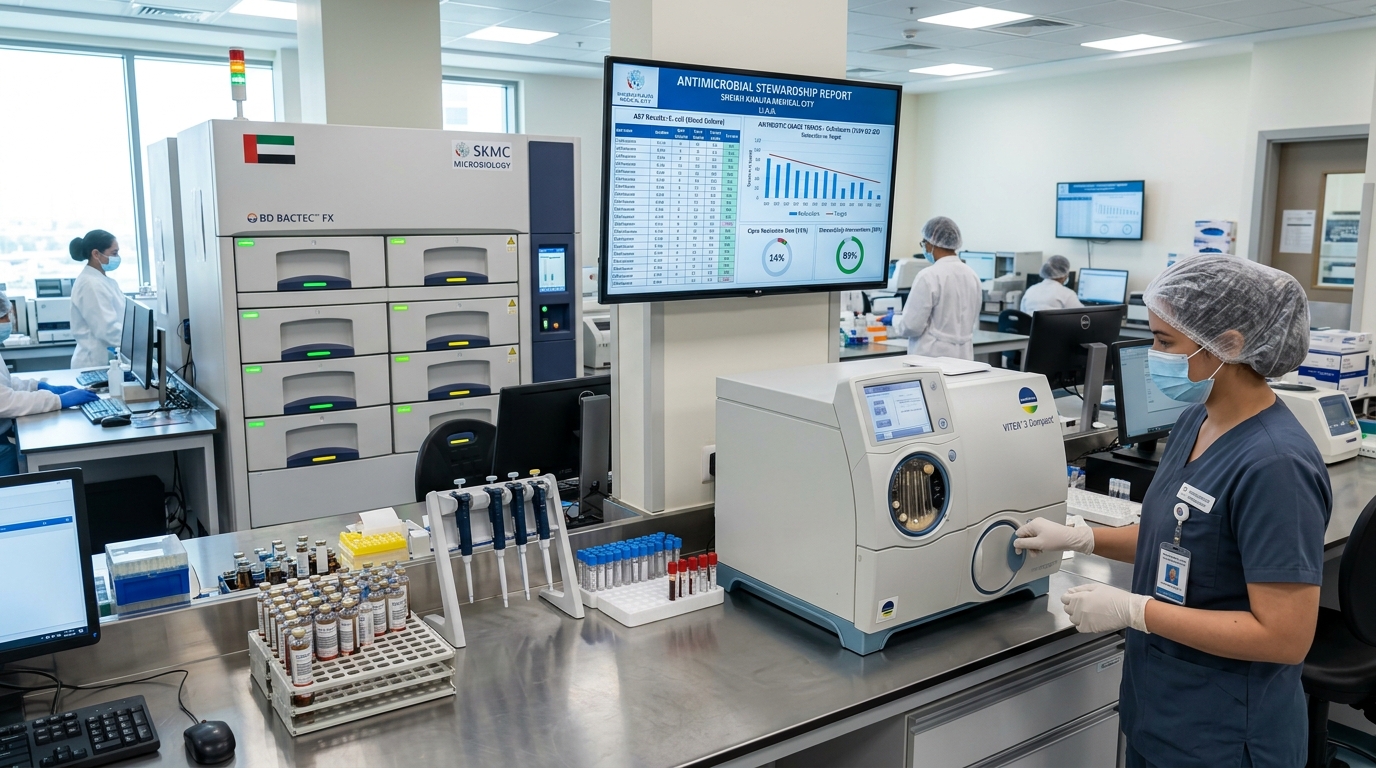
In tertiary care hospitals and intensive care units across Dubai, Abu Dhabi, and the Northern Emirates, sepsis management requires split-second therapeutic decisions. Historically, waiting 48 to 72 hours for standard broth microdilution or disc diffusion susceptibility profiles led to widespread empirical overuse of broad-spectrum carbapenems, vancomycin, and colistin. Modern hospital laboratories equipped with rapid diagnostic point-of-care tools and specialized respiratory rapid diagnostic test cassettes deliver actionable pathogen identification within 1 to 2 hours of culture positivity, preventing kidney toxicity and institutional outbreaks.
The 4 Core Laboratory Stewardship Interventions
The Centers for Disease Control and Prevention (CDC) and College of American Pathologists (CAP) define four foundational interventions led directly by laboratory professionals:
| Laboratory Intervention | Technological Platform | Mechanistic Action | Clinical Stewardship Impact |
|---|---|---|---|
| 1. Rapid Blood Culture Identification (BCID) | Multiplex RT-PCR & Microarray Panels | Direct identification of 24+ bacteria, yeasts, and AMR genes from positive blood culture bottles in 60 min | Reduces time to effective targeted antibiotic therapy by 24 to 36 hours; lowers ICU sepsis mortality |
| 2. MALDI-TOF Mass Spectrometry | Matrix-Assisted Laser Desorption Ionization | Protein mass fingerprinting identifying species from early bacterial colonies in 5 minutes | Replaces 24-hour manual biochemical tests; enables same-day species-guided antibiotic adjustment |
| 3. Selective & Cascade Reporting | Laboratory Information System (LIS) Rule Engines | Suppresses reporting of broad-spectrum reserve agents when first-line narrow agents are fully susceptible | Prevents reflexive prescribing of carbapenems when cefazolin or ampicillin is active |
| 4. Cumulative Hospital Antibiograms | CLSI M39 Statistical Data Analytics | Annual statistical compilation of local institutional bacterial susceptibility percentages | Guides empirical antibiotic formulary choices tailored specifically to local resistance patterns |
Selective Cascade Reporting: Guiding Prescriber Behavior
One of the most powerful behavioral stewardship levers within the laboratory is Selective (Cascade) Reporting of antimicrobial susceptibility results:
- The Unintended Consequence of Full Reporting: When a laboratory report displays sensitivity to every tested drug (e.g., Ampicillin: Sensitive, Ceftriaxone: Sensitive, Meropenem: Sensitive), treating clinicians frequently choose Meropenem under the false assumption that “stronger is better.”
- Tiered Reporting Architecture: Under CLSI M100 guidelines, antibiotics are divided into Tier 1 (narrow-spectrum, first-line agents like ampicillin, cefazolin, amoxicillin-clavulanate) and Tier 2 (broad-spectrum agents like cefepime, piperacillin-tazobactam, and carbapenems).
- Automated LIS Suppression Rules: If Tier 1 narrow-spectrum antibiotics are susceptible, the laboratory’s computer system automatically conceals and suppresses Tier 2 and Tier 3 reserve drugs from the electronic medical record. Tier 2 agents are unmasked only if the isolate is resistant to all first-line drugs or if the patient is infected at a privileged anatomical site (e.g., central nervous system meningitis).
Rapid Blood Culture Diagnostics: Saving Lives in Sepsis
In bloodstream infections, every hour of delayed targeted antimicrobial therapy increases septic shock mortality by approximately 7.6%. Hospital microbiology laboratories transform sepsis outcomes using a two-stage rapid workflow:
Stage 1: Immediate Gram Stain Critical Call (0 to 15 Minutes)
The moment an automated blood culture bottle flags positive, the laboratory performs an immediate Gram stain and phones the critical result directly to the treating physician and clinical pharmacist champion (e.g., “Gram-positive cocci in clusters” vs. “Gram-negative bacilli”).
Stage 2: Direct Molecular Multiplex PCR (60 to 75 Minutes)
An aliquot from the positive bottle is loaded directly into an automated syndromic blood culture panel without waiting for agar subculture. Within one hour, the panel provides definitive species identification and detects critical resistance genes:
- mecA/mecC Detection in S. aureus: If positive, confirms MRSA, mandating vancomycin or daptomycin. If negative, confirms MSSA, triggering immediate de-escalation to high-dose cefazolin or oxacillin, which provides superior bactericidal killing and avoids vancomycin nephrotoxicity.
- vanA/vanB Detection in Enterococcus: Instantly detects Vancomycin-Resistant Enterococcus (VRE), prompting immediate switch to linezolid or daptomycin and initiating hospital infection control contact isolation.
- Carbapenemase Genes (KPC, NDM, OXA-48): In Gram-negative sepsis, early identification directs selection of novel beta-lactamase inhibitor combinations (e.g., Ceftazidime-Avibactam) within 2 hours of bacteremia detection.
Developing Annual Hospital Antibiograms (CLSI M39 Guidelines)
Hospital laboratories analyze all microbiological isolates annually to generate the hospital’s official antibiogram:
- First-Isolate Principle: To avoid statistical skewing, only the first isolate of a given species per patient per 365-day period is included, preventing repeat cultures from long-stay ICU patients from artificially inflating resistance rates.
- Statistical Minimums: Guidelines require a minimum of 30 isolates for a species to be included in the public antibiogram table, ensuring statistical validity.
- Unit-Specific Stratification: Modern laboratories generate dedicated antibiograms stratified by clinical unit (e.g., Medical ICU vs. Pediatric Ward vs. Outpatient Clinic), recognizing that pathogen resistance profiles vary dramatically across hospital departments. Complementary frontline tools like Strep A rapid diagnostic cassettes assist out-of-hospital triage.
Frequently Asked Questions (FAQs)
What is selective or cascade reporting in a hospital laboratory?
Selective or cascade reporting is a laboratory policy where broad-spectrum, reserve antibiotics are hidden from the final medical report if older, narrower-spectrum antibiotics are effective against the bacteria. This prevents doctors from reflexively prescribing unnecessarily powerful antibiotics.
How does MALDI-TOF technology help antimicrobial stewardship?
MALDI-TOF mass spectrometry identifies bacterial and fungal species in 5 minutes using protein mass spectrometry, compared to 24 to 48 hours with older chemical testing. Early species identification allows clinicians to narrow or adjust antibiotic therapy a full day earlier.
What is an antibiogram and why is it updated annually?
An antibiogram is an institutional report that summarizes the percentage of local bacteria susceptible to various antibiotics over a 12-month period. It is updated annually because bacterial resistance mutations evolve constantly, and doctors rely on current data to choose the most effective empiric treatments.
Scientific References & Clinical Guidelines
- Clinical and Laboratory Standards Institute (CLSI). M39: Analysis and Presentation of Cumulative Antimicrobial Susceptibility Test Data. 5th ed. CLSI Guideline. 2022; Wayne, PA.
- Clinical Infectious Diseases. Implementing an Antibiotic Stewardship Program: Guidelines by the Infectious Diseases Society of America and the Society for Healthcare Epidemiology of America. Clin Infect Dis. 2016;62(10):e51-e77.
- Journal of Clinical Microbiology. Diagnostic Stewardship in Clinical Microbiology: A Comprehensive Review of Strategies to Optimize Antimicrobial Use. J Clin Microbiol. 2020;58(6):e00224-20.