
Antimicrobial Stewardship in Outpatient Clinics: How Rapid Testing Reduces Antibiotic Misuse
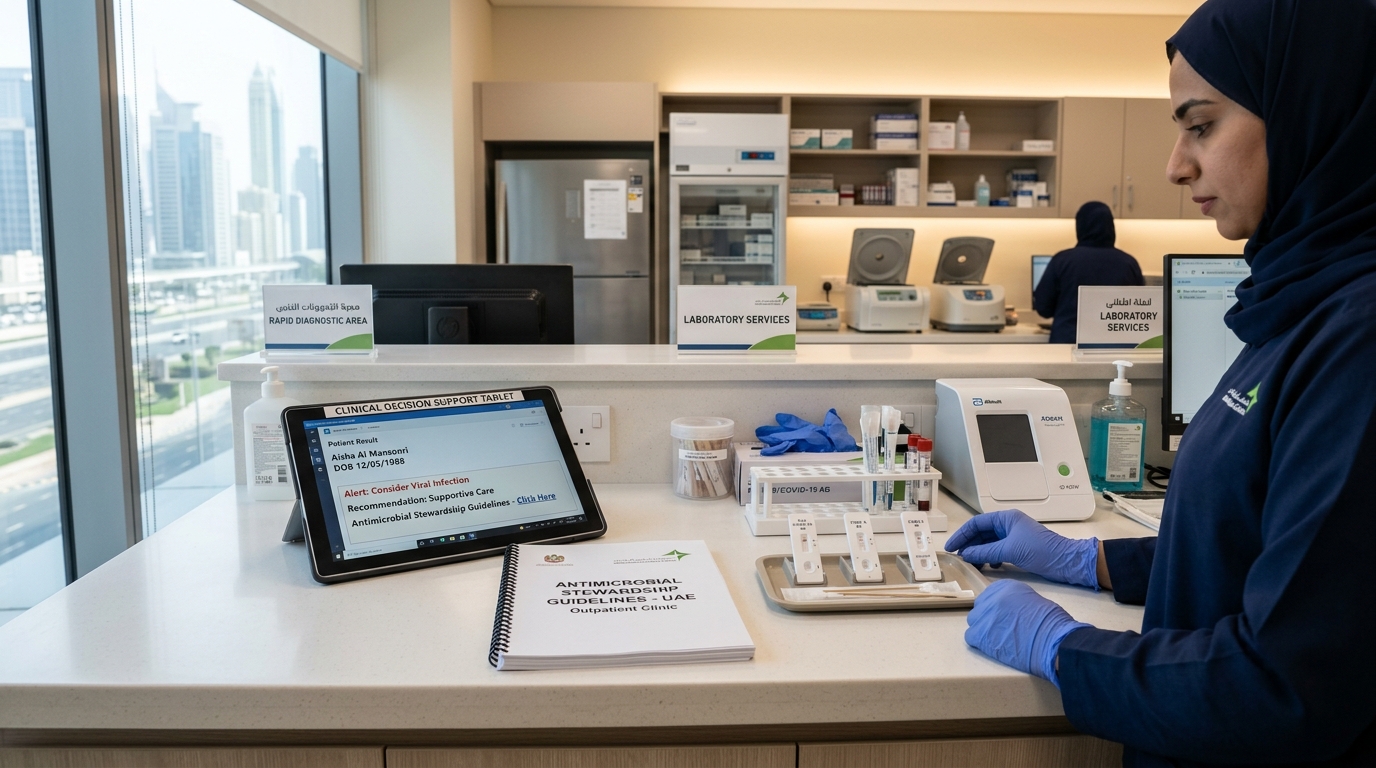
Antimicrobial resistance (AMR) represents one of the top global public health threats identified by the World Health Organization. In ambulatory care, urgent care centers, and private outpatient polyclinics throughout Dubai, Abu Dhabi, and the Northern Emirates, clinicians face tremendous daily pressure from patients expecting antibiotic prescriptions for common coughs, sore throats, and fever. Deploying accurate professional respiratory rapid test kits transforms subjective clinical impressions into objective biomarker evidence, giving clinicians the confidence to withhold unnecessary antibacterial therapy.
The Crisis of Inappropriate Outpatient Antibiotic Prescribing
Epidemiological studies demonstrate that between 30% and 50% of antibiotics prescribed in outpatient clinics are completely unnecessary or non-adherent to clinical guidelines. This diagnostic dilemma stems from several acute operational factors:
- Symptom Overlap in Acute Respiratory Infections: Viral rhinoviruses, influenza A/B, respiratory syncytial virus (RSV), and adenovirus produce pharyngeal erythema, rhinorrhea, fever, and cough that are clinically indistinguishable from bacterial etiologies like Group A Streptococcus or Mycoplasma pneumoniae.
- Turnaround Time Lag of Traditional Microbiology: Standard throat and sputum cultures require 48 to 72 hours for microbial incubation and antimicrobial susceptibility reporting. Physicians cannot easily delay care in ambulatory patients, prompting reflexive empiric broad-spectrum antibiotic coverage.
- Patient Satisfaction Pressure: Patients frequently conflate receiving a prescription with receiving quality medical care. Without diagnostic visualization, physicians spend significant consultative effort reassuring patients without objective proof.
Core Pillars of Ambulatory Antimicrobial Stewardship
The Centers for Disease Control and Prevention (CDC) and regional health authorities outline four foundational pillars tailored specifically to outpatient and primary care environments:
| Stewardship Pillar | Clinical Objective | Practical Outpatient Implementation | Impact on Antibiotic Consumption |
|---|---|---|---|
| 1. Leadership Commitment | Establish institutional policy prioritizing judicious antibiotic use | Display public commitment posters in waiting rooms; assign clinical pharmacy champions | 15% to 20% baseline reduction |
| 2. Diagnostic Action (POCT) | Confirm bacterial etiology prior to prescription | Routine Strep A rapid cassettes, Covid/Flu combo tests, and POC C-reactive protein (CRP) | 35% to 50% reduction in ARTI prescribing |
| 3. Tracking & Benchmarking | Monitor prescribing patterns across physician panels | Monthly electronic medical record (EMR) audit and peer comparison feedback reports | Deters reflexive outlier prescribing |
| 4. Patient Communication | Educate on viral natural history and symptom management | Provide printed viral prescription pads detailing hydration, analgesics, and warning signs | Maintains 95%+ patient satisfaction scores |
How Point-of-Care Rapid Testing Revolutionizes Prescribing
Rapid diagnostic cassettes, lateral flow immunoassays, and compact molecular benchtop instruments directly address the diagnostic vacuum that historically drove empirical overtreatment. Utilizing validated assays such as the Strep A rapid test cassette provides critical operational advantages:
1. Instant Confirmation of Group A Streptococcus
In pediatric and adult patients presenting with acute pharyngitis, fewer than 15% to 30% of cases are caused by bacterial Group A Strep (which requires amoxicillin to prevent acute rheumatic fever). The remaining 70% to 85% are viral. Performing an in-clinic swab test with >96% sensitivity allows immediate targeted treatment for positive patients while safely protecting negative patients from superfluous antibiotics.
2. Differentiating Influenza and COVID-19 from Bacterial Pneumonia
During winter respiratory surges across the UAE, multiplex antigen cassettes detecting SARS-CoV-2 and Influenza A/B simultaneously enable physicians to prescribe targeted antiviral therapies (such as oseltamivir or nirmatrelvir/ritonavir) within the 48-hour therapeutic window rather than prescribing cephalosporins or macrolides that have zero antiviral utility.
3. Visual Diagnostic Engagement with Patients
When patients observe a negative rapid test line in the clinic alongside their physician, their acceptance of supportive non-antibiotic symptom management increases exponentially. The rapid cassette acts as tangible clinical evidence that an antibiotic is neither needed nor clinically beneficial.
Best Practice Implementation Checklist for UAE Medical Centers
- Implement “No Swab, No Antibiotic” Pharyngitis Policy: Restrict antibiotic dispensing for sore throats unless a positive rapid antigen test or molecular NAAT confirms Group A Strep.
- Maintain Dedicated Point-of-Care Testing Quality Controls: Follow ISO 15189 and local laboratory guidelines by recording daily kit temperatures, running external positive/negative control swabs per new lot number, and logging staff competency assessments.
- Integrate POCT Results into EMR Order Sets: Configure clinic electronic health records to require selecting a confirmatory rapid diagnostic test result prior to signing antibiotic prescriptions for upper respiratory diagnosis codes.
- Adopt “Delayed Prescribing” Protocols: In borderline cases, provide patients with a post-dated prescription to be filled only if symptoms deteriorate after 48 to 72 hours of conservative hydration and antipyretics.
Frequently Asked Questions (FAQs)
What is antimicrobial stewardship in an outpatient setting?
Antimicrobial stewardship in outpatient clinics is an organized clinical framework designed to optimize the appropriate prescribing of antibiotics, ensuring they are used only when medically necessary, with the correct drug, dosage, and duration, while minimizing drug resistance and adverse side effects.
How does a Strep A rapid test reduce antibiotic misuse?
Group A Streptococcus accounts for only 10% to 30% of sore throats, with the vast majority being viral. A rapid Strep A test delivers definitive results in 5 to 10 minutes, preventing empiric antibiotic prescribing for the 70% to 90% of patients who have viral pharyngitis.
Are rapid diagnostic tests cost-effective for private outpatient clinics?
Yes. Rapid tests significantly reduce unnecessary repeat clinic visits, prevent antibiotic-associated adverse drug reactions (such as C. difficile colitis and severe allergic reactions), and enhance clinic reputation through evidence-based, high-quality care.
Scientific References & Clinical Guidelines
- Centers for Disease Control and Prevention (CDC). The Core Elements of Outpatient Antibiotic Stewardship. MMWR Recomm Rep. 2016;65(6):1-12.
- World Health Organization (WHO). Antimicrobial Stewardship Programmes in Health-Care Facilities in Low- and Middle-Income Countries: A WHO Practical Toolkit. 2021; ISBN 978-92-4-003426-6.
- The Lancet Infectious Diseases. Impact of Point-of-Care Testing on Antibiotic Prescribing for Acute Respiratory Tract Infections in Primary Care: A Systematic Review and Meta-Analysis. Lancet Infect Dis. 2021;21(7):995-1007.