
Azoospermia Evaluation Fertility Testing Meaning: Obstructive vs Non-Obstructive Workup, CFTR Genetics & Micro-TESE Prognosis
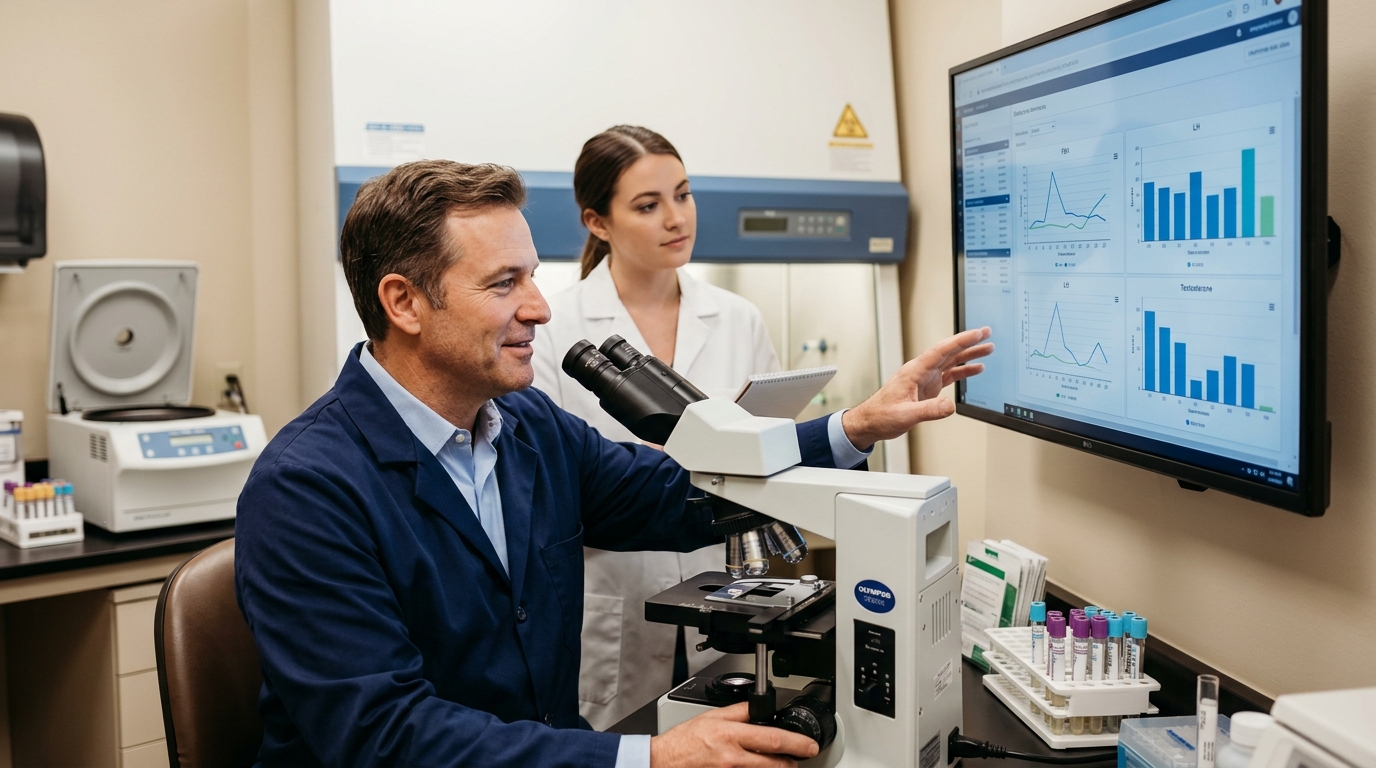
In specialized fertility centers across Dubai, Abu Dhabi, and Sharjah, advanced reproductive andrology has revolutionized the prognosis for men with zero sperm count. Booking comprehensive specialized andrology and male fertility evaluation packages in UAE ensures rigorous centrifugal pellet confirmation and genetic profiling in accredited reproductive laboratories.
The Crucial First Diagnostic Step: Centrifuged Pellet Examination
Azoospermia cannot be diagnosed from a single unstained droplet of semen on a glass slide. The WHO 6th Edition mandates a rigorous laboratory verification protocol before classifying a patient as azoospermic:
- Standard Centrifugation Protocol: The liquefied semen sample must be centrifuged at 3,000 × g for at least 15 minutes (or 1,000 × g for 20 minutes) to concentrate cellular elements into a compact pellet at the tube bottom.
- Exhaustive Pellet Search: The supernatant is carefully aspirated, and the entire pellet is re-suspended in a small droplet (50 µL) and thoroughly examined under phase-contrast microscopy at 400x to 1,000x magnification.
- Cryptozoospermia Distinction: If even one or two living spermatozoa are observed in the centrifuged pellet, the diagnosis is Cryptozoospermia, not azoospermia. These rare sperm can be harvested and cryopreserved directly for immediate Intracytoplasmic Sperm Injection (ICSI), completely sparing the patient from surgical testicular biopsy!
- Mandatory Confirmatory Sample: Azoospermia must be confirmed on at least two separate semen analyses performed at least 2 to 4 weeks apart to exclude transient suppression from acute febrile illness or collection error.
Differentiating Obstructive (OA) vs. Non-Obstructive Azoospermia (NOA)
Once azoospermia is verified, clinical and laboratory testing resolves the underlying pathophysiological branch:
| Diagnostic Clinical Marker | Obstructive Azoospermia (OA) (~40% of cases) | Non-Obstructive Azoospermia (NOA) (~60% of cases) |
|---|---|---|
| Testicular Volume (Prader Orchidometer) | Normal (>15 to 25 mL); firm bilateral consistency | Reduced (<10 to 12 mL); soft, atrophic testicular parenchyma |
| Serum FSH (Follicle-Stimulating Hormone) | Normal (1.5 to 8.0 mIU/mL); intact feedback loop | Markedly Elevated (>10 to 30 mIU/mL); reflects loss of Sertoli cell inhibin B feedback |
| Serum Inhibin B | Normal (>100 pg/mL); reflects healthy Sertoli cell population | Very low or undetectable (<40 pg/mL); direct marker of spermatogenic failure |
| Epididymal Physical Examination | Dilated, turgid, indurated epididymis; vas deferens may be absent (CBAVD) | Flat, soft, non-dilated epididymal tissue; vas deferens palpable |
| Semen Volume & pH Profile | Often low (<1.4 mL) and acidic (pH <7.0) if blockage is at ejaculatory ducts/CBAVD | Normal volume (>1.4 mL) and normal alkaline pH (7.2 to 8.0) |
| Surgical Sperm Retrieval Success | 99% to 100% (via simple needle aspiration: PESA / MESA) | 45% to 55% (requires Microsurgical Testicular Sperm Extraction: Micro-TESE) |
Mandatory Genetic Profiling in Azoospermia
International andrology guidelines mandate comprehensive genetic testing for all men with confirmed azoospermia prior to surgical intervention:
- Karyotyping (Chromosomal Analysis): Identifies numerical and structural chromosomal anomalies. Klinefelter Syndrome (47,XXY) accounts for up to 10% to 15% of all non-obstructive azoospermia cases. Men with non-mosaic 47,XXY can still achieve 40%–50% sperm retrieval success on Micro-TESE.
- Y-Chromosome Microdeletion Analysis (AZF Region): Tests for microdeletions in the Azoospermia Factor (AZF) region on the long arm of the Y chromosome (Yq11):
- AZFa or AZFb Complete Deletions: Results in total Sertoli-cell-only syndrome or maturation arrest. Sperm retrieval rate is 0%; surgical Micro-TESE is contraindicated.
- AZFc Deletions: Most common microdeletion (~70%). Associated with residual focal spermatogenesis. Surgical sperm retrieval succeeds in >50% to 70% of cases. Note: Male offspring will inherit the AZFc deletion.
- CFTR Gene Mutation Sequencing: Mandated for all men with low-volume acidic azoospermia and absent vas deferens (CBAVD). Both partners must be sequenced to evaluate cystic fibrosis transmission risk to children.
Surgical Sperm Retrieval Options: PESA, TESE & Micro-TESE
The chosen surgical extraction modality depends directly on the obstructive versus non-obstructive etiology:
| Surgical Retrieval Modality | Anatomical Target | Surgical Technique | Primary Indication |
|---|---|---|---|
| PESA (Percutaneous Epididymal Sperm Aspiration) | Cauda or caput epididymis | Fine needle aspiration under local anesthesia; minimally invasive; takes 10 minutes | Obstructive Azoospermia (e.g., post-vasectomy, CBAVD) |
| MESA (Microsurgical Epididymal Sperm Aspiration) | Single epididymal tubule | Operating microscope at 25x magnification; yields millions of pure motile sperm for cryopreservation | Obstructive Azoospermia when high cryopreservation yield is desired |
| Micro-TESE (Microsurgical Testicular Sperm Extraction) | Seminiferous tubules within the testis | Extensive testicular bisection under operating microscope (20x–30x); andrologist targets plump, opaque, dilated tubules | Gold Standard for Non-Obstructive Azoospermia (NOA); maximizes sperm yield while preserving testicular blood supply |
Frequently Asked Questions (FAQ)
Does azoospermia mean a man cannot produce testosterone or has low libido?
Not necessarily. In Obstructive Azoospermia, Leydig cells produce completely normal testosterone, libido is normal, and erection/ejaculation feel entirely ordinary. Even in Non-Obstructive Azoospermia, testosterone levels are often normal or only mildly borderline low despite high FSH levels.
Can lifestyle changes or medications cure azoospermia?
Lifestyle changes cannot unblock physical obstructions (OA) or overcome genetic microdeletions. However, if non-obstructive azoospermia is secondary to hypogonadotropic hypogonadism (pituitary failure, anabolic steroid abuse), medical treatment with hCG and recombinant FSH can restore spermatogenesis to the ejaculate in over 80% of patients without surgery.
What happens if sperm are found on Micro-TESE?
The retrieved spermatozoa are immediately used to inject mature eggs retrieved from the female partner on the same day via ICSI, or they are cryopreserved in liquid nitrogen micro-straws for future IVF/ICSI cycles.
Scientific References & Authoritative Clinical Guidelines
- World Health Organization (WHO). WHO Laboratory Manual for the Examination and Processing of Human Semen. 6th Edition, WHO Press, Geneva, 2024.
- American Urological Association (AUA) & ASRM. Diagnosis and Treatment of Infertility in Men: Clinical Evaluation of Azoospermia. J Urol, 2024.
- Dubai Health Authority (DHA). Standards for Assisted Reproductive Technologies (ART) and Surgical Andrology Services. UAE Health Regulations, 2024.