
Day-3 Hormone Testing Fertility Testing Meaning: Basal FSH, Estradiol & LH Ratios, Ovarian Reserve Assessment & Dubai IVF Protocols
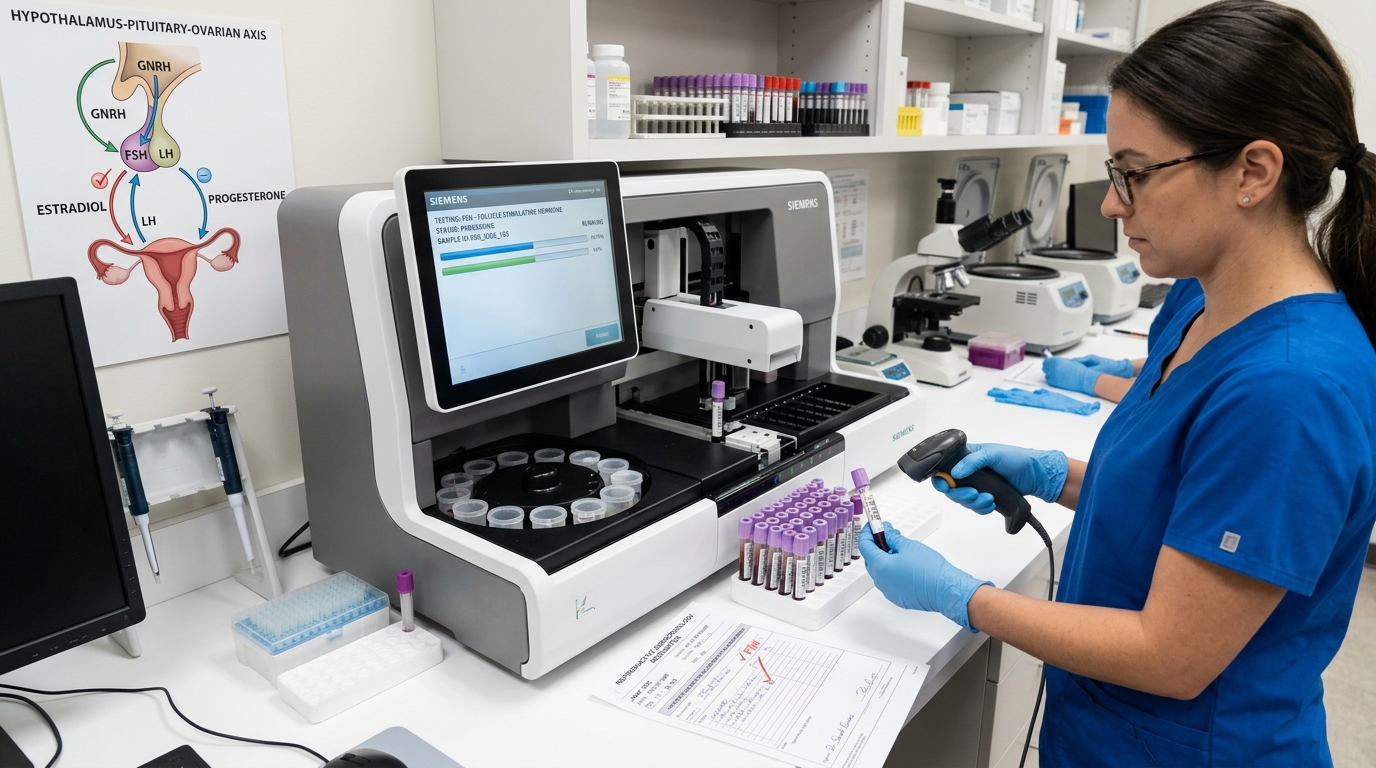
In modern reproductive medical centers and IVF hospitals throughout Dubai, Abu Dhabi, and the wider UAE, early follicular hormonal mapping forms the foundation of individualized fertility protocols. Sourcing validated professional fertility and diagnostic systems in Dubai ensures patients and physicians obtain reliable, precision-calibrated hormonal data.
The Physiology of the Early Follicular Window: Why Day 3?
During the late luteal phase of the preceding menstrual cycle, the demise of the corpus luteum causes circulating progesterone, estradiol, and inhibin A to plummet. This release from negative feedback prompts the pituitary gland to secrete a basal pulse of FSH (the “intercycle FSH rise”), which rescues a cohort of antral follicles from apoptotic atresia.
- The Biological Meaning of Day 2, 3, or 4: Testing must be conducted between Day 2 and Day 4 of active menstrual flow (where Day 1 is defined as the first day of full, bright-red menstrual bleeding, not light pre-menstrual spotting). At this specific time point, the pituitary and ovaries are at baseline biological equilibrium, allowing unmasked evaluation of hypothalamic-pituitary-ovarian communication.
- The Endocrine Reflex: In a young woman with robust ovarian reserve, numerous developing follicles secrete healthy basal concentrations of Inhibin B and estradiol, which exert gentle negative feedback on the pituitary, keeping basal Day-3 FSH low (typically < 8–10 mIU/mL).
- Diminished Reserve Reflex: When the primordial follicle pool is depleted, fewer granulosa cells exist to produce inhibin B. The pituitary senses this deficiency and secretes increasingly high amounts of FSH to force remaining resistant follicles into development.
Day-3 Hormone Parameters: Clinical Thresholds & Interpretation
Clinical practice guidelines from the American Society for Reproductive Medicine (ASRM) and the European Society of Human Reproduction and Embryology (ESHRE) outline specific diagnostic cutoffs:
| Hormone Parameter | Optimal Day-3 Target Range | Borderline / Compromised Range | Clinical & Prognostic Interpretation |
|---|---|---|---|
| Basal Follicle-Stimulating Hormone (FSH) | < 8.0 mIU/mL (Normal reserve) | 10.0–15.0 (Diminished); > 15.0 (Severely compromised) | Values > 10 mIU/mL correlate with reduced oocyte yield during IVF, higher cancellation rates, and increased gonadotropin medication requirements. |
| Basal 17-Beta Estradiol (E2) | 20–50 pg/mL (Normal baseline) | > 60–80 pg/mL (Premature luteinization) | Elevated Day-3 estradiol (> 80 pg/mL) indicates advanced follicular recruitment and artificially suppresses (masks) an elevated FSH into normal ranges. |
| Basal Luteinizing Hormone (LH) | 2.0–6.0 mIU/mL (Balanced ratio) | LH:FSH Ratio > 2:1 or 3:1 | Reversed LH:FSH ratio (> 2:1) is a classic endocrine hallmark of Polycystic Ovary Syndrome (PCOS); very low LH (< 1.5) suggests hypothalamic amenorrhea. |
| Serum Prolactin & TSH | TSH: 0.5–2.5 mIU/L; Prolactin: < 20 ng/mL | TSH > 2.5–4.0; Prolactin > 25 ng/mL | Subclinical hypothyroidism and hyperprolactinemia disrupt GnRH pulsatility, leading to luteal insufficiency and anovulatory cycles. |
The Critical “Estradiol Masking Trap”
One of the most frequent clinical misinterpretations in primary care is evaluating Day-3 FSH in isolation without checking Estradiol. This creates the dangerous Estradiol Masking Trap:
- The Biological Trap: In women with diminished ovarian reserve or accelerated reproductive aging, elevated baseline FSH drives premature follicular development during the preceding luteal transition. By Day 3 of menses, the emerging dominant follicle is already abnormally large and pumping out high levels of estradiol (> 80–100 pg/mL).
- The False Reassurance: This elevated estradiol feeds back on the anterior pituitary, suppressing FSH into an apparently “normal” range (e.g., FSH of 6.5 mIU/mL). If the doctor only orders FSH, they will falsely reassure the patient that her ovarian reserve is normal!
- The Golden Clinical Rule: A Day-3 FSH value is uninterpretable unless Estradiol is < 60–80 pg/mL. If Estradiol is > 80 pg/mL with a “normal” FSH, the test must be regarded as showing diminished ovarian reserve, and the patient must be evaluated with Anti-Müllerian Hormone (AMH).
Day-3 Testing vs Anti-Müllerian Hormone (AMH)
While Day-3 FSH and Estradiol evaluate dynamic pituitary responsiveness, Anti-Müllerian Hormone (AMH) has emerged as the premier quantitative biomarker of ovarian reserve:
| Diagnostic Feature | Day-3 Basal FSH & Estradiol | Anti-Müllerian Hormone (AMH) |
|---|---|---|
| Biological Source | Anterior Pituitary (FSH) / Ovarian Stroma (E2) | Granulosa cells of pre-antral and small antral follicles |
| Timing Requirement | Strictly Day 2, 3, or 4 of active menses | Any day of the cycle (Cycle-independent stability) |
| Inter-Cycle Variability | High cycle-to-cycle fluctuation based on stress/illness | Low variability across consecutive cycles |
| Affected by Oral Contraceptives | Uninterpretable while on birth control pills | Suppressed by 20–30% during prolonged pill use |
| Predictive Power for IVF Yield | Moderate (Predicts poor response if > 12) | Superior (Direct correlation with mature oocyte numbers) |
Clinical Decision-Making: From Labs to Treatment Pathways
Once Day-3 hormonal results and AMH are compiled, reproductive endocrinologists classify the patient’s prognosis:
- Normal Reserve (FSH < 8 mIU/mL, E2 < 50 pg/mL, AMH 1.5–3.5 ng/mL): Excellent prognosis. Natural conception, ovulation induction, or mild ovarian stimulation protocols are appropriate based on age and tubal/sperm factors.
- Diminished Ovarian Reserve (FSH > 10–12 mIU/mL, E2 > 80 pg/mL, AMH < 1.0 ng/mL): Accelerated fertility timeline. Clinicians advise against prolonged trial of natural conception, recommending expedited Intrauterine Insemination (IUI) or In Vitro Fertilization (IVF) utilizing microdose flare or antagonist stimulation protocols.
- Polycystic Ovarian Pattern (LH:FSH > 2:1, AMH > 4.0 ng/mL): High risk for Ovarian Hyperstimulation Syndrome (OHSS). IVF protocols utilize GnRH antagonist regimens with GnRH agonist triggers to ensure maximum safety.
Frequently Asked Questions (FAQ)
Can Day-3 hormone testing predict whether a woman can get pregnant naturally?
Ovarian reserve testing predicts oocyte quantity and response to fertility medications, but it does not measure oocyte quality. In young women (< 35 years), pregnancy rates per cycle remain relatively high even with diminished reserve markers because remaining eggs are genetically normal.
What should a woman do if Day 3 falls on a weekend or public holiday?
Testing on Day 2 or Day 4 of the menstrual cycle is clinically equivalent to Day 3. If Day 3 falls on a Sunday, having blood drawn on Saturday (Day 2) or Monday (Day 4) provides valid, uncompromised baseline results.
Can taking fertility supplements change Day-3 FSH levels?
Supplements such as CoQ10, DHEA, or Vitamin D support mitochondrial energy and follicle health, but they cannot create new eggs. While DHEA may slightly modulate hormone ratios in older women, it does not reverse the natural biological depletion of the primordial follicle pool.
Authoritative Clinical References
- American Society for Reproductive Medicine (ASRM) – Testing and Interpreting Measures of Ovarian Reserve: A Committee Opinion (2020)
- European Society of Human Reproduction and Embryology (ESHRE) – Assessment of Ovarian Reserve in Clinical Practice
- American College of Obstetricians and Gynecologists (ACOG) – Infertility Workup for the Practicing Gynecologist