
Dengue NS1-IgM-IgG Combo Rapid Test: What Does it Detect? Acute Viremia vs Secondary Infection & Clinical Triage in UAE Travel Medicine
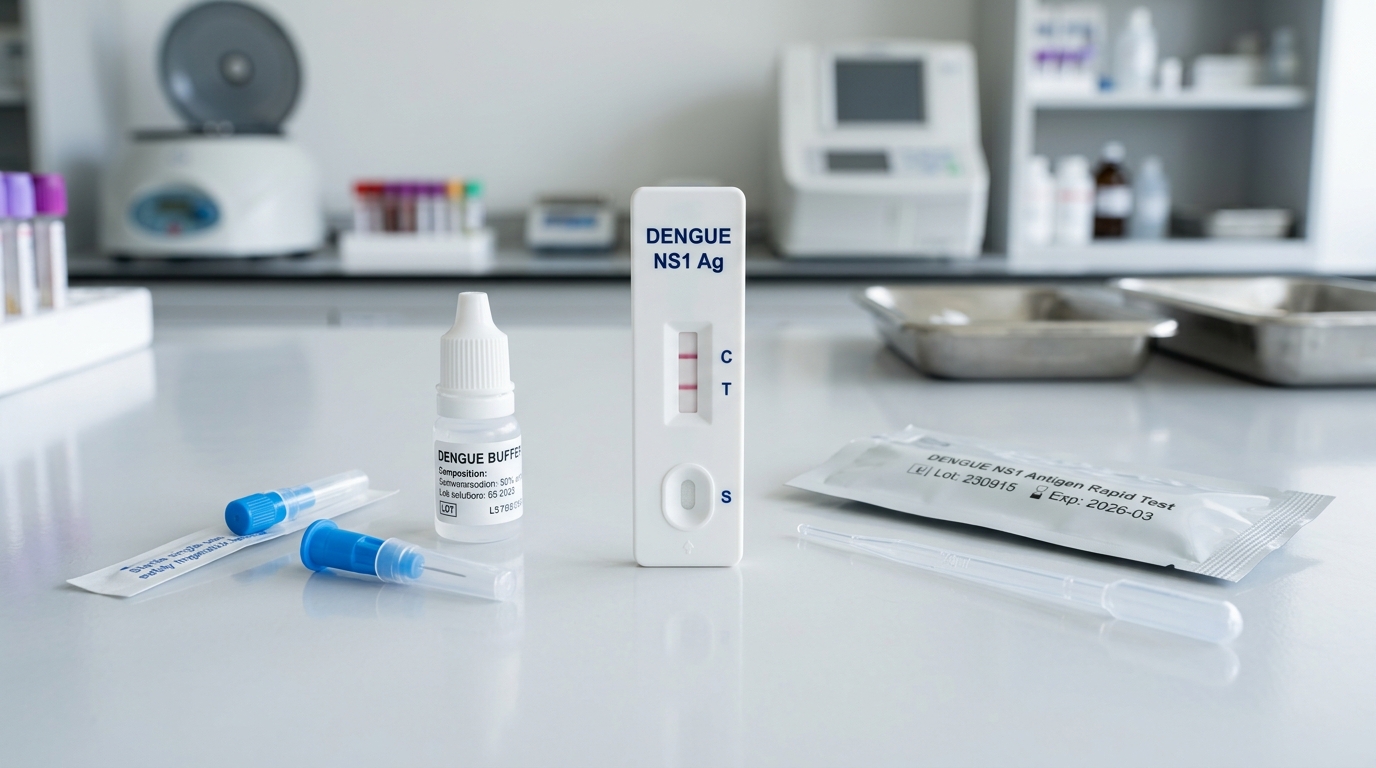
In international travel clinics and tertiary hospital emergency triage units across Dubai, Abu Dhabi, and the wider UAE, rapid arboviral testing delivers vital diagnostic answers within minutes of arrival. Procuring verified professional tropical disease rapid test kits in the UAE ensures clinic operators deploy high-sensitivity immunochromatographic assays compliant with international regulatory benchmarks.
The 3 Biological Targets: NS1, IgM, and IgG Explained
The diagnostic power of the combo rapid test lies in its ability to interrogate three distinct immunological and virological markers simultaneously:
- Target 1 — Dengue NS1 Antigen (Direct Viremic Biomarker): NS1 is a highly conserved, non-structural glycoprotein synthesized by DENV within infected mammalian cells. Large quantities of hexameric NS1 are secreted into the bloodstream during active viral replication. NS1 appears in patient blood on Day 1 of fever—long before host antibodies are produced—and persists through Days 7 to 9. It provides definitive proof of acute viremic infection.
- Target 2 — Anti-Dengue IgM Antibodies (Primary Immune Response): Immunoglobulin M (IgM) represents the host’s acute adaptive humoral response. In primary dengue infection, IgM emerges between Days 3 and 5 following fever onset, peaks at 2 to 3 weeks, and gradually wanes over 2 to 3 months. A positive IgM band indicates recent acute or subacute dengue infection.
- Target 3 — Anti-Dengue IgG Antibodies (Immunological Memory & Secondary Alert): In primary infection, IgG appears slowly after Day 10 to 14 at low titers and persists for life. However, in secondary dengue infection (infection with a different DENV serotype in an individual with past immunity), pre-existing memory B-cells mount an immediate, explosive anamnestic IgG response, with titers surging within 24 to 48 hours of fever onset.
Diagnostic Interpretation Matrix: Unraveling the 5 Clinical Profiles
Combining the presence or absence of the three test lines yields precise staging of the patient’s infection:
| NS1 Band | IgM Band | IgG Band | Clinical & Immunological Staging | Pathophysiology & Clinical Management |
|---|---|---|---|---|
| Positive (+) | Negative (-) | Negative (-) | Early Acute Primary Dengue Infection (Days 1–3 of fever) | High viral replication prior to seroconversion. Monitor complete blood count (CBC) daily for hematocrit rise and platelet drop. |
| Positive (+) | Positive (+) | Negative (-) | Acute Primary Dengue Infection (Days 4–7 of fever) | Active viremia overlapping with early humoral seroconversion. Patient enters the critical “defervescence” phase; monitor for capillary leak. |
| Positive (+) | Positive (+) or Negative (-) | Positive (+) (Strong) | Acute Secondary Dengue Infection (High Risk for Severe Dengue) | High Risk Alert: Antibody-Dependent Enhancement (ADE) significantly increases risk of Dengue Hemorrhagic Fever (DHF) and Shock Syndrome. Immediate hospital admission advised. |
| Negative (-) | Positive (+) | Negative (-) or Positive (+) | Late Acute or Convalescent Dengue (Days 7–14+) | Viral clearance has occurred; active antibody response persists. Resolving phase; monitor for recovery of platelet count. |
| Negative (-) | Negative (-) | Positive (+) | Past Cured Dengue Infection (Remote Immunity) | Immunological scar reflecting historical exposure. Current acute fever is likely caused by an alternative pathogen (Malaria, Typhoid, COVID-19). |
The Threat of Secondary Dengue: Antibody-Dependent Enhancement (ADE)
The single greatest clinical danger in dengue management is secondary infection with a heterologous serotype (e.g., infected with DENV-2 after past DENV-1 recovery):
The Mechanism of ADE: Cross-reactive, non-neutralizing IgG antibodies from the primary infection bind the new virus serotype but fail to neutralize it. Instead, the Fc portions of these antibodies bind Fc-gamma receptors on monocytes and macrophages, facilitating viral entry and accelerating replication. This triggers a massive “cytokine storm” that damages vascular endothelial junctions, causing sudden plasma leakage, severe thrombocytopenia (< 20,000/µL), hemoconcentration, and Dengue Shock Syndrome (DSS).
Clinical Value of Rapid IgG Band: Detecting a strong, immediate IgG band alongside NS1 in a patient with acute Day 2 fever alerts the emergency physician that the patient has secondary dengue, prompting proactive intravenous fluid management before shock develops.
WHO Warning Signs Mandating Immediate Inpatient Admission
Under World Health Organization (WHO) and UAE Ministry of Health clinical management guidelines, patients diagnosed with dengue who exhibit any of the following Warning Signs require immediate hospitalization:
- Severe abdominal pain or tenderness.
- Persistent, intractable vomiting (≥ 3 episodes within 12 hours).
- Clinical fluid accumulation (pleural effusion, ascites, periorbital edema).
- Mucosal bleeding (epistaxis, gingival bleeding, hematuria, menorrhagia).
- Lethargy, extreme restlessness, or altered mental status.
- Hepatomegaly (> 2 cm below the right costal margin).
- Laboratory: Progressive increase in Hematocrit (> 20% jump) concurrent with rapid, precipitous drop in Platelet Count (< 100,000/µL).
Frequently Asked Questions (FAQ)
Can Dengue antibodies cross-react with other flaviviruses?
Yes. Flavivirus antibodies (IgM and IgG) exhibit significant cross-reactivity with related viruses, including Zika virus, Yellow Fever virus, and West Nile virus, as well as recent Japanese Encephalitis vaccination. However, the NS1 antigen test is highly specific (> 98%) and does not cross-react with other flaviviruses.
Can Aspirin or Ibuprofen be given for fever in a patient with suspected dengue?
Strictly Contraindicated! Non-Steroidal Anti-Inflammatory Drugs (NSAIDs such as Ibuprofen, Naproxen, Diclofenac) and Aspirin impair platelet aggregation and cause gastric mucosal erosions, dramatically multiplying the risk of fatal gastrointestinal bleeding in thrombocytopenic dengue patients. Only Paracetamol (Acetaminophen) should be used for fever control.
Is Dengue virus endemic in the UAE?
The vast majority of dengue cases diagnosed in the UAE are travel-associated (“imported”) infections acquired during visits to endemic countries. However, municipal vector surveillance programs actively monitor and control local Aedes mosquito populations across urban centers to prevent local transmission cycles.
Authoritative Clinical References
- World Health Organization (WHO) – Dengue: Guidelines for Diagnosis, Treatment, Prevention and Control
- Centers for Disease Control and Prevention (CDC) – Clinical Guidance for Dengue Virus Testing
- Infectious Diseases Society of America (IDSA) – Clinical Practice Guidelines for the Diagnosis of Dengue in Returned Travelers