
Dust Mite Allergy Symptoms Testing: Specific IgE Blood Panels, Skin Prick Tests & UAE Indoor Allergens
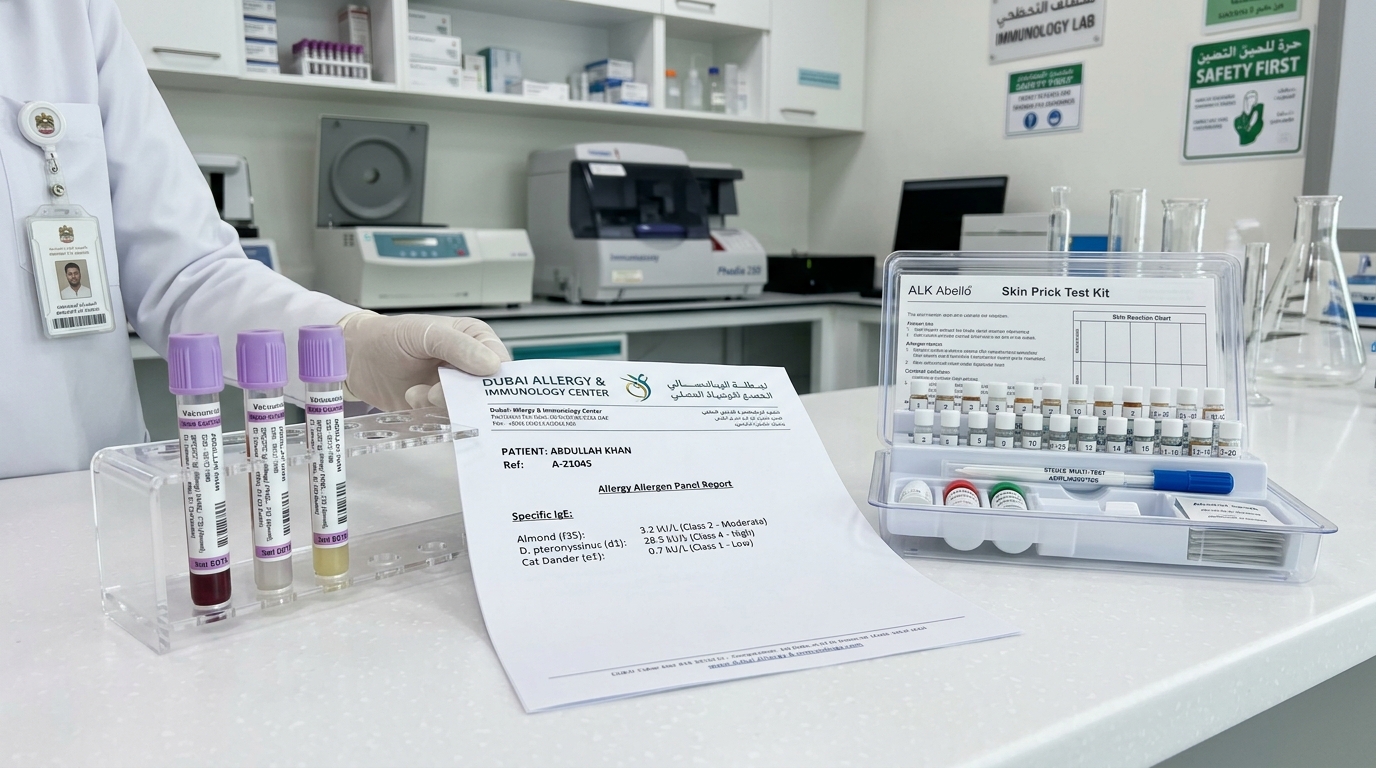
In the UAE, residents spend up to 90% of their daily lives indoors within air-conditioned environments due to intense summer heat and desert sandstorms. While air conditioning maintains comfortable thermal conditions, it creates ideal micro-climates for dust mite proliferation inside mattresses and pillows. Adults and children experiencing chronic morning nasal congestion, paroxysmal sneezing, itchy watery eyes, and unexplained nighttime coughing often misattribute symptoms to “dust from outside.” Scheduling comprehensive specialized allergy testing blood panels in Dubai pinpoints specific sensitization and guides targeted allergen immunotherapy.
The Molecular Allergens: Der p 1 and Der f 1
Clinical allergists examine the specific molecular components triggering hypersensitivity reactions:
- Der p 1 & Der f 1 (Major Group 1 Allergens): Heat-labile digestive cysteine proteases present in mite fecal pellets. These enzymes actively digest human epithelial tight junctions in the bronchial and nasal mucosa, allowing foreign antigens direct access to dendritic antigen-presenting cells and driving immediate Type I IgE sensitization.
- Der p 2 & Der f 2 (Major Group 2 Allergens): Lipid-binding proteins that mimic human MD-2 (the LPS-binding component of Toll-Like Receptor 4 – TLR4), triggering innate inflammatory pathways and intense mast cell degranulation.
- Cross-Reactivity with Shellfish (Tropomyosin): Dust mites share an invertebrate muscle protein called tropomyosin (Der p 10) with crustaceans (shrimp, crab, lobster) and mollusks. Up to 15% of patients with severe dust mite allergy demonstrate clinical or serological cross-reactivity when consuming seafood.
Diagnostic Comparison: Specific IgE Blood Test vs. Skin Prick Test
Two primary clinical testing modalities confirm dust mite sensitization:
| Evaluation Parameter | Specific IgE Blood Test (ImmunoCAP / FEIA) | In Vivo Skin Prick Testing (SPT) |
|---|---|---|
| Diagnostic Principle | Quantitative measurement of circulating allergen-specific IgE antibodies in serum (kUA/L) | Immediate cutaneous wheal-and-flare mast cell histamine response on forearm skin |
| Antihistamine Interference | Zero interference; patient can take all antihistamines and steroids freely | Must discontinue antihistamines for 5 to 7 days prior to prevent false negatives |
| Skin Condition Limitations | Can be performed in patients with severe eczema, dermographism, or widespread dermatitis | Cannot be performed on irritated, broken, or dermatographic skin |
| Risk of Anaphylaxis | Zero risk (in vitro test using drawn venous blood) | Extremely low, but theoretical risk of systemic allergic reaction during testing |
| Turnaround Time | 24 to 48 hours in automated laboratory | Immediate visual results in 15 to 20 minutes |
| Quantitative Precision | Exact numerical stratification (Classes 0 to 6; 0.10 to >100 kUA/L) | Millimeter wheal diameter measurement compared to histamine control |
Interpreting Specific IgE (sIgE) Quantitative Results
Specific IgE blood tests are reported using international quantitative classes:
- Class 0 (<0.35 kUA/L): Undetectable specific IgE; clinical dust mite allergy is unlikely.
- Class 1 (0.35 to 0.69 kUA/L): Low level of sensitization; clinical symptoms depend on total environmental mite burden.
- Class 2 (0.70 to 3.49 kUA/L): Moderate sensitization; clinical symptoms (rhinitis, eye itching) are common upon exposure.
- Class 3 (3.50 to 17.49 kUA/L): High sensitization; strong correlation with persistent allergic rhinitis and chronic asthma.
- Classes 4 to 6 (≥17.50 to >100 kUA/L): Very high to extreme sensitization; high risk of severe bronchial hyperreactivity and nocturnal wheezing.
Clinical Presentation: Dust Mite Allergy vs. Desert Sand Irritation
In the UAE desert environment, distinguishing allergic hypersensitivity from non-allergic particulate irritation is critical:
| Clinical Feature | House Dust Mite Allergy (IgE Mediated) | Desert Sand / Particulate Irritation (Non-Allergic) |
|---|---|---|
| Timing of Peak Symptoms | Worse at night and immediately upon waking in bed; year-round perennial | Worse outdoors during active sandstorms or high wind events |
| Pruritus (Itching) | Severe itching of deep nasal passages, roof of mouth, and inner ears | Gritty burning sensation in eyes and nasal dryness without deep pruritus |
| Nasal Secretions | Profuse clear, watery rhinorrhea accompanied by repetitive sneezing fits | Thick, dry, or dusty-colored mucus crusting |
| Response to Antihistamines | Significant rapid improvement with oral antihistamines and nasal steroids | Minimal response to antihistamines; responds best to saline nasal rinses |
Comprehensive Clinical Management & Environmental Control Protocol
Once dust mite sensitization is confirmed via specific IgE testing, allergists prescribe a multi-tiered management strategy:
1. Medical Pharmacotherapy
- Intranasal Corticosteroid Sprays: First-line daily therapy (e.g., fluticasone, mometasone) that suppresses mucosal eosinophilic inflammation and relieves chronic turbinate congestion.
- Non-Sedating Oral Antihistamines: Second-generation H1-blockers (e.g., desloratadine, fexofenadine, bilastine) that control sneezing, rhinorrhea, and ocular itching without central drowsiness.
- Allergen Immunotherapy (AIT): Sublingual immunotherapy (SLIT tablets/drops) or subcutaneous allergy injections (SCIT) administered over 3 to 5 years that induce permanent immune tolerance, curing the underlying allergic disease. Point-of-care triaging with certified diagnostic rapid testing cassettes helps rule out concurrent infectious respiratory episodes.
2. Environmental Mite Reduction Protocols
- Certified Micro-Porous Mattress Encasings: Encase mattresses, duvets, and pillows in tightly woven medical-grade impermeable covers with pore sizes <6 microns, preventing mites from colonizing bedding.
- High-Temperature Bedding Laundering: Wash all bed sheets and pillowcases weekly in hot water at ≥60°C; standard cold-water washing fails to kill live dust mites.
- HEPA Filtration & Humidity Control: Maintain indoor relative humidity below 50% using air conditioners and dehumidifiers (mites cannot survive in relative humidity <50%), and utilize vacuum cleaners equipped with true sealed HEPA filtration systems.
Frequently Asked Questions (FAQs)
Can dust mites live in modern air-conditioned apartments in Dubai?
Yes. In fact, air conditioning creates a stable, moderate temperature environment that mites prefer. When coupled with human skin shed into mattresses and pillows and micro-humidity from bodily sweat, dust mites proliferate rapidly inside UAE homes year-round.
Do I need to stop taking my antihistamines before an allergy blood test?
No. One of the greatest advantages of specific IgE blood testing (ImmunoCAP) is that it is completely unaffected by medications. You can continue taking oral antihistamines, nasal sprays, and asthma inhalers without altering the laboratory test accuracy.
Can dust mite allergy cause asthma in children?
Yes. Dust mite sensitization is one of the strongest independent risk factors for childhood asthma. Inhaling mite fecal proteases causes chronic airway inflammation, leading to nighttime coughing, wheezing, chest tightness, and exercise-induced asthma.
Scientific References & Clinical Guidelines
- World Allergy Organization (WAO). Allergic Rhinitis and Its Impact on Asthma (ARIA) Guidelines: 2020 Revision. World Allergy Organ J. 2020;13(4):100116.
- Journal of Allergy and Clinical Immunology. House Dust Mite Respiratory Allergy: Diagnostic Evaluation, Component-Resolved Diagnostics, and Allergen Immunotherapy. J Allergy Clin Immunol. 2020;145(2):437-448.
- Allergy: European Journal of Allergy and Clinical Immunology. EAACI Guidelines on Allergen Immunotherapy: House Dust Mite-Driven Allergic Asthma and Allergic Rhinitis. Allergy. 2021;76(1):15-32.