
Gastrointestinal Pathogen PCR Panel Explained
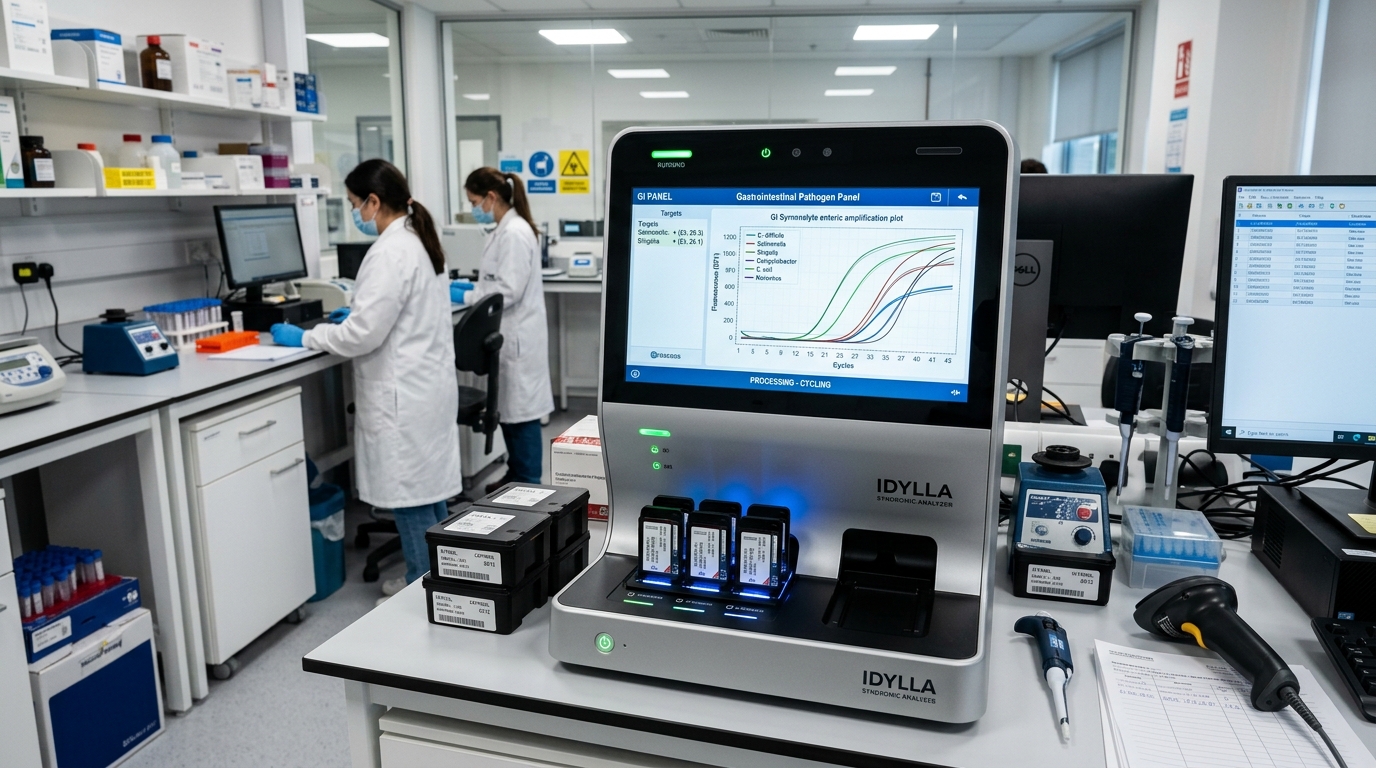
In acute care hospitals, emergency departments, and gastroenterology clinics across the UAE, acute gastroenteritis accounts for a massive burden of patient morbidity, dehydration admissions, and nosocomial outbreak investigations. Conventional stool diagnostic workflows—consisting of selective agar culture, enrichment broths, enzyme immunoassays (EIA), and manual stool microscopy for ova and parasites (O&P)—suffer from profound turnaround delays (taking 3 to 5 days) and notoriously poor analytical sensitivity (frequently failing to identify an etiology in over 60% of infectious cases). Implementing high-throughput gastrointestinal PCR panel solutions compresses this diagnostic timeline to a single clinical shift, delivering actionable pathogen identification directly to the treating physician.
The Diagnostic Bottleneck in Acute Infectious Diarrhea
Infectious diarrhea can stem from dozens of clinically indistinguishable microbial agents spanning enteric bacteria, enterotoxin producers, gastrointestinal viruses, and protozoan parasites. Historically, a clinician evaluating a patient with severe watery or bloody diarrhea had to order multiple disjointed diagnostic tests: bacterial stool culture (targeting Salmonella, Shigella, Campylobacter), specialized selective sorbitol-MacConkey agar (for Shiga toxin-producing E. coli), separate EIA testing for Clostridioides difficile toxins, enzyme assays for Rotavirus and Norovirus, and repeated microscopic examinations for Giardia and Cryptosporidium.
This fragmented approach introduces significant pre-analytical waste, consumes precious laboratory technologist hours, and frequently forces clinicians to prescribe inappropriate empiric antibiotics while waiting for culture readouts. In cases of Shiga toxin-producing E. coli (STEC), inappropriate antibiotic administration is dangerous, as it triggers massive prophage induction and Shiga toxin release, precipitating life-threatening Hemolytic Uremic Syndrome (HUS). Rapid syndromic PCR panel testing provides immediate, definitive identification of STEC and other critical pathogens, preventing catastrophic clinical mismanagement.
Molecular Architecture of Gastrointestinal PCR Panels: Target Organisms
Modern CE-IVD and FDA-cleared syndromic gastrointestinal panels typically detect between 20 and 25 of the most clinically prevalent enteric pathogens in a single closed reaction cartridge:
- Bacterial Pathogens: Campylobacter (C. jejuni, C. coli, C. lari), Clostridioides difficile (toxin A/B genes), Plesiomonas shigelloides, Salmonella species, Vibrio species (V. cholerae, V. parahaemolyticus, V. vulnificus), and Yersinia enterocolitica.
- Diarrheagenic Escherichia coli / Shigella: Enteroaggregative E. coli (EAEC), Enteropathogenic E. coli (EPEC), Enterotoxigenic E. coli (ETEC lt/st), Shiga toxin-producing E. coli (STEC stx1/stx2), E. coli O157 serotype, and Shigella / Enteroinvasive E. coli (EIEC).
- Gastrointestinal Viruses: Adenovirus F 40/41, Astrovirus, Norovirus GI/GII, Rotavirus A, and Sapovirus (I, II, IV, V).
- Protozoan Parasites: Cryptosporidium (C. parvum, C. hominis), Cyclospora cayetanensis, Entamoeba histolytica, and Giardia lamblia (G. duodenalis).
| Diagnostic Parameter | Conventional Stool Culture & O&P | Multiplex Syndromic GI PCR Panel | Clinical Laboratory Benefit |
|---|---|---|---|
| Turnaround Time (TAT) | 48 to 96 hours (3–4 days) | 60 to 120 minutes (Same shift) | Reduces hospital length of stay; immediate isolation |
| Diagnostic Yield | 15% to 25% of infectious cases | 55% to 75% of infectious cases | Identifies fastidious and viral causes missed by culture |
| Specimen Requirement | Multiple fresh and preserved vials | Single Cary-Blair transport vial | Simplifies sample collection and phlebotomy intake |
| STEC Toxin Detection | Requires specialized culture + broth EIA | Direct molecular detection of stx1/stx2 genes | Prevents contraindicated antibiotic therapy and HUS |
| Co-Infection Detection | Rarely detected due to selective media | Commonly detected (20%–30% polymicrobial) | Uncovers true polymicrobial etiology in travel diarrhea |
Pre-Analytical Specimen Requirements and Stool Preservation Media
The clinical validity of gastrointestinal PCR testing is dependent upon strict pre-analytical adherence to guidelines published by the Infectious Diseases Society of America (IDSA) for Infectious Diarrhea:
Testing must strictly be performed on raw, unformed (liquid, semi-solid, or soft) stool specimens that conform to the shape of the collection container. Submitting formed, hard stool for syndromic GI PCR testing is analytically contraindicated and rejected by accredited laboratories, as healthy individuals frequently harbor asymptomatic low-titer colonization of organisms like EPEC or C. difficile that does not reflect acute clinical pathology.
Specimens should be collected into Cary-Blair transport media vials within two hours of passage. Cary-Blair medium stabilizes bacterial viability and viral nucleic acids while buffering against pH shifts that can degrade target DNA/RNA. If unpreserved raw stool is submitted, testing must occur within 2 hours at room temperature or within 24 hours if refrigerated at 2°C to 8°C to prevent enzymatic nucleic acid degradation by endogenous fecal proteases and nucleases.
Syndromic Multiplex PCR vs Conventional Culture: Diagnostic Stewardship
Extensive clinical studies, including multicenter prospective trials documented in PubMed / Journal of Clinical Microbiology evaluations, demonstrate that syndromic GI panels increase pathogen detection rates threefold compared to traditional stool microbiology, with detection rates climbing from ~20% to over 65% in acute gastroenteritis presentations.
However, molecular stewardship remains paramount. The extreme analytical sensitivity of PCR means the assay detects non-viable genomic fragments as well as asymptomatic shedding. For example, Norovirus and Rotavirus RNA can shed in stool for 3 to 6 weeks following clinical recovery. Similarly, high detection rates of Enteropathogenic E. coli (EPEC) in young pediatric cohorts may represent benign colonization rather than the primary driver of disease.
As reinforced by the CDC Guidance on Culture-Independent Diagnostic Tests (CIDTs), when a GI panel flags positive for a critical public health bacterial pathogen (such as Salmonella, Shigella, or Vibrio), the clinical laboratory must perform reflexive reflex subculture to obtain a physical bacterial isolate. Bacterial isolates are mandatory for antimicrobial susceptibility testing (AST), whole-genome sequencing (WGS), and epidemiological outbreak surveillance.
Laboratory Implementation Checklist and Frequently Asked Questions (FAQ)
Ensure regulatory compliance and optimal clinical stewardship with this laboratory protocol checklist:
- Verify Stool Consistency: Enforce strict laboratory specimen rejection criteria for hard or formed stool.
- Prevent Cross-Contamination: Utilize closed-cartridge automated extraction systems to prevent aerosolization of high-titer Norovirus or C. difficile spores.
- Reflex Bacterial Isolates: Inoculate selective agar from positive Cary-Blair vials for mandatory public health reporting and AST.
- Establish Clinical Stewardship: Educate clinicians that positive molecular results must always be interpreted in the context of patient symptoms, travel history, and immune status.
Authoritative Medical References:
- Infectious Diseases Society of America (IDSA). Clinical Practice Guidelines for the Diagnosis and Management of Infectious Diarrhea. Clinical Infectious Diseases; Available from: idsociety.org/practice-guideline/infectious-diarrhea/
- Centers for Disease Control and Prevention (CDC). Culture-Independent Diagnostic Tests (CIDTs) in Enteric Surveillance and Outbreak Response. Atlanta: CDC; Available from: cdc.gov/foodsafety/outbreaks/investigating-outbreaks/culture-independent-diagnostic-tests.html
- Spina A, et al. Spectrum of Enteropathogens Detected by the FilmArray Gastrointestinal Panel in a Multicenter Clinical Trial. Journal of Clinical Microbiology / PubMed; Available from: pubmed.ncbi.nlm.nih.gov/29166290/