
H. Pylori Antibody Rapid Test Indications: Serology Limitations, Historical Exposure vs Active Infection & UAE Primary Care Practice
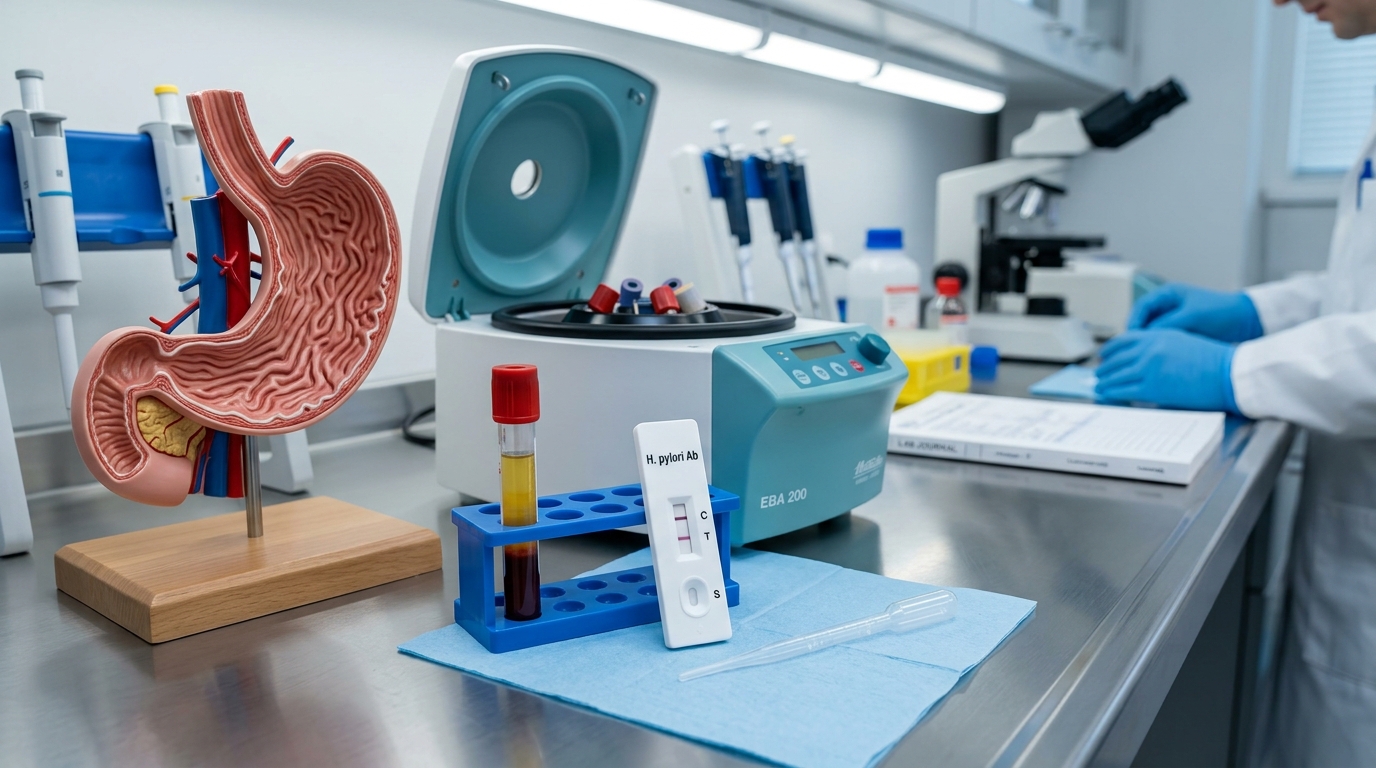
In community clinics and corporate wellness centers throughout Dubai, Abu Dhabi, and the wider UAE, understanding the nuances of gastrointestinal biomarker testing ensures accurate diagnosis and prevents antibiotic overuse. Sourcing verified professional rapid diagnostic test kits in the UAE guarantees healthcare facilities utilize monoclonal and validated serological systems adhering to international diagnostic criteria.
Active Infection vs Immune Memory: The Serology Dilemma
The immunological response to chronic gastric colonization by H. pylori produces high titers of circulating IgG and IgA antibodies. When clinicians order a rapid chromatographic antibody test, they must understand the underlying immunological kinetics:
- Antibody Persistence: Following complete eradication with bismuth quadruple therapy, IgG antibody titers decline very slowly over 6 to 12 months, and in many individuals, low-to-moderate antibody levels remain detectable for decades or for life (“serological scar”).
- Zero Utility for Test-of-Cure: A positive antibody test 1 month, 6 months, or 2 years after antibiotic treatment does not mean the patient still has H. pylori. Using serology to evaluate post-treatment cure leads to inappropriate, toxic re-treatment with second- and third-line rescue antibiotics.
- High Sensitivity in Treatment-Naive Patients: In a patient who has never previously taken antibiotics for H. pylori, a negative high-sensitivity antibody test has a Negative Predictive Value (NPV) exceeding 95%, effectively ruling out chronic infection.
Valid Clinical Indications for H. Pylori Antibody Testing
While the international Maastricht VI / Florence Consensus and the American College of Gastroenterology (ACG) prioritize Stool Antigen Tests (SAT) and Urea Breath Tests (UBT), antibody testing retains specific clinical niches:
| Diagnostic Indication | Clinical Context | Diagnostic Strength vs Weakness | Clinical Action Required |
|---|---|---|---|
| Acute Bleeding Peptic Ulcer | Patient hospitalized with upper GI hemorrhage; active PPI infusion | Gastric blood washes away urease and dilutes stool antigens, causing false-negative UBT/SAT; circulating IgG is unaffected by blood. | Positive serology in a naive patient justifies initiating empiric eradication therapy alongside endoscopic hemostasis. |
| Patients Unable to Discontinue PPIs | Severe GERD or refractory peptic symptoms where stopping PPI for 2 weeks is impossible | PPIs suppress bacterial load, causing false-negative UBT and SAT; serological antibody titers remain stable. | Useful as an initial screening tool; positive results should ideally be verified with endoscopy or stool antigen post-washout. |
| Epidemiological & Sero-Surveillance | Population health studies, occupational health pre-employment health screening | Rapid, cost-effective, easily performed on fingerstick capillary whole blood in non-laboratory settings. | Estimates population prevalence and exposure rates across regional demographics. |
| Severe Gastric Atrophy / Metaplasia | Advanced atrophic gastritis where bacterial colonization has died out due to achlorhydria | Direct tests (culture, histology, UBT, SAT) are frequently negative because bacteria have cleared; IgG confirms historic causation. | Guides gastric cancer surveillance protocols without requiring antibiotic therapy. |
Direct Comparison: Antibody vs Stool Antigen vs Urea Breath Test
To optimize diagnostic stewardship, outpatient physicians in the UAE should evaluate the three primary non-invasive modalities side-by-side:
| Diagnostic Feature | Rapid Antibody Test (Blood) | Monoclonal Stool Antigen Test (SAT) | 13C-Urea Breath Test (UBT) |
|---|---|---|---|
| Biomarker Detected | Circulating Host IgG Antibodies | Bacterial Surface Antigens (Active) | Active Bacterial Urease Enzymatic Activity |
| Differentiates Active vs Past | No (Reflects immune memory) | Yes (Only active bacterial shedding) | Yes (Only viable metabolizing bacteria) |
| Valid for Post-Treatment Cure | Strictly Contraindicated | Yes (≥ 4 weeks post-treatment) | Yes (≥ 4 weeks post-treatment) |
| Affected by PPI Therapy | No (Total immunity to PPIs) | Yes (Requires 2-week washout) | Yes (Requires 2-week washout) |
| Affected by Antibiotics / Bismuth | No | Yes (Requires 4-week washout) | Yes (Requires 4-week washout) |
| Turnaround Time | 10–15 Minutes (Rapid POC) | 10–15 Min (POC) or 2–4 Hrs (Lab) | 15–30 Minutes |
Diagnostic Interpretation Algorithm in Primary Care
When an outpatient clinic utilizes rapid H. pylori antibody cassettes, healthcare providers must follow a structured interpretive algorithm:
- Negative Result in Any Patient: Confirms with > 95% confidence that the patient does not have H. pylori-associated gastritis. Investigate other causes of dyspepsia (functional dyspepsia, biliary colic, GERD).
- Positive Result in Treatment-Naive Patient: Represents likely active infection. The clinician may proceed with the “test-and-treat” strategy, prescribing 14-day bismuth quadruple therapy if the patient is < 50 years without alarm features.
- Positive Result in Previously Treated Patient: Clinically uninterpretable. Do not prescribe antibiotics based on this result. Confirm active recurrence using a Monoclonal Stool Antigen Test or 13C-Urea Breath Test after verifying proper medication washout.
Frequently Asked Questions (FAQ)
Why do some insurance plans in the UAE reject H. pylori antibody claims?
Insurance payers and regulatory bodies increasingly align with international clinical guidelines that prioritize active infection testing (Stool Antigen or Breath Test) over serology to prevent unnecessary empirical antibiotic prescriptions for past, resolved infections.
Can a rapid antibody test be performed on capillary fingerstick blood?
Yes. Validated rapid cassettes are engineered to operate on a single drop (10–20 µL) of capillary whole blood obtained via fingerstick lancet, delivering visual qualitative results within 10 to 15 minutes at the bedside.
Does testing for H. pylori IgM offer any diagnostic benefit?
No. Testing for H. pylori IgM is clinically useless and not recommended by any international society. H. pylori is almost universally acquired in early childhood, and adult presentations represent chronic, decades-long carriage where IgM is undetectable.
Authoritative Clinical References
- Gut Journal – Management of Helicobacter pylori Infection: The Maastricht VI/Florence Consensus Report
- American College of Gastroenterology (ACG) – ACG Clinical Guideline: Treatment of Helicobacter pylori Infection
- British Society of Gastroenterology (BSG) – Non-Invasive Diagnostic Pathways for Helicobacter pylori