
H. Pylori Antibody vs Antigen: Serum Serology vs Stool Antigen & Urea Breath Tests in Dubai Gastroenterology Practice
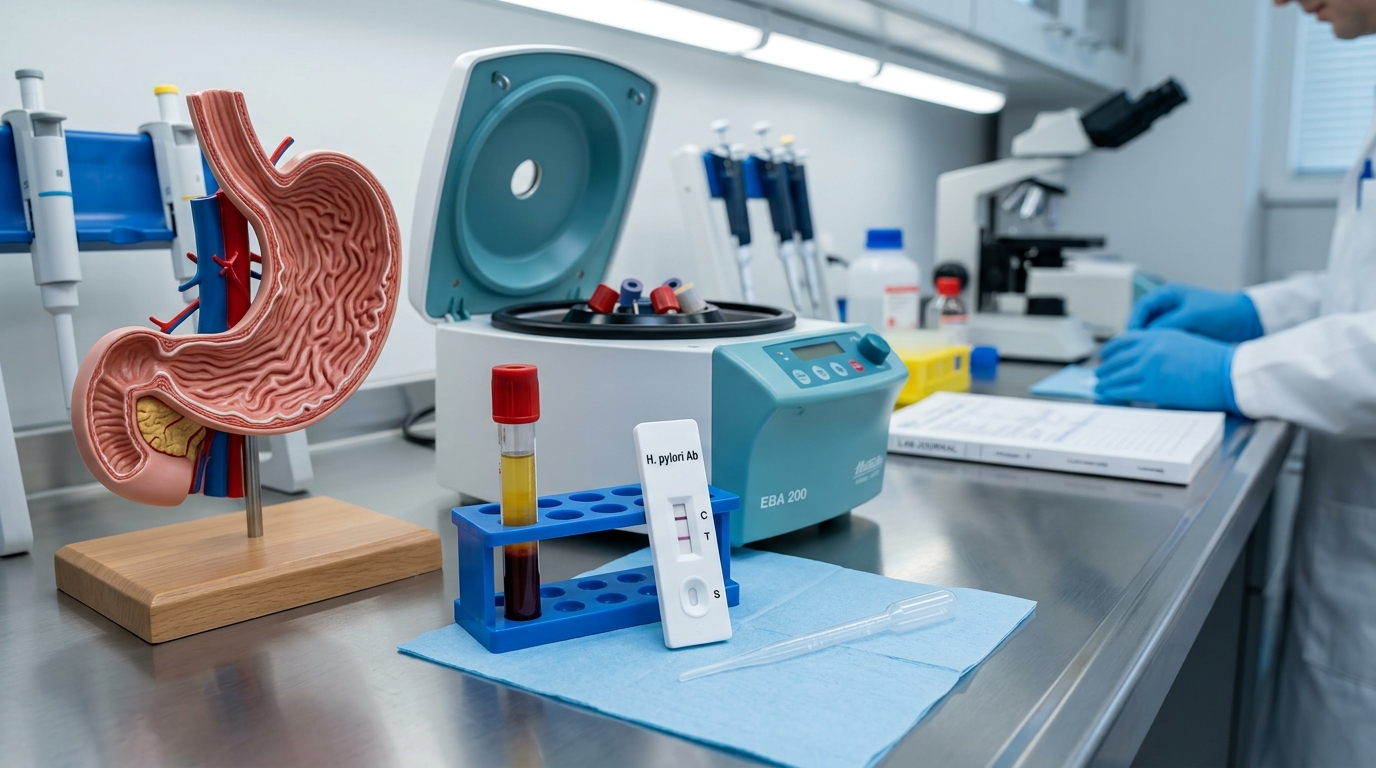
In medical centers across Dubai, Abu Dhabi, and Sharjah, precise non-invasive gastric testing prevents severe ulcer complications. Explore certified CE-IVD H. pylori stool antigen rapid test kits in Dubai delivering monoclonal antibody specificity, 15-minute point-of-care accuracy, and definitive active infection detection.
Pathophysiological Mechanisms of Gastric Colonization
Understanding bacterial virulence clarifies why active antigen detection diverges from systemic antibody persistence:
- Gastric Survival via Urease Activity: To survive the intensely acidic gastric lumen (pH 1.5–2.0), H. pylori produces copious amounts of the urease enzyme, which hydrolyzes endogenous urea into carbon dioxide and basic ammonia (NH3). The resulting neutral microenvironment “cloud” shields the bacterium from gastric acid. (This enzymatic machinery is the physiological basis of the Urea Breath Test and Rapid Urease / CLO tests).
- Mucosal Adherence and CagA/VacA Toxins: Using polar flagella, the bacterium burrows through gastric mucus to adhere to gastric foveolar epithelial cells via BabA and SabA adhesins. Strains harboring the cag pathogenicity island translocate the CagA oncoprotein via a type IV secretion system directly into host cells, inducing intense interleukin-8 (IL-8) cytokine release, neutrophilic infiltration, and cellular metaplasia. The VacA vacuolating cytotoxin induces host cell apoptosis and vacuolation.
- Shedding into Feces (Antigen Target): As colonized gastric epithelial cells naturally turn over and exfoliate, dead and viable H. pylori bacteria descend through the gastrointestinal tract. High-affinity monoclonal antibodies in stool antigen assays specifically bind these excreted structural bacterial surface proteins.
- Systemic Immune Response (Antibody Target): Mucosal infection stimulates systemic B-cells to synthesize circulating anti-H. pylori IgG antibodies. However, because mucosal immune responses cannot eradicate intra-gastric bacteria without antibiotic therapy, antibody titers persist in the bloodstream for months, years, or even decades after successful medical eradication!
Head-to-Head Diagnostic Comparison: Antibody vs Antigen vs Breath Test
The comparative diagnostic accuracy, clinical indications, and major limitations are detailed in the evidence-based reference table below:
| Diagnostic Modality | Biological Target Detected | Indicates Active Current Infection? | Suitable for Post-Treatment Eradication Check? | Impact of PPIs & Antibiotics |
|---|---|---|---|---|
| Stool Antigen Test (HpSA) (Monoclonal EIA / POC Rapid) | Bacterial surface antigens shed into feces | YES (Active Infection Confirmed) | YES (Perform ≥4 weeks post-antibiotics and ≥2 weeks post-PPI) | Yes. PPIs and antibiotics suppress bacterial shedding, causing temporary false negatives. |
| Urea Breath Test (UBT) (13C non-radioactive or 14C) | Exhaled labeled CO2 produced by bacterial urease hydrolysis | YES (Gold Standard Active Test) | YES (Perform ≥4 weeks post-antibiotics and ≥2 weeks post-PPI) | Yes. PPIs and antibiotics suppress urease activity; mandatory wash-out period required. |
| Serum Antibody Test (Total or IgG Serology) | Host circulating IgG antibodies against H. pylori | NO (Cannot distinguish past resolved infection from current active disease) | STRICTLY CONTRAINDICATED. IgG antibodies remain positive for 1 to 5+ years after cure. | None. Circulating IgG levels are unaffected by current PPI or antibiotic therapy. |
| Rapid Urease Test (RUT / CLO) | Urease activity in endoscopic gastric antral/body biopsy | YES | Used during post-treatment endoscopy (if endoscopy is clinically indicated) | Yes. PPIs reduce sensitivity; requires stopping PPI 2 weeks prior to endoscopy. |
Why International Guidelines Condemn Routine Serology
Under the European Helicobacter and Microbiota Study Group (EHMSG) Maastricht VI Consensus and the American College of Gastroenterology (ACG) guidelines, serum antibody testing is strongly discouraged:
- The “Serological Scar” Trap: When a patient with dyspepsia undergoes a blood antibody test and tests positive for H. pylori IgG, the clinician has no way of knowing whether the patient has an active peptic ulcer today or successfully cleared the infection ten years ago. Prescribing triple or quadruple antibiotic therapy based solely on a positive antibody test leads to massive unnecessary antibiotic overuse!
- Poor Positive Predictive Value (PPV): In populations with moderate to low prevalence, the PPV of serology drops below 50%, meaning more than half of antibody-positive patients are receiving antibiotics for cured historical infections.
- Only Valid Clinical Role for Serology: The sole validated indication for serology is in patients with bleeding peptic ulcers, gastric atrophy, or recent extensive antibiotic exposure where acute bacterial loads are suppressed, causing false-negative breath or stool tests. If serology is negative in this scenario, it reliably rules out H. pylori (high negative predictive value).
Pre-Analytical Medication Washout Rules for Antigen Testing
To avoid false-negative results on Stool Antigen and Urea Breath Tests, clinicians must enforce strict medication discontinuation periods:
- Proton Pump Inhibitors (PPIs): Omeprazole, Esomeprazole, Pantoprazole, Lansoprazole, and Rabeprazole must be discontinued for at least 14 days (2 weeks) prior to testing. PPIs raise gastric pH, causing H. pylori to transition from spiral to non-culturable coccoid forms and suppress urease activity. (Patients may use H2-receptor antagonists such as Famotidine or simple antacids until 24–48 hours before testing).
- Systemic Antibiotics: Any oral or parenteral antibiotic therapy must be discontinued for at least 28 to 30 days (4 weeks) prior to testing.
- Bismuth Subsalicylate Preparations: Bismuth compounds (Pepto-Bismol) exert direct bactericidal effects and must be withheld for at least 4 weeks prior to testing.
Dubai First-Line Eradication Regimens and Confirmation of Cure
Rising clarithromycin resistance in the Middle East has revolutionized therapeutic guidelines:
- First-Line Therapy (Bismuth Quadruple Therapy for 14 Days):
- Proton Pump Inhibitor (e.g., Esomeprazole 40 mg BID)
- Bismuth Subcitrate (240 mg BID or 120 mg QID)
- Metronidazole (500 mg TID or QID)
- Tetracycline Hydrochloride (500 mg QID)
- Alternative Therapy (Non-Bismuth Concomitant Therapy for 14 Days): PPI + Amoxicillin 1,000 mg BID + Clarithromycin 500 mg BID + Metronidazole 500 mg BID.
- Mandatory Test-of-Cure Protocol: Every treated patient must undergo formal eradication testing at least 4 weeks after finishing antibiotics and 2 weeks after stopping PPI therapy, utilizing either a laboratory Stool Antigen Test (HpSA) or 13C-Urea Breath Test. Testing should NEVER be performed using blood serology!
Frequently Asked Questions (Clinical FAQ)
Can a blood test prove that my H. pylori infection has been cured?
No. Blood tests measure circulating IgG antibodies produced by your immune system. These antibodies persist in your bloodstream for months to years after all bacteria have been completely eliminated. Testing blood after treatment will remain positive and cannot determine cure. Eradication must be confirmed using a Stool Antigen Test or Urea Breath Test.
Which is more accurate: the stool antigen test or the urea breath test?
Both tests demonstrate equivalent, outstanding diagnostic accuracy, with clinical sensitivities and specificities exceeding 95% in non-bleeding patients who adhere to medication washout rules. The Urea Breath Test is often preferred by adult patients for convenience, while the Stool Antigen Test is exceptionally practical for pediatric patients and clinics with rapid on-site point-of-care testing cassettes.
What should I do for stomach burning while waiting for the 2-week PPI washout?
While you must stop Proton Pump Inhibitors (such as Nexium, Losec, or Controloc) for 14 days before your stool or breath test, you can take H2-blockers (such as Famotidine 20 mg) or liquid antacids (such as Gaviscon or Maalox) up until 24 to 48 hours before your test appointment to safely control your symptoms without interfering with test accuracy.
Authoritative Clinical References
- European Helicobacter and Microbiota Study Group (EHMSG) — Management of Helicobacter pylori Infection: The Maastricht VI / Florence Consensus Report
- American College of Gastroenterology (ACG) — Clinical Guideline: Treatment and Diagnostics of Helicobacter pylori Infection
- World Health Organization (WHO) / IARC — Helicobacter pylori as a Primary Class 1 Carcinogen and Eradication Strategies