
H. Pylori Stool Antigen Rapid Test Indications: Dyspepsia Workup, Eradication Confirmation, PPI Interference & UAE Clinical Guidelines
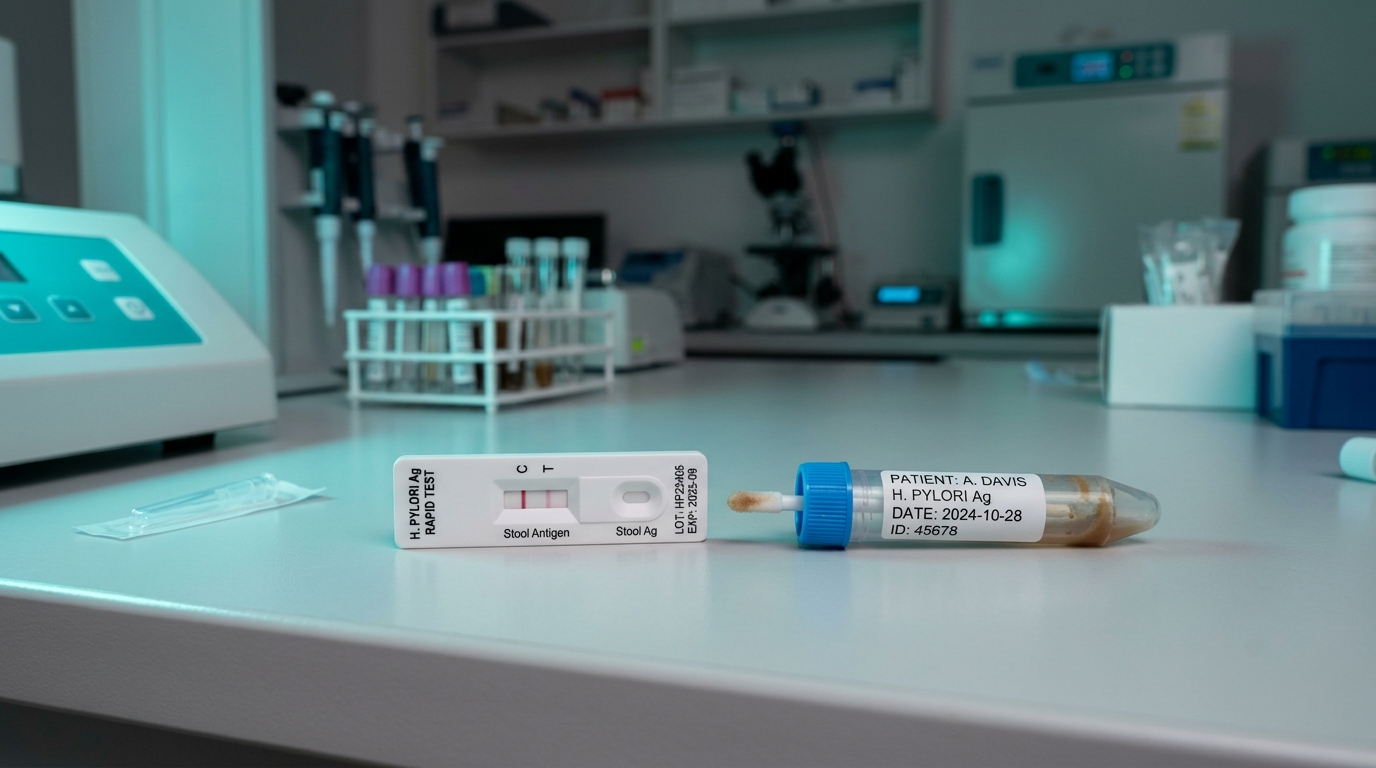
In outpatient primary care clinics and hospital networks throughout Dubai and the UAE, rapid point-of-care and laboratory-based monoclonal stool antigen tests offer instantaneous, non-invasive diagnostic precision. Sourcing validated professional rapid diagnostic test kits in the UAE ensures clinic operators meet stringent international diagnostic sensitivity benchmarks without unnecessary endoscopic delays.
Active Infection vs Past Exposure: Why Serology is Clinically Obsolete
The single greatest pitfall in community gastric diagnostic workups remains the ordering of serum H. pylori IgG antibodies. Serological tests merely reflect immunological memory; circulating antibodies persist for years or even decades following successful spontaneous or antimicrobial bacterial eradication. Consequently, serology exhibits an unacceptably high rate of false-positive results, cannot differentiate past cured infection from active bacterial carriage, and must never be used to confirm therapeutic cure.
- Direct Biomarker Detection: The monoclonal Stool Antigen Test (SAT) utilizes highly specific antibodies targeting flagellar and surface structural antigens actively shed by viable H. pylori into the gastrointestinal lumen.
- Equivalence to Urea Breath Test: In extensive meta-analyses, laboratory-based monoclonal SAT demonstrates clinical sensitivity and specificity exceeding 94% to 97%, performing equivalently to the 13C-Urea Breath Test (UBT) while avoiding radioactive/isotope exposure and specialized breath collection equipment.
- Pediatric & Elderly Compliance: Stool collection eliminates the active cooperation required for deep respiratory breath-holds in UBT, making SAT the modality of choice for infants, young children, and uncooperative elderly patients.
Comprehensive Clinical Indications for H. Pylori Stool Antigen Testing
International gastroenterology clinical guidelines delineate explicit clinical pathways indicating when monoclonal stool antigen testing should be implemented:
| Diagnostic Indication | Target Patient Cohort | Clinical Guidelines & Benchmarks | Clinical Objective |
|---|---|---|---|
| Uninvestigated Dyspepsia (< 50 Years) | Patients presenting with epigastric burning, postprandial fullness, or early satiety | Maastricht VI / ACG “Test-and-Treat” strategy | Cures underlying gastritis and prevents peptic ulcer progression without requiring invasive esophagogastroduodenoscopy (EGD). |
| Post-Eradication Confirmation | All patients who completed 14-day antibiotic eradication therapy | Strictly ≥ 4 weeks post-antibiotic and ≥ 2 weeks post-PPI cessation | Documents microbiological cure and detects therapeutic resistance requiring secondary rescue regimens. |
| Unexplained Iron-Deficiency Anemia | Patients with refractory microcytic anemia unresponsive to oral iron | British Society of Gastroenterology (BSG) guidelines | H. pylori impairs gastric ascorbic acid secretion and causes occult mucosal bleeding; eradication restores iron homeostasis. |
| Immune Thrombocytopenic Purpura (ITP) | Adults with isolated low platelet counts | American Society of Hematology (ASH) guidelines | Molecular mimicry between H. pylori CagA antigen and platelet glycoproteins triggers autoimmune destruction; eradication resolves ITP in 50% of cases. |
| Pre-Chronic NSAID / Aspirin Therapy | Patients initiating long-term non-steroidal anti-inflammatory drugs | Maastricht VI consensus recommendations | Eliminates synergistic mucosal ulceration risk, dramatically cutting gastrointestinal bleeding events by over 70%. |
| Family History of Gastric Carcinoma | First-degree relatives of patients diagnosed with gastric cancer | European Society of Gastrointestinal Endoscopy (ESGE) | Primary chemoprevention against progressive atrophic gastritis, intestinal metaplasia, and malignant transformation. |
Crucial Pre-Analytical Washout Rules: Avoiding the False-Negative Trap
The reliability of stool antigen testing depends fundamentally on avoiding pharmacologic suppression of bacterial density. Suppressing bacterial reproduction causes transient antigen reduction below the assay’s limit of detection, causing dangerous false-negative results:
- Proton Pump Inhibitors (PPIs) — Minimum 2-Week Washout: Medications such as Omeprazole, Esomeprazole, Lansoprazole, and Pantoprazole directly inhibit gastric urease and suppress bacterial load. All PPIs must be discontinued for a minimum of 14 full days before stool specimen collection. If symptomatic acid suppression is essential, clinicians may switch patients to H2-receptor antagonists (Famotidine) or antacids, which do not interfere with SAT accuracy.
- Antibiotics & Bismuth Subsalicylate — Minimum 4-Week Washout: Any systemic antibiotic treatment or bismuth-containing mucosal agents drastically reduce H. pylori antigen shedding. Testing must be delayed for at least 4 full weeks following the last ingested dose of antibiotics or bismuth compounds.
- Specimen Consistency & Handling: Watery, diarrheal stool specimens dilute antigen concentration and must be rejected. Formed or semi-formed stool collected in clean, preservative-free containers should be tested immediately or stored refrigerated at 2°C to 8°C for no longer than 48 hours to prevent proteolytic degradation.
Monoclonal vs Polyclonal Antibodies in Stool Antigen Rapid Cassettes
When selecting rapid lateral flow chromatographic cassettes or laboratory ELISA assays, healthcare professionals must differentiate between monoclonal and polyclonal reagents. Older assays utilized polyclonal antibodies derived from animal antiserum. These suffered from significant batch-to-batch variability and cross-reacted with other gastrointestinal microflora, yielding lower specificity (~80%).
In contrast, monoclonal antibody assays target discrete, highly conserved epitope sequences of H. pylori surface antigens. Monoclonal lateral flow cassettes deliver analytical sensitivity > 96% and analytical specificity > 98%, matching the diagnostic accuracy of centralized laboratory microplate spectrophotometers while delivering actionable results within 10 to 15 minutes in community clinical environments.
When Endoscopy (EGD) is Mandated Over Stool Testing
While the non-invasive “test-and-treat” paradigm using stool antigen is optimal for younger dyspeptic patients, clinicians must strictly observe alarm red-flag symptoms. Patients presenting with any of the following features are not candidates for solitary stool antigen testing and must be immediately referred for urgent upper GI endoscopy with mucosal biopsy:
- Unintentional, progressive weight loss.
- Progressive dysphagia (difficulty swallowing) or odynophagia (painful swallowing).
- Persistent, intractable vomiting.
- Evidence of overt gastrointestinal bleeding (melena, hematemesis) or unexplained profound anemia.
- New-onset dyspeptic symptoms in patients aged ≥ 50 to 55 years (depending on local gastric malignancy regional epidemiology).
- Palpable epigastric mass or persistent lymphadenopathy.
Frequently Asked Questions (FAQ)
Can stool antigen testing distinguish between antibiotic-resistant H. pylori strains?
No. Standard stool antigen rapid tests detect structural bacterial proteins but do not perform genotypic sequencing. If clarithromycin or levofloxacin resistance is suspected due to repeated treatment failures, stool molecular PCR testing for 23S rRNA mutations or endoscopic culture with antimicrobial susceptibility testing (AST) is indicated.
What is the recommended first-line treatment if the stool test is positive in the UAE?
Due to high regional clarithromycin resistance exceeding 15–20% in the Middle East, the Maastricht VI and UAE guidelines recommend 14-day Bismuth Quadruple Therapy (PPI, Bismuth subcitrate/subsalicylate, Metronidazole, and Tetracycline) as the optimal first-line empirical eradication regimen.
Why must patients wait 4 weeks post-treatment before taking a confirmation stool test?
A 4-week interval is necessary to allow residual non-viable bacterial antigens to be completely cleared from the gastric lumen and to ensure that any surviving bacteria have replicated to detectable threshold levels if treatment was unsuccessful.
Authoritative Clinical References
- Gut Journal – Management of Helicobacter pylori Infection: The Maastricht VI/Florence Consensus Report
- American College of Gastroenterology (ACG) – ACG Clinical Guideline: Treatment of Helicobacter pylori Infection
- British Society of Gastroenterology (BSG) – Guidelines on the Management of Dyspepsia and Peptic Ulcer Disease