
H. pylori Stool Antigen vs. Urea Breath Test: Clinical Accuracy, Diagnostic Indications, PPI Washout & UAE Guidelines
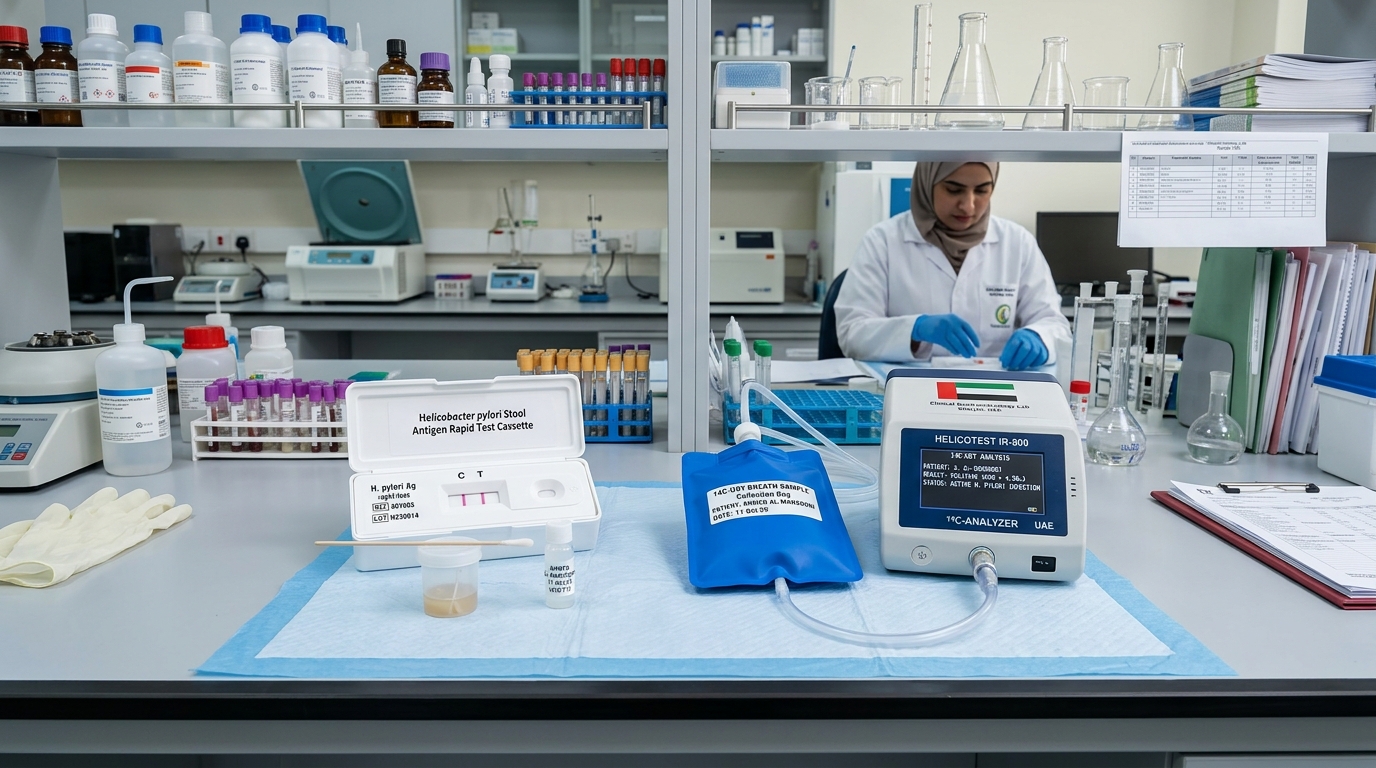
In clinics and hospitals across Dubai, Abu Dhabi, and Sharjah, dyspepsia, acid reflux, epigastric pain, and bloating represent extremely common patient complaints. Because serological antibody testing cannot differentiate past resolved exposure from active infection, international consensus guidelines mandate active non-invasive testing. Accessing certified advanced gastrointestinal rapid test kits in UAE enables clinicians to achieve rapid bedside confirmation of H. pylori colonization, facilitating timely triple- or quadruple-therapy eradication regimens.
Biological Mechanisms: How Each Modality Detects H. pylori
The two non-invasive gold-standard modalities utilize fundamentally different physiological mechanisms to confirm active bacterial presence:
- The Urea Breath Test (UBT): Exploits H. pylori’s potent internal urease enzyme. The patient ingests a capsule or liquid containing isotopically labeled urea (either non-radioactive Carbon-13 or low-dose radioactive Carbon-14). In the presence of gastric H. pylori, bacterial urease rapidly hydrolyzes urea into ammonia and labeled carbon dioxide (13CO2 or 14CO2). The labeled CO2 is absorbed into the bloodstream and exhaled through the lungs, where it is measured in a breath collection bag using infrared spectrometry or scintillation counters.
- The Stool Antigen Test (SAT): Directly detects shed bacterial outer membrane antigens in the patient’s stool specimen. Modern laboratory assays and rapid point-of-care cassettes utilize monoclonal antibodies directed against specific H. pylori surface proteins, delivering a visible test band within 10 to 15 minutes.
Head-to-Head Comparative Matrix
A detailed side-by-side comparison across key diagnostic, practical, and clinical parameters:
| Comparative Parameter | 13C/14C Urea Breath Test (UBT) | Monoclonal Stool Antigen Test (SAT) |
|---|---|---|
| Clinical Sensitivity | 95% to 98% | 94% to 97% (Monoclonal formats) |
| Clinical Specificity | 96% to 99% | 95% to 98% |
| Primary Diagnostic Target | Bacterial urease enzymatic activity | Shed bacterial surface structural antigens |
| Time to Result | 15 to 30 Minutes (On-site analyzer) | 10 to 15 Minutes (Rapid cassette) or 24h (ELISA) |
| Patient Experience | Pleasant, breath-exhalation into bag | Requires stool collection container (Lower compliance) |
| Suitability in Young Children | Challenging in children <5 years (Swallowing/breathing protocol) | Ideal for pediatrics, elderly, and non-verbal patients |
| Impact of Active GI Bleeding | False-negative rate elevated due to blood buffering | False-negative rate elevated due to blood dilution |
| Capital Equipment Required | Dedicated infrared spectrometer or scintillation counter | None (Self-contained rapid cassette) or standard plate reader |
The Critical Medication Washout Period: Avoiding False Negatives
The most common cause of diagnostic failure for BOTH the breath test and stool antigen test is failure to observe mandatory pre-test medication washout intervals. Medications that suppress bacterial load or inhibit urease activity create falsely negative results:
| Medication Class | Examples | Mandatory Washout Interval Before Testing | Underlying Mechanism of Interference |
|---|---|---|---|
| Proton Pump Inhibitors (PPIs) | Omeprazole, Esomeprazole, Pantoprazole, Rabeprazole | At least 2 Weeks (14 Days) | Elevates gastric pH, causing H. pylori to transform into dormant coccoid forms with suppressed urease activity |
| Antibiotics | Amoxicillin, Clarithromycin, Metronidazole, Levofloxacin | At least 4 Weeks (28 Days) | Temporarily suppresses bacterial density below analytical detection thresholds |
| Bismuth Compounds | Bismuth subsalicylate (Pepto-Bismol) | At least 4 Weeks (28 Days) | Exerts direct antibacterial action against H. pylori |
| H2-Receptor Antagonists | Famotidine, Cimetidine | 24 to 48 Hours | Minimal interference, but stopping 2 days prior is recommended |
| Antacids (Simple Neutralizers) | Gaviscon, Maalox, Tums | No washout needed (Can take up to night before) | Does not alter bacterial physiology or enzyme synthesis |
Test of Cure (TOC): Confirming Eradication Post-Treatment
Due to surging global and regional antibiotic resistance—especially Clarithromycin resistance exceeding 20% in the Middle East—treatment failure occurs in 15% to 25% of eradication attempts. A Test of Cure is mandatory for all treated patients:
- Timing Milestone: Testing must be performed strictly 4 to 8 weeks after completing antibiotic therapy, and at least 2 weeks after stopping PPI maintenance therapy.
- Endorsed Modalities: Both UBT and monoclonal Stool Antigen Testing are fully validated for post-treatment confirmation.
- Contraindicated Modality: H. pylori serology (blood antibody testing) is STRICTLY CONTRAINDICATED for assessing cure. IgG antibodies persist in circulating blood for months to years after successful microbial eradication, leading to false-positive diagnoses of treatment failure.
Clinical Decision Framework: Which Test to Order?
UAE gastroenterology consensus algorithms recommend test selection based on patient-specific factors:
- Choose the Urea Breath Test When: Patient is an adult or child over 6 years who prefers an immediate, clean, breath-based test without stool handling; analyzer is on-site in clinic; high patient compliance is needed.
- Choose the Stool Antigen Test When: Patient is a young child under 5 years, elderly or bedridden patient unable to blow into a collection bag, rural/outreach setting without breath spectrometry equipment, or when immediate low-cost bedside rapid cassette triage is required.
- Choose Upper Endoscopy (EGD + Biopsy) When: Patient exhibits “Alarm Features” (Ages >55 with new-onset dyspepsia, unintentional weight loss, progressive dysphagia, persistent vomiting, iron-deficiency anemia, or family history of gastric cancer).
Frequently Asked Questions (FAQ)
Is the Carbon-14 Urea Breath Test safe during pregnancy?
The 14C-UBT uses a very low micro-curie radioactive dose (less than normal daily background radiation). However, in pregnant or lactating women, guidelines recommend the completely non-radioactive Carbon-13 (13C) Urea Breath Test or a Monoclonal Stool Antigen Test.
What is the difference between polyclonal and monoclonal stool antigen tests?
Early stool antigen tests used polyclonal antibodies which suffered from batch-to-batch variation and cross-reacted with normal gut flora, yielding lower accuracy. Modern monoclonal antibody assays recognize specific invariant H. pylori epitopes, achieving sensitivity and specificity exceeding 95%, matching the breath test.
Can I brush my teeth or drink water before a urea breath test?
Patients must fast (no food or drink) for at least 4 to 6 hours before the urea breath test. Small sips of plain water are permitted up to 2 hours before testing. Brushing teeth is encouraged to eliminate oral urease-producing bacteria (such as Streptococcus species) that could cause false-positive breath results.
Scientific References & Authoritative Clinical Guidelines
- Management of Helicobacter pylori infection: The Maastricht VI/Florence Consensus Report. Gut, 2022/2024.
- American College of Gastroenterology (ACG). ACG Clinical Guideline: Treatment and Diagnostic Modalities for Helicobacter pylori Infection. Am J Gastroenterol, 2024.
- Dubai Health Authority (DHA). Diagnostic Guidelines for Dyspepsia and Upper Gastrointestinal Pathologies in Outpatient Practice. UAE Health Regulations, 2024.