
Male Hormone Panel Fertility Testing Meaning: Total vs Free Testosterone, FSH, LH, Prolactin & Andrology Evaluation Guidelines
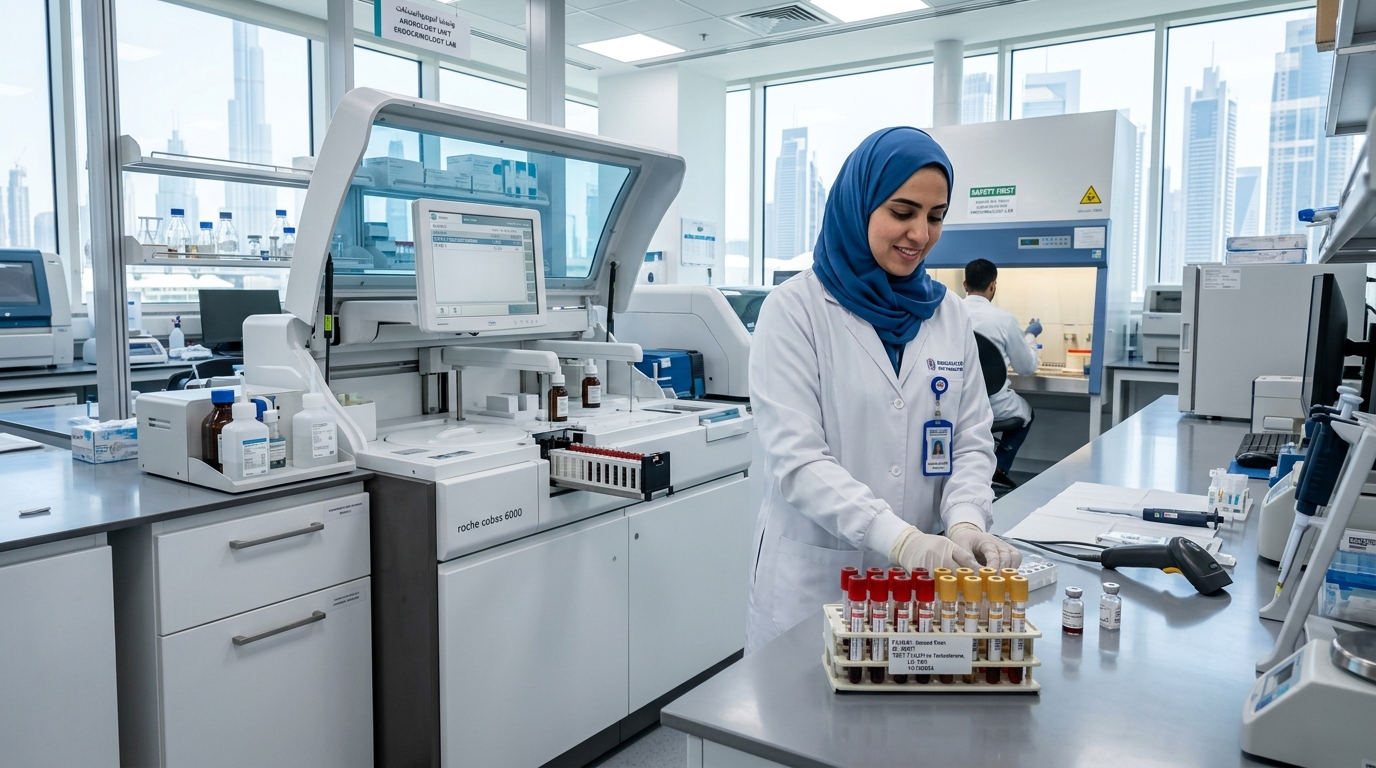
In modern reproductive medical centers and andrology clinics across Dubai, Abu Dhabi, and the wider UAE, comprehensive endocrine profiling identifies treatable hormonal causes of subfertility. Sourcing validated professional fertility and diagnostic systems in Dubai ensures patients and physicians obtain reliable, precision-calibrated hormonal data.
The Hypothalamic-Pituitary-Gonadal (HPG) Axis in Men
To interpret male hormone results, clinicians must understand the dual-compartment physiology of the human testis:
- The Seminiferous Tubule Compartment (Sertoli Cells & Spermatogenesis): Regulated primarily by Follicle-Stimulating Hormone (FSH). FSH binds Sertoli cells (“nurse cells”) lining the seminiferous tubules, stimulating the production of Androgen-Binding Protein (ABP) and facilitating germ cell development. Sertoli cells secrete Inhibin B, which feeds back negatively on the anterior pituitary to control FSH output. When seminiferous tubules are damaged or depleted, Inhibin B plummets, causing serum FSH to rise dramatically.
- The Interstitial Compartment (Leydig Cells & Steroidogenesis): Regulated primarily by Luteinizing Hormone (LH). LH binds Leydig cell surface receptors in the testicular interstitium, stimulating enzymatic synthesis of Testosterone. Circulating testosterone aromatizes to estradiol, which exerts negative feedback on both the hypothalamus (GnRH) and pituitary (LH).
- Intratesticular Testosterone Requirement: Crucially, the local concentration of testosterone within the testicular tissue must be 50 to 100 times higher than circulating blood levels to sustain spermatogenesis. Systemic blood testosterone levels do not reflect intratesticular concentration.
Comprehensive Male Hormone Panel: Reference Limits & Significance
Clinical practice guidelines from the American Urological Association (AUA) and the European Association of Urology (EAU) define specific reference parameters:
| Hormonal Parameter | Standard Adult Reference Range | Optimal Fertility Target | Clinical & Diagnostic Significance |
|---|---|---|---|
| Serum Total Testosterone | 300 – 1,000 ng/dL (10.4 – 34.7 nmol/L) | > 400 – 500 ng/dL | Early-morning fasting sample (08:00–10:00 AM); reflects total Leydig cell steroidogenesis; uninterpretable without SHBG in obesity. |
| Calculated Free Testosterone | 50 – 210 pg/mL (Varies by assay) | > 65 – 80 pg/mL | Biologically active, unbound fraction; crucial for symptomatic hypogonadal men with altered SHBG levels (obesity, diabetes). |
| Follicle-Stimulating Hormone (FSH) | 1.5 – 12.4 mIU/mL | 1.5 – 8.0 mIU/mL | Direct indicator of seminiferous tubule health. Values > 10–12 indicate primary testicular failure; low/normal in azoospermia suggests obstruction or hypogonadism. |
| Luteinizing Hormone (LH) | 1.7 – 8.6 mIU/mL | 2.0 – 6.0 mIU/mL | Reflects pituitary drive to Leydig cells. Elevated LH with low testosterone = primary hypogonadism; low LH with low testosterone = secondary hypogonadism. |
| Serum Prolactin | 4.0 – 15.2 ng/mL | < 15.0 ng/mL | Elevated prolactin (> 25 ng/mL) suppresses GnRH pulsatility, causing secondary hypogonadism, low libido, and severe oligospermia; warrants pituitary MRI. |
| Serum 17-Beta Estradiol (E2) | 10 – 40 pg/mL | 15 – 30 pg/mL (T:E2 ratio > 10:1) | Elevated estradiol (> 50 pg/mL) in overweight men suppresses the HPG axis via negative feedback; treated with aromatase inhibitors (Anastrozole). |
Diagnostic Endocrine Patterns: Deciphering the Results
Combining hormone results with semen analysis categorizes male subfertility into distinct clinical pathways:
- Pattern 1: Hypergonadotropic Hypogonadism (Primary Testicular Failure):
- Lab Findings: High FSH (> 12 mIU/mL), High/Normal LH, Low or Normal Testosterone.
- Etiology: Intrinsic testicular damage—Klinefelter syndrome (47,XXY), mumps orchitis, bilateral cryptorchidism, chemotherapy/radiation, or Y-chromosome microdeletions.
- Management: Exogenous gonadotropins or SERMs are ineffective because the testes cannot respond. Management focuses on Micro-TESE surgical sperm retrieval or donor options.
- Pattern 2: Hypogonadotropic Hypogonadism (Secondary Testicular Failure):
- Lab Findings: Low or Inappropriately Normal FSH and LH, Low Testosterone (< 300 ng/dL).
- Etiology: Pituitary adenoma, Kallmann syndrome, severe systemic illness, or exogenous anabolic steroid abuse.
- Management: Highly treatable! Gonadotropin replacement therapy (hCG combined with recombinant FSH or human menopausal gonadotropin [hMG]) stimulates Leydig and Sertoli cells, successfully restoring spermatogenesis in > 80% of men.
- Pattern 3: Obstructive Azoospermia with Normal Spermatogenesis:
- Lab Findings: Normal FSH (1.5–8.0 mIU/mL), Normal LH, Normal Testosterone, Zero sperm in semen.
- Etiology: Physical blockage of the reproductive tract (congenital bilateral absence of the vas deferens [CBAVD], post-vasectomy, or epididymal obstruction).
- Management: Excellent prognosis. Testicular sperm extraction (PESA/TESA) yields viable mature sperm with > 95% success for ICSI.
The Anabolic Steroid Crisis: The Pituitary Shutdown
A major cause of severe oligospermia and azoospermia in young athletic men across the UAE is illicit anabolic-androgenic steroid (AAS) or exogenous testosterone use:
The Pathological Mechanism: Exogenous testosterone floods the bloodstream, triggering overwhelming negative feedback on the hypothalamus and anterior pituitary. The pituitary completely ceases LH and FSH production (often < 0.5 mIU/mL). Deprived of LH stimulation, intratesticular testosterone collapses to zero, and Sertoli cells undergo atrophy, shutting down sperm production entirely. Recovery following AAS cessation can take 6 to 18 months, often requiring medical intervention with hCG and Clomiphene citrate.
Pre-Analytical Testing Rules: The 08:00–10:00 AM Requirement
To avoid false diagnoses of hypogonadism, blood collection must adhere to strict circadian biology:
- Diurnal Rhythm: Serum testosterone exhibits a profound circadian variation, peaking in the early morning (07:00 to 09:00 AM) and dropping by up to 30% to 40% in the late afternoon. Blood must be drawn between 08:00 AM and 10:00 AM in a fasting state.
- Confirmatory Testing: A low testosterone measurement must never be diagnosed on a single blood draw. Guidelines mandate repeating the measurement on a second morning at least one week later.
Frequently Asked Questions (FAQ)
Can taking testosterone replacement therapy (TRT) cure male infertility?
No! Prescribing TRT to an infertile man is a major medical malpractice error. Exogenous testosterone acts as a male contraceptive: it suppresses pituitary LH and FSH, eliminates intratesticular testosterone production, and halts spermatogenesis entirely. Men seeking fertility must never receive TRT.
How does Clomiphene Citrate increase sperm count in men?
Clomiphene citrate is a selective estrogen receptor modulator (SERM). In men, it blocks estrogen receptors in the hypothalamus and pituitary, preventing estrogen’s negative feedback. The pituitary responds by releasing more endogenous LH and FSH, boosting natural intratesticular testosterone and stimulating sperm production.
What is the clinical significance of a high Testosterone-to-Estradiol (T:E2) ratio?
A normal T:E2 ratio is greater than 10:1 (when testosterone is measured in ng/dL and estradiol in pg/mL). In overweight men with excess aromatase enzyme activity, estradiol rises and the ratio drops below 10:1. Aromatase inhibitors (such as Anastrozole 1 mg twice weekly) normalize this ratio, frequently improving sperm motility and concentration.
Authoritative Clinical References
- American Urological Association (AUA) & ASRM – Diagnosis and Treatment of Infertility in Men: AUA/ASRM Guideline (2020)
- European Association of Urology (EAU) – Guidelines on Sexual and Reproductive Health
- The Endocrine Society – Testosterone Therapy in Men with Hypogonadism: An Endocrine Society Clinical Practice Guideline