
Mycoplasma Genitalium Symptoms in Women: Pelvic Inflammatory Disease Risks, NAAT Diagnostics & Dubai STI Management
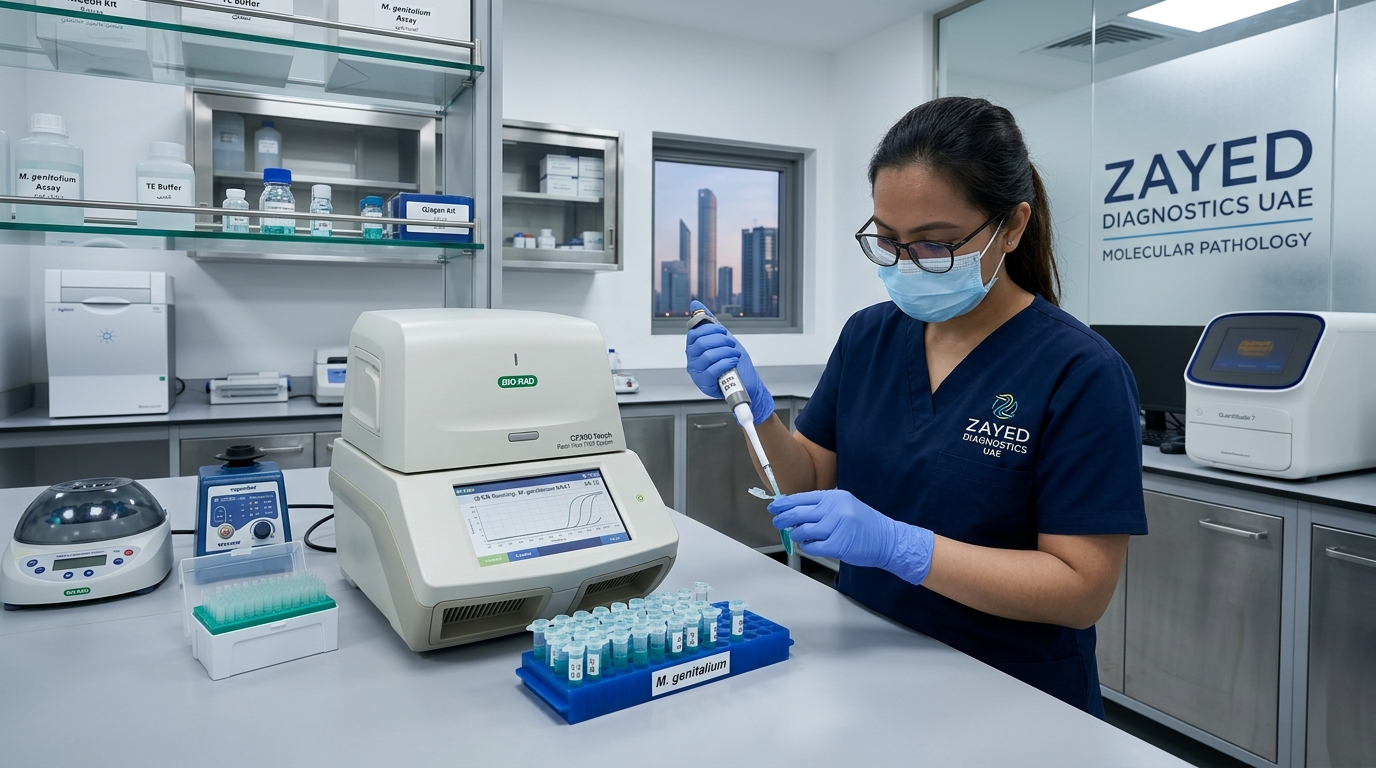
In women’s health clinics throughout Dubai and Abu Dhabi, objective molecular STI screening prevents chronic pelvic complications. Explore confidential comprehensive sexual health testing packages in Dubai delivering multiplex real-time PCR detection for M. genitalium, Chlamydia, Gonorrhea, and Trichomonas under complete medical privacy.
Microbiology and Pathogenic Mechanisms in the Female Genital Tract
To understand the clinical manifestations in female patients, clinicians must examine the unique biology of M. genitalium:
- Extremely Small Genome and Absence of Peptidoglycan Cell Wall: With a minute genome of only 580 kilobases (encoding ~482 proteins), MGen is among the smallest self-replicating prokaryotes. Lacking a rigid bacterial peptidoglycan cell wall, MGen is intrinsically 100% resistant to all beta-lactam antibiotics (penicillins, cephalosporins, carbapenems) and glycopeptides.
- Terminal Attachment Organelle (MgPa Protein): MGen possesses a specialized flask-shaped terminal attachment organelle equipped with the MgPa tip adhesin complex. This organelle facilitates high-affinity adherence to host mucosal epithelial cells and provides gliding motility, enabling the bacterium to ascend past the cervical mucus plug into the sterile upper genital tract (endometrium, fallopian tubes, and peritoneal cavity).
- Intracellular Sequestration and Chronic Inflammation: Once attached, MGen invades host epithelial cells and evades mucosal phagocytosis. Intracellular survival triggers persistent release of inflammatory cytokines (interleukin-6, interleukin-8, TNF-alpha), recruiting neutrophils and causing mucosal friability, micro-ulceration, and contact bleeding.
Clinical Spectrum of Symptoms in Female Patients
While often silent, symptomatic MGen in women manifests across a spectrum of lower and upper genital tract pathologies:
| Anatomical Site / Syndrome | Clinical Manifestations & Patient Symptoms | Physical Examination Findings |
|---|---|---|
| Mucopurulent Cervicitis | Altered, yellowish/greenish vaginal discharge; dyspareunia (painful intercourse); deep pelvic aching | Hyperemic, friable ectocervix; contact bleeding upon touching with collection swab; purulent exudate at cervical os |
| Abnormal Uterine Bleeding | Post-coital bleeding (bleeding immediately following intercourse); intermenstrual spotting between periods | Endocervical micro-ulceration and capillary engorgement visible on speculum examination |
| Urethritis & Dysuria | Internal stinging or burning during urination; urinary frequency; absence of true cystitis pathogens on urine culture | Meatal erythema; sterile pyuria (≥10 WBC/HPF on centrifuged urine without bacteria on Gram stain) |
| Pelvic Inflammatory Disease (PID) | Bilateral lower abdominal/pelvic pain; dyspareunia; malaise; low-grade fever; pelvic heaviness | Cervical motion tenderness (“chandelier sign”); uterine fundal tenderness; bilateral adnexal fullness or tenderness |
| Asymptomatic Carriage | Completely asymptomatic (present in 40%–70% of infected females); unaware of infection | Normal physical examination; diagnosed during routine screening or partner notification contact tracing |
Severe Long-Term Reproductive Sequelae
Untreated persistent MGen infection carries profound reproductive consequences for women:
- Tubal Factor Infertility: Chronic ascending salpingitis causes mucosal damage to fallopian tube ciliated endosalpinx cells, resulting in intratubal scarring, fimbrial phimosis, and complete tubal occlusion (hydrosalpinx), doubling the risk of female infertility.
- Ectopic Pregnancy: Partial endosalpingeal deciliation impairs the transport of fertilized blastocysts toward the uterine cavity, significantly increasing the relative risk of life-threatening tubal ectopic pregnancy.
- Adverse Pregnancy Outcomes: Active MGen infection during pregnancy is strongly associated with chorioamnionitis, spontaneous second-trimester abortion, and a two-fold increase in preterm birth (<37 weeks gestation).
Diagnostic Modalities: Why NAAT is the Only Valid Option
Traditional diagnostic modalities completely fail in the detection of Mycoplasma genitalium:
- Failure of Culture: MGen is extraordinarily fastidious, requiring specialized SP-4 medium and up to 2 to 6 months of incubation in specialized reference laboratories. Routine clinical bacterial culture is impossible.
- Failure of Microscopy: Due to its lack of a cell wall and minute dimensions (0.2 µm), MGen cannot be seen on standard Gram stain light microscopy.
- Nucleic Acid Amplification Testing (NAAT) as the Gold Standard: Certified real-time PCR or transcription-mediated amplification (TMA) targeting the 16S rRNA or MgPa gene demonstrates sensitivity and specificity >95% to 98%.
- Optimal Specimen Selection in Women:
- First Choice: Self-collected or clinician-collected vaginal swab (flocked nylon swab placed in molecular transport buffer). Vaginal swabs yield significantly higher bacterial loads and sensitivity (95%–98%) than first-void urine in women.
- Second Choice: Endocervical swab collected during speculum exam (90%–95% sensitivity).
- Third Choice: First-void urine (sensitivity only 60%–75% in females; should only be utilized if vaginal swabbing is unacceptable to the patient).
The Antibiotic Resistance Crisis & Resistance-Guided Therapy
Widespread misuse of single-dose azithromycin has driven catastrophic antimicrobial resistance in M. genitalium:
- Macrolide Resistance Epidemic (23S rRNA Mutations): Point mutations at positions 2058 and 2059 (E. coli numbering) in region V of the bacterial 23S rRNA gene confer high-level resistance to Azithromycin. Globally and across the Middle East, macrolide resistance rates currently exceed 50% to 70%! Single-dose 1 g Azithromycin fails in the majority of cases and actively selects for resistant mutants.
- Quinolone Resistance (parC Gene Mutations): Mutations in the parC gene (encoding topoisomerase IV, particularly S83I) confer resistance to second-line fluoroquinolones (Moxifloxacin), resulting in dual-class resistant superbug strains.
- The Resistance-Guided Treatment Algorithm (CDC / IUSTI / BASHH Standards):
- Step 1 (Pre-Treatment / Debulking Phase): All patients are immediately initiated on Doxycycline 100 mg orally twice daily for 7 days. Doxycycline suppresses bacterial load and reduces organism titers, although its single cure rate is only 30%–40%.
- Step 2 (Pathogen-Specific Consolidation):
- If Macrolide-Sensitive (or resistance testing unavailable): Follow Doxycycline immediately with Azithromycin: 1 g orally on Day 1, followed by 500 mg orally once daily on Days 2, 3, and 4 (Total dose 2.5 g).
- If Macrolide-Resistant (or treatment failure): Follow Doxycycline immediately with Moxifloxacin 400 mg orally once daily for 7 days (extended to 14 days in complicated Pelvic Inflammatory Disease).
- Mandatory Test-of-Cure (TOC): Because clinical symptom resolution does not guarantee microbiological eradication, a repeat NAAT swab is mandatory 3 to 4 weeks after finishing antibiotic therapy. Testing before 3 weeks risks false-positive detection of non-viable residual bacterial DNA.
Frequently Asked Questions (Clinical FAQ)
Can Mycoplasma genitalium be detected on a standard routine Pap smear?
No. A routine liquid-based Pap smear is designed to screen for abnormal cervical cellular dysplasia caused by Human Papillomavirus (HPV). It does not test for bacteria. To detect Mycoplasma genitalium, a specific molecular PCR swab must be requested alongside your sexual health panel.
Does my partner need to be treated if only I tested positive for MGen?
Yes, absolutely. Current sexual partners must be treated simultaneously with the exact same resistance-guided antibiotic regimen, regardless of whether they have symptoms or have received their test results. Both partners must strictly abstain from all sexual contact until both complete treatment and a negative Test-of-Cure is documented, preventing “ping-pong” reinfection.
Can MGen be cured with over-the-counter antibiotics or home remedies?
No. Mycoplasma genitalium lacks a cell wall and has developed extensive resistance to common antibiotics. It cannot be cured with over-the-counter medications, herbal remedies, or single-dose treatments. It requires a precise, doctor-prescribed two-step antibiotic regimen combining Doxycycline with high-dose Azithromycin or Moxifloxacin.
Authoritative Clinical References
- Centers for Disease Control and Prevention (CDC) — Mycoplasma genitalium Treatment Guidelines and Resistance Management
- International Union against Sexually Transmitted Infections (IUSTI) — European Guideline on Mycoplasma genitalium Infections
- British Association for Sexual Health and HIV (BASHH) — National Guideline for the Management of Infection with Mycoplasma genitalium