
Ovulation Hormone Testing Fertility Testing Meaning: LH Surge Kits, Mid-Luteal Progesterone, AMH Ovarian Reserve & Dubai Conception Protocols
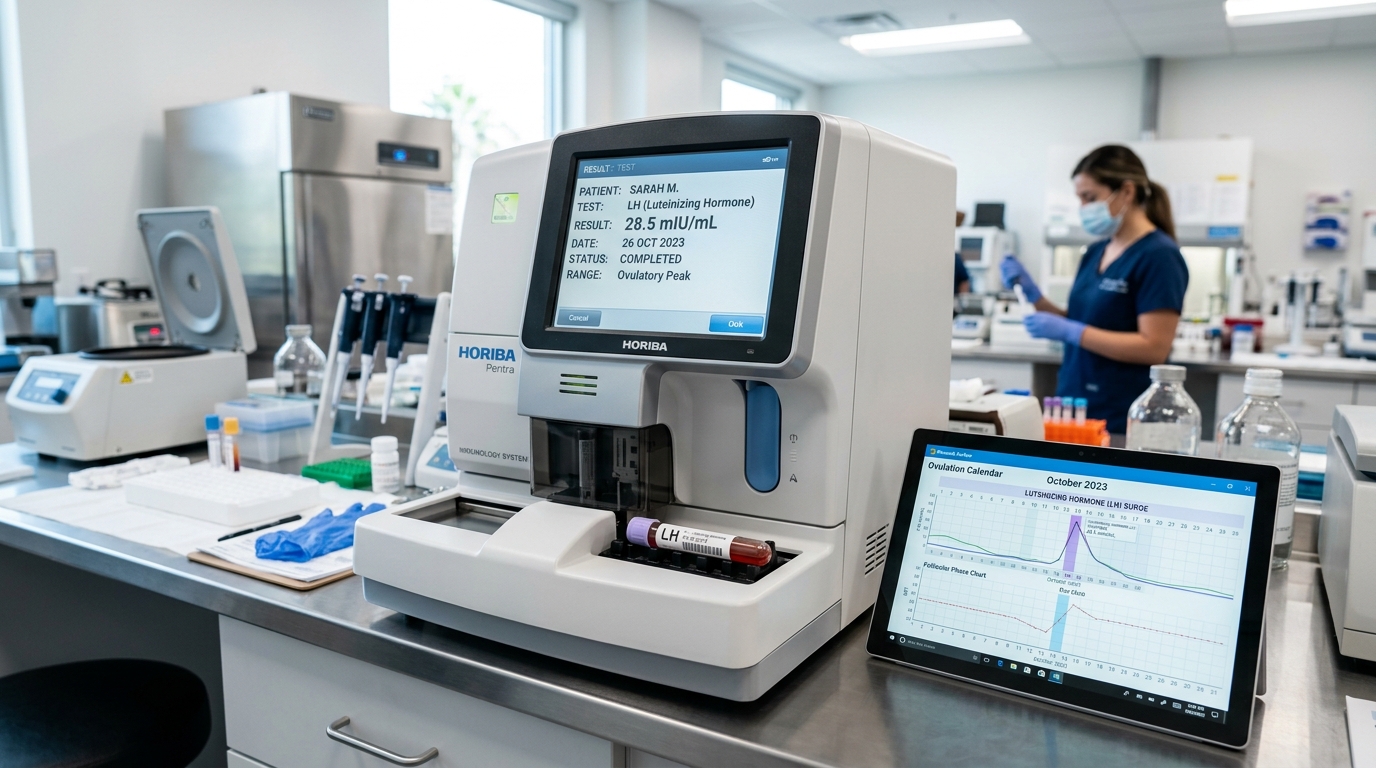
In modern reproductive medicine and fertility centers across Dubai, Abu Dhabi, and the wider UAE, precise hormonal profiling eliminates trial-and-error guesswork. Accessing validated professional fertility and diagnostic test kits in the UAE empowers women to track biological ovulation signals with maximum scientific accuracy.
The Hormonal Cascade of Ovulation: Physiological Foundations
A normal ovulatory menstrual cycle is governed by tightly choreographed endocrine feedback loops spanning four sequential phases:
- Early Follicular Phase (Days 1–5): The anterior pituitary gland secretes Follicle-Stimulating Hormone (FSH) in response to pulsatile GnRH, recruiting a cohort of antral follicles. Ovarian granulosa cells begin producing basal 17-beta estradiol (E2).
- Mid-to-Late Follicular Phase (Days 6–12): A single dominant Graafian follicle emerges, secreting exponentially escalating concentrations of estradiol. When sustained serum estradiol exceeds 200–300 pg/mL for > 48 hours, it flips from negative to positive feedback on the pituitary gland.
- The Preovulatory LH Surge (Day 13–14): The pituitary releases a massive surge of Luteinizing Hormone (LH), accompanied by an FSH peak. This triggers oocyte resumption of meiosis, follicular wall proteolytic digestion, and extrusion of the cumulus-oocyte complex within 24 to 36 hours (and 10 to 12 hours after peak urinary LH).
- Luteal Phase (Days 15–28): The ruptured follicle collapses to form the Corpus Luteum, which synthesizes large amounts of Progesterone. Progesterone transforms proliferative endometrium into a secretory, vascularized bed primed for blastocyst implantation.
Comprehensive Biomarker Guide: What Each Hormone Signifies
Clinical practice guidelines from the American Society for Reproductive Medicine (ASRM) and the European Society of Human Reproduction and Embryology (ESHRE) define specific testing windows and clinical interpretations:
| Biomarker / Assay | Optimal Testing Window | Reference Cutoff Values | Clinical & Diagnostic Significance |
|---|---|---|---|
| Urinary Luteinizing Hormone (LH) Surge | Daily urine testing 3–5 days prior to expected mid-cycle | Qualitative cutoff ≥ 25–40 mIU/mL | Predicts imminent follicular rupture within 24–36 hours; identifies the optimal 48-hour fertile conception window. |
| Mid-Luteal Serum Progesterone | Day 21 of a 28-day cycle (or 7 days prior to anticipated menses) | > 3.0 ng/mL (> 10 nmol/L) confirms ovulation; > 10 ng/mL ideal | Definitive biochemical proof that follicular collapse occurred and a functional corpus luteum was established. |
| Day 2–3 Basal FSH & Estradiol | Day 2, 3, or 4 of active menstrual bleeding | FSH < 10 mIU/mL; Estradiol < 50 pg/mL | Evaluates ovarian reserve and pituitary feedback. Elevated FSH (> 12–15 mIU/mL) indicates diminished ovarian reserve. |
| Anti-Müllerian Hormone (AMH) | Any day of cycle (cycle-independent) | Normal: 1.0–3.5 ng/mL; Diminished: < 1.0; High (PCOS): > 4.0 | Produced by pre-antral and small antral follicles; serves as the gold-standard direct quantitative index of remaining primordial follicle pool. |
| Serum Thyroid-Stimulating Hormone (TSH) | Early morning fasting | Optimal fertility preconception target: 0.5–2.5 mIU/L | Subclinical hypothyroidism impairs GnRH pulsatility and causes luteal phase deficiency; hyperprolactinemia causes anovulation. |
At-Home Urinary LH Surge Rapid Tests: Best Practice Protocols
Urinary LH predictor kits utilize monoclonal immunochromatographic lateral flow strips to detect the excretion of excess pituitary LH into urine. To ensure diagnostic reliability, women should follow these clinical guidelines:
- Avoid First-Morning Urine: Unlike human Chorionic Gonadotropin (hCG) pregnancy tests, LH synthesis begins in the early morning hours and takes 4 to 6 hours to appear in urine. Testing between 10:00 AM and 08:00 PM (ideally around 12:00 PM to 02:00 PM) yields the highest analytical sensitivity.
- Fluid Restriction: Excessive water or beverage consumption in the two hours preceding testing dilutes urine, which can mask the LH surge line below the 25 mIU/mL detection threshold.
- The Fertile Window Timing: Sperm can survive within female fertile cervical mucus for up to 3 to 5 days, whereas an ovulated oocyte degenerates within 12 to 24 hours. The most fertile days are the day of the LH surge and the following day. Intercourse should be timed on the day of the positive surge and the day after.
The Day 21 Progesterone Myth: Adjusting for Irregular Cycles
The standard textbook instruction to order “Day 21 Progesterone” assumes a strictly stereotypical 28-day cycle with ovulation occurring precisely on Day 14 (luteal peak occurring 7 days later on Day 21). However, in real-world clinical practice, cycle lengths vary widely:
The Golden Rule: Mid-luteal progesterone testing must always be scheduled 7 days before the anticipated onset of the next menstrual period (or 7 days post-LH surge). For example:
- In a 28-day cycle: Test on Day 21 (Day 14 + 7).
- In a 35-day cycle: Test on Day 28 (Day 21 + 7). Testing on Day 21 in this patient will falsely show low progesterone (< 1.5 ng/mL), generating an erroneous diagnosis of anovulation when the patient hasn’t ovulated yet!
- In a 24-day cycle: Test on Day 17 (Day 10 + 7).
Understanding Anovulatory Disorders: PCOS and Beyond
When ovulation hormone testing reveals persistent anomalies, reproductive endocrinologists classify the underlying cause using WHO categories:
- WHO Group I (Hypogonadotropic Hypogonadal Anovulation): Characterized by low or low-normal FSH/LH and low estradiol. Causes include hypothalamic amenorrhea, excessive athletic training, rapid weight loss, or chronic psychological stress.
- WHO Group II (Normogonadotropic Normoestrogenic Anovulation): Accounts for over 80% of anovulatory infertility, predominantly driven by Polycystic Ovary Syndrome (PCOS). Women exhibit normal FSH, elevated LH/FSH ratios (> 2:1), elevated AMH (> 4.0 ng/mL), hyperandrogenism, and anovulation. At-home LH strips in PCOS women frequently yield persistent “false-positive” strong lines due to chronically elevated tonic LH secretion.
- WHO Group III (Hypergonadotropic Hypogonadal Anovulation): Characterized by high FSH/LH and low estradiol. Indicates premature ovarian insufficiency (POI) or advanced biological ovarian aging.
Frequently Asked Questions (FAQ)
Can a woman have regular monthly periods without ovulating?
Yes. This phenomenon is known as an anovulatory cycle. Estrogen from developing follicles causes the uterine endometrium to thicken. When estrogen levels fluctuate or exceed the vascular capacity of the tissue, the endometrium breaks down and sheds (estrogen breakthrough bleeding). To the woman, this looks like a normal period, but no egg was ever released.
Does a positive LH surge test guarantee that an egg was successfully released?
No. A positive urinary LH test confirms that the pituitary released the surge signal, but it cannot confirm that the ovary responded with physical follicular rupture. In Luteinized Unruptured Follicle (LUF) syndrome, a full LH surge occurs, but the follicle fails to rupture. Only a post-surge rise in serum progesterone (> 3 ng/mL) confirms ovulatory luteinization.
How does QuRapid assist couples investigating fertility in the UAE?
QuRapid provides certified diagnostic point-of-care rapid testing kits and laboratory hormone screening panels across Dubai and the UAE. With fast, reliable access to LH ovulation tracking tools and comprehensive reproductive hormone testing, couples receive clinically validated insights to plan their path to parenthood.
Authoritative Clinical References
- American Society for Reproductive Medicine (ASRM) – Diagnostic Evaluation of the Infertile Female: A Committee Opinion (2021)
- European Society of Human Reproduction and Embryology (ESHRE) – International Evidence-Based Guideline for the Assessment and Management of PCOS
- American College of Obstetricians and Gynecologists (ACOG) – Infertility Workup for the Practicing Gynecologist