
PCOS Hormone Assessment Fertility Testing Meaning: LH/FSH Ratio, AMH, Androgens, Insulin Resistance & Dubai Diagnostic Workups
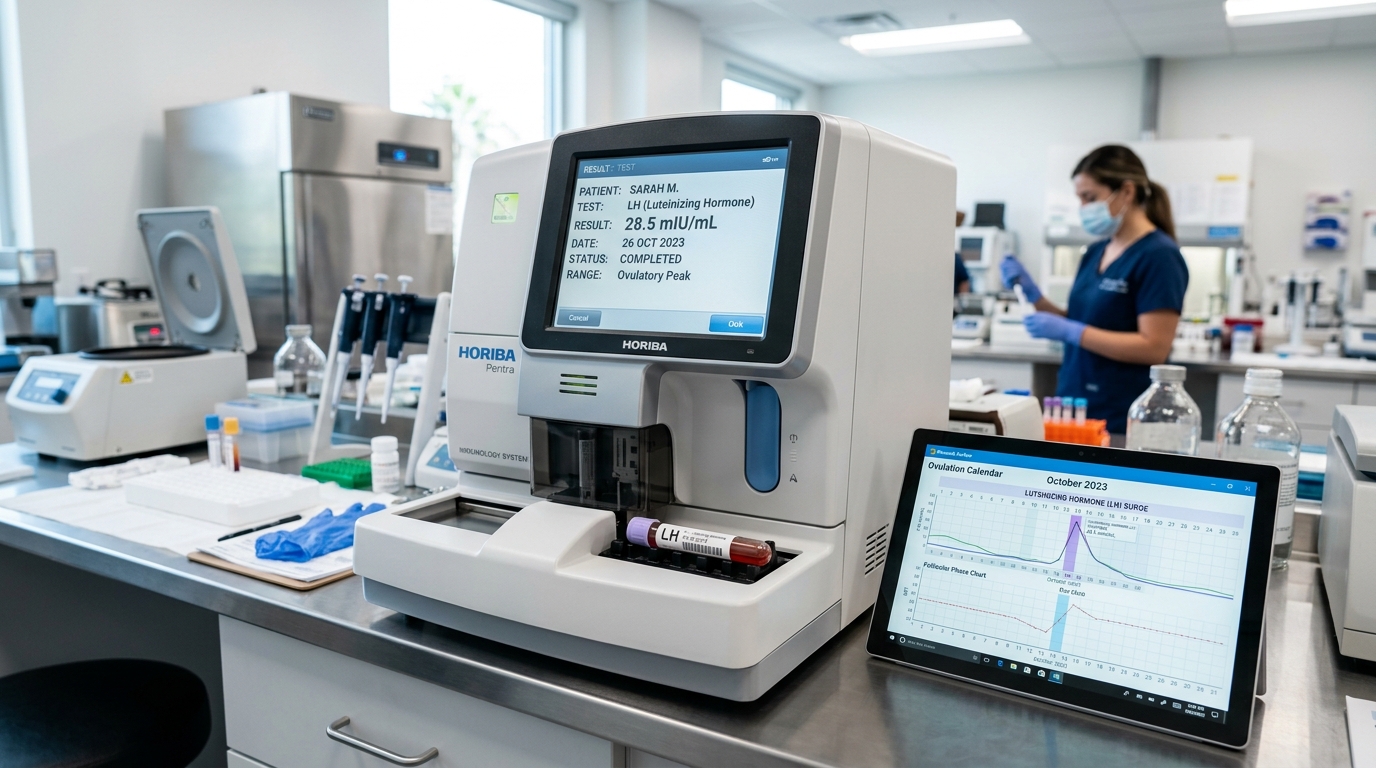
In specialized fertility centers and polyclinics across Dubai, accurate endocrine mapping is the foundation of successful conception. Couples and physicians can book advanced female fertility hormone blood testing packages in Dubai delivering certified chemiluminescent immunoassay precision for AMH, LH, FSH, Estradiol, Free Testosterone, DHEA-S, and metabolic panels under expert clinical oversight.
Pathophysiological Mechanisms of PCOS Anovulation
To understand the clinical meaning of hormonal lab numbers, one must examine the endocrine feedback loops governing normal versus polycystic ovarian physiology:
- Hypothalamic GnRH Pulse Frequency Acceleration: In women with PCOS, the hypothalamic Gonadotropin-Releasing Hormone (GnRH) pulse generator fires at an abnormally rapid frequency. Rapid GnRH pulsatility selectively stimulates anterior pituitary gonadotropes to synthesize and secrete excessive Luteinizing Hormone (LH) while relatively suppressing Follicle-Stimulating Hormone (FSH).
- Ovarian Theca Cell Hyperplasia and Hyperandrogenism: Excessive tonic LH binds to LH/hCG receptors on ovarian theca cells, upregulating steroidogenic enzymes (notably CYP17A1 / 17-alpha-hydroxylase). This drives massive overproduction of ovarian androgens—primarily androstenedione and testosterone.
- Follicular Arrest and Granulosa Cell Dysfunction: Insufficient pituitary FSH prevents ovarian granulosa cells from synthesizing adequate aromatase enzyme to convert theca-derived androgens into estrogens. As a result, antral follicles cannot mature to dominant Graafian follicles; instead, dozens of pre-antral follicles become arrested at 2–9 mm in diameter, creating the classic “string of pearls” ultrasound appearance.
- Hyperinsulinemia and Metabolic Synergy: Up to 70% of women with PCOS exhibit peripheral insulin resistance independent of body mass index. Compensatory hyperinsulinemia directly stimulates theca cell androgen production, synergizing with LH. Crucially, high circulating insulin profoundly suppresses hepatic synthesis of Sex Hormone-Binding Globulin (SHBG), leading to a massive increase in biologically active Free Testosterone!
Decoding the Comprehensive PCOS Hormone Fertility Panel
The diagnostic markers, normal physiological ranges, and PCOS diagnostic interpretation are detailed in the clinical reference table below:
| Biochemical Hormone Biomarker | Optimal Cycle Timing | Physiological Normal Range | PCOS Diagnostic Findings & Clinical Meaning |
|---|---|---|---|
| LH / FSH Ratio | Cycle Days 2 to 4 (Early Follicular) | Approx. 1:1 (LH: 2–6 IU/L, FSH: 4–8 IU/L) | Ratio > 2:1 or > 3:1. Tonic LH elevation reflects rapid hypothalamic GnRH pulsatility; inadequate FSH relative to LH prevents dominant follicle emergence. |
| Anti-Müllerian Hormone (AMH) | Any cycle day (Minimal cycle fluctuation) | 1.5 to 4.0 ng/mL (Age-dependent) | Significantly Elevated (>4.5 to 15.0+ ng/mL). Secreted by the excess pool of arrested pre-antral follicles; directly inhibits FSH sensitivity and reflects follicular arrest. |
| Total & Free Testosterone | Early morning (08:00–10:00), Days 2–5 | Total: 15–45 ng/dL; Free: 0.1–0.8 ng/dL | Elevated Free Testosterone. Drives clinical hirsutism, cystic acne, and androgenic alopecia; impairs oocyte maturation and endometrial receptivity. |
| Sex Hormone-Binding Globulin (SHBG) | Early Follicular phase | 40 to 120 nmol/L | Suppressed (<30 nmol/L). Driven down by hyperinsulinemia and hepatic steatosis; lower SHBG leaves more testosterone unbound and biologically active. |
| DHEA-Sulfate (DHEA-S) | Early Follicular phase | 35 to 250 µg/dL (Age-dependent) | Elevated in 25%–35% of PCOS patients. Indicates co-existing adrenal androgen hypersecretion mediated by exaggerated adrenal sensitivity to ACTH. |
| Fasting Insulin & HOMA-IR | 10–12 hour overnight fast | Fasting Insulin <10 µIU/mL; HOMA-IR <2.0 | Elevated Fasting Insulin (>12 µIU/mL) & HOMA-IR >2.5. Confirms metabolic insulin resistance driving both androgen excess and long-term cardiometabolic risk. |
| 17-Hydroxyprogesterone (17-OHP) | Cycle Day 3, 08:00 AM | <200 ng/dL (<2.0 ng/mL) | Normal in true PCOS. Essential mandatory rule-out test: values >200–500 ng/dL indicate Non-Classical Congenital Adrenal Hyperplasia (NCAH / 21-hydroxylase deficiency). |
The Rotterdam Diagnostic Framework in Clinical Practice
To establish a definitive diagnosis of PCOS, the patient must meet at least two of the following three criteria, with secondary endocrinopathies rigorously excluded:
- 1. Oligo- or Anovulation: Menstrual cycles exceeding 35 days (oligomenorrhea) or complete absence of menses for >90 days (amenorrhea), reflecting chronic failure to recruit and ovulate a mature oocyte.
- 2. Clinical and/or Biochemical Hyperandrogenism:
- Clinical: Modified Ferriman-Gallwey hirsutism score ≥8, severe adult cystic acne, or progressive female androgenetic alopecia (Ludwig pattern).
- Biochemical: Elevated serum Free Testosterone, Free Androgen Index (FAI = [Total T / SHBG] × 100 > 5), or elevated DHEA-S.
- 3. Polycystic Ovarian Morphology (PCOM) on Ultrasound: Transvaginal ultrasound demonstrating either ≥20 follicles per ovary (measuring 2 to 9 mm in diameter) OR an increased ovarian volume ≥10 mL (using the formula: 0.5 × length × width × thickness) in at least one ovary.
- Crucial Exclusionary Testing: Thyroid stimulating hormone (TSH) to exclude hypothyroidism, prolactin to rule out hyperprolactinemia/prolactinoma, 17-OHP to exclude 21-hydroxylase CAH, and 24-hour urinary free cortisol or low-dose dexamethasone suppression test if Cushing’s syndrome is suspected.
Translating Lab Findings into Fertility Treatment Strategies
Understanding which physiological sub-pathway is driving subfertility dictates the therapeutic regimen:
- First-Line Ovulation Induction (Letrozole): The aromatase inhibitor Letrozole (2.5 mg to 7.5 mg daily for 5 days starting Cycle Day 3) is the internationally recommended first-line medical therapy for anovulatory PCOS (superior to Clomiphene Citrate). By temporarily suppressing estrogen synthesis, Letrozole releases the pituitary gland from negative feedback, generating a physiological FSH surge that matures a dominant follicle with high mono-ovulation and live-birth rates.
- Targeting Insulin Resistance (Metformin & Inositol): In patients with high fasting insulin and elevated HOMA-IR, adding Metformin (1,500–2,000 mg/day) and/or combined Myo-Inositol & D-Chiro-Inositol (40:1 ratio) improves peripheral insulin sensitivity, lowers circulating androgens, restores spontaneous ovulatory cycles, and reduces first-trimester miscarriage risks.
- Ovarian Reserve Caution with Extremely High AMH: In women undergoing Assisted Reproductive Technology (IVF), an AMH >5–7 ng/mL indicates an elevated risk of Ovarian Hyperstimulation Syndrome (OHSS). Fertility specialists must employ GnRH antagonist protocols, reduced starting gonadotropin doses, and a GnRH agonist trigger with “freeze-all” embryo vitrification to completely avert OHSS complications.
Frequently Asked Questions (Clinical FAQ)
Does a high AMH level in PCOS mean I am super-fertile?
No. While Anti-Müllerian Hormone (AMH) reflects the total quantity of microscopic antral follicles in the ovaries, in PCOS these follicles are biochemically arrested and cannot ovulate spontaneously. Therefore, high AMH indicates a robust ovarian reserve but simultaneously reflects ovulation arrest. Once ovulation is medically triggered with medications like Letrozole, high AMH often translates to excellent conception potential.
Can I have PCOS if my menstrual cycles are completely regular?
Yes. Under the Rotterdam criteria, a woman can have “Phenotype C” PCOS (ovulatory PCOS), characterized by clinical or biochemical hyperandrogenism (elevated testosterone, hirsutism) and polycystic ovaries on ultrasound, despite having regular 28-day menses. Testing mid-luteal progesterone (Day 21) confirms whether cycles are truly ovulatory.
Why must my LH and FSH be drawn specifically on Day 2 or 3 of my period?
Cycle Days 2 to 4 represent the early follicular “baseline” phase when ovarian steroid hormones (estrogen and progesterone) are at their lowest levels. Measuring gonadotropins at this time provides the true basal hypothalamic-pituitary set-point. Testing LH later in the cycle risks catching the mid-cycle ovulatory LH surge, causing false interpretation of the LH/FSH ratio.
Authoritative Clinical References
- European Society of Human Reproduction and Embryology (ESHRE) — International Evidence-Based Guideline for the Assessment and Management of PCOS
- American Society for Reproductive Medicine (ASRM) — Clinical Evaluation and Treatment of Infertility in Polycystic Ovary Syndrome
- The Endocrine Society — Clinical Practice Guideline: Diagnosis and Treatment of Polycystic Ovary Syndrome