
Professional COVID Antigen Rapid Test Indications: Point-of-Care Clinical Triage, Pre-Admission Screening & High-Risk Protocols
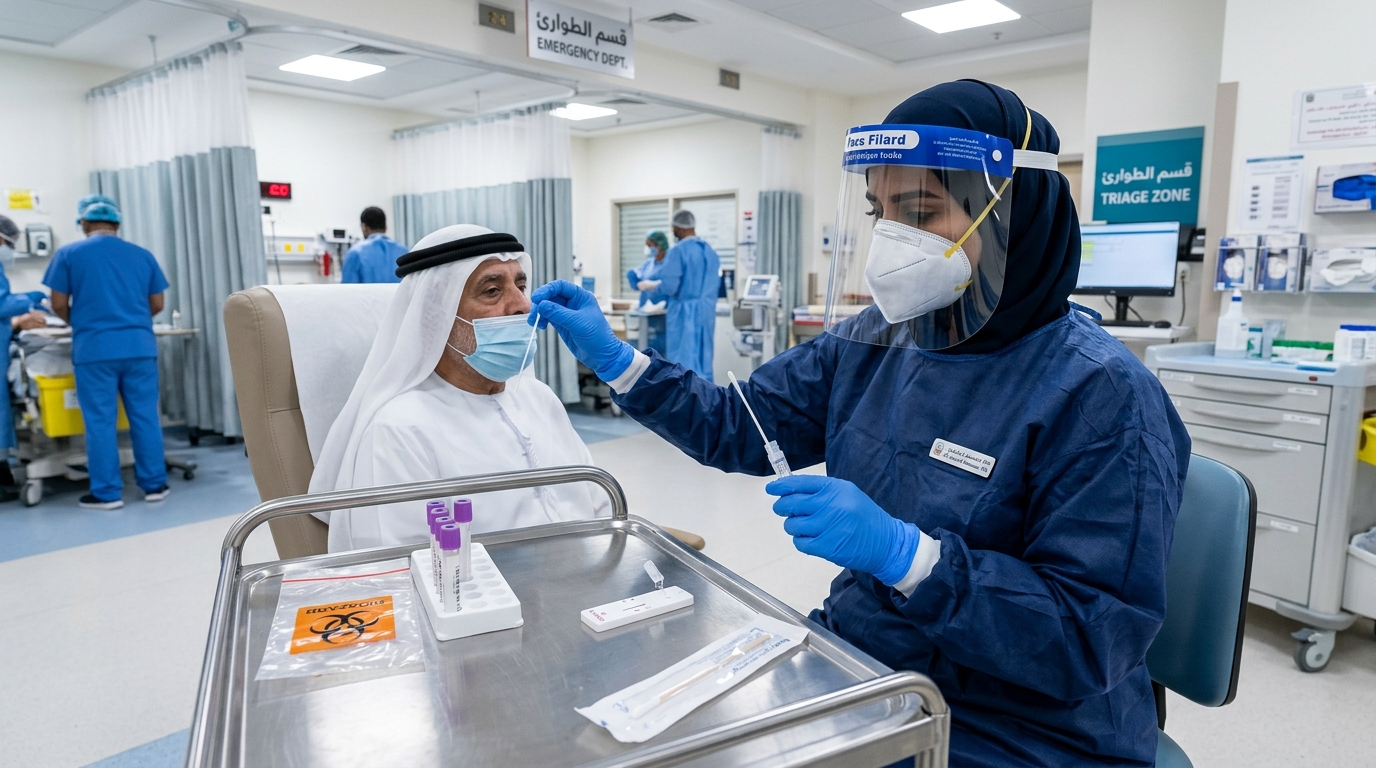
Across the vibrant healthcare infrastructure of Dubai, Abu Dhabi, and the Northern Emirates, managing acute respiratory surges requires fast, accurate clinical triaging. While laboratory RT-PCR remains the analytical gold standard, its turnaround time of several hours can hinder urgent surgical admissions or emergency bed allocations. Deploying certified professional respiratory rapid test kits in UAE equips healthcare providers with high-sensitivity, point-of-care diagnostic precision that keeps clinical workflows moving smoothly.
Professional Ag-RDTs vs. Over-the-Counter Home Self-Tests
Professional-grade rapid antigen tests differ significantly from consumer home test kits across several clinical parameters:
| Evaluation Parameter | Professional-Use Ag-RDT | Over-the-Counter Home Self-Test |
|---|---|---|
| Operator Competence | Trained clinical personnel (Nurses, MLTs, Physicians) | Untrained lay consumer |
| Specimen Source | Deep nasopharyngeal or combined nasal/oropharyngeal swab | Shallow anterior nasal or saliva |
| Analytical Sensitivity | Higher (>88% to 94% at Ct <30) due to anatomical swab depth | Variable (70% to 82%) due to self-swabbing hesitation |
| Quality Assurance & QC | Mandatory daily positive/negative control validation | Internal cassette procedural line only |
| Electronic Health Integration | Direct documentation into Hospital LIS (Malaffi, Nabidh) | Self-reported or undocumented |
Core Clinical Indications for Professional Testing
Professional rapid antigen testing is indicated across specific medical departments where clinical urgency demands rapid turnaround:
- Emergency Department Triage: Patients presenting with acute dyspnea, fever, or chest pain requiring immediate segregation into respiratory isolation beds vs. general medical bays.
- Pre-Operative & Pre-Procedure Clearance: Same-day surgical cases, emergency endoscopies, dental surgeries, or bronchoscopies where aerosol-generating procedures (AGPs) present severe occupational transmission risks to healthcare personnel.
- Antiviral Eligibility Determination: Symptomatic outpatients aged >65 or immunocompromised patients presenting within 5 days of symptom onset. A positive professional test satisfies criteria for immediate initiation of oral Paxlovid (Nirmatrelvir/Ritonavir) or IV Remdesivir.
- Hospital Ward Admission Screening: All unplanned hospital admissions to pediatric, oncology, hematology, and transplant units to protect severely vulnerable inpatient populations.
- Healthcare Worker Exposure Evaluation: Rapid baseline and serial daily screening of exposed clinical staff to prevent staffing shortages while maintaining clinical safety standards.
The Diagnostic Kinetics: Nucleocapsid Protein vs. Cycle Threshold (Ct)
Rapid antigen cassettes detect the internal SARS-CoV-2 nucleocapsid (N) protein, the most abundantly expressed structural protein during active viral replication:
| Viral Load Status | RT-PCR Cycle Threshold (Ct) | Infectious Virion Shedding | Professional Antigen Sensitivity |
|---|---|---|---|
| High Viral Shedding | Ct <25 | Extremely high transmissible viral particles | >96% to 99% Sensitivity (Thick, immediate test line) |
| Moderate Viral Shedding | Ct 25 to 29 | Moderate replication; contagious | 85% to 92% Sensitivity (Visible test line at 15 min) |
| Low Viral Shedding | Ct 30 to 35 | Early incubation or late resolution; low infectivity | 40% to 60% Sensitivity (Faint line or negative) |
| Trace Genomic Residue | Ct >35 | Non-viable fragmented viral RNA; non-contagious | <10% Sensitivity (Correctly negative; avoids false isolation) |
Standard Operating Procedure (SOP) for Professional Execution
Accredited UAE medical facilities execute a rigorous 5-step SOP to guarantee valid results:
- PPE & Environmental Preparation: Operator dons N95 respirator, eye protection, fluid-resistant gown, and gloves. Ensure cassette and buffer are equilibrated to room temperature (20°C to 25°C).
- Deep Nasopharyngeal Swab: Tilt patient’s head back 70 degrees. Insert sterile flexible flocked swab parallel to the palate until resistance or contact with the nasopharyngeal wall is met (depth equal to distance from nostril to earlobe). Leave in place for several seconds and rotate 5 times.
- Optimal Extraction Buffer Elution: Insert swab into pre-filled buffer tube. Vigorously rotate and compress swab head against flexible tube walls at least 10 times to dislodge cellular nucleocapsid proteins.
- Controlled Droplet Dispensing: Firmly affix dropper cap. Deliver precisely 3 drops vertically into the sample well (S) of the cassette. Avoid touching the dropper tip to the cassette plastic.
- Timed Result Interpretation: Read results under bright clinical light at exactly 15 minutes. Results read after 20 minutes are invalid due to potential chromatographic backflow artifacts.
Clinical Management of Discordant or Negative Results
In accordance with UAE health authority infection control protocols:
- Symptomatic Patient with Negative Rapid Test: If clinical index of suspicion for COVID-19 is high (e.g., household exposure, classic anosmia, bilateral chest infiltrates), the patient must undergo immediate confirmatory molecular RT-PCR testing while remaining in droplet isolation.
- Serial Testing Protocol: For outpatients presenting within the first 24 hours of fever (before peak viral load), performing a repeat professional antigen test 48 hours later increases cumulative sensitivity from ~80% to over 95%.
Frequently Asked Questions (FAQ)
Do professional rapid antigen tests detect circulating SARS-CoV-2 variants?
Yes. Because commercial professional cassettes target the highly conserved nucleocapsid (N) protein rather than the heavily mutated spike (S) glycoprotein, analytical sensitivity is preserved across all Omicron sub-lineages and emerging recombinant variants.
What causes a false-positive result on a professional antigen test?
False positives are rare (<0.5%) and primarily result from pre-analytical errors: improper acidic pH from contaminated swabs, severe blood contamination in the nasal cavity, reading past the 20-minute interpretation window, or extreme buffer drying.
Can professional antigen tests be used for asymptomatic screening?
Yes. Professional Ag-RDTs are widely deployed for serial asymptomatic screening in high-risk institutional settings (e.g., dialysis centers, bone marrow transplant units) to identify asymptomatic viral shedders with high viral loads (Ct <25) who drive super-spreading events.
Scientific References & Authoritative Clinical Guidelines
- World Health Organization (WHO). Use of SARS-CoV-2 Antigen-Detecting Rapid Diagnostic Tests for COVID-19 Diagnosis. WHO Interim Guidance, 2023.
- Centers for Disease Control and Prevention (CDC). Guidance for Antigen Testing for SARS-CoV-2 for Healthcare Providers. CDC Guidelines, 2024.
- Dubai Health Authority (DHA). Infection Control and Diagnostic Microbiology Standards for Point-of-Care Testing (POCT) in Healthcare Facilities. UAE Health Regulations, 2024.