
Professional COVID Antigen Rapid Test Limitations: CLIA-Waived vs Laboratory-Grade Assays, Early Viral Shedding & UAE Healthcare Protocols
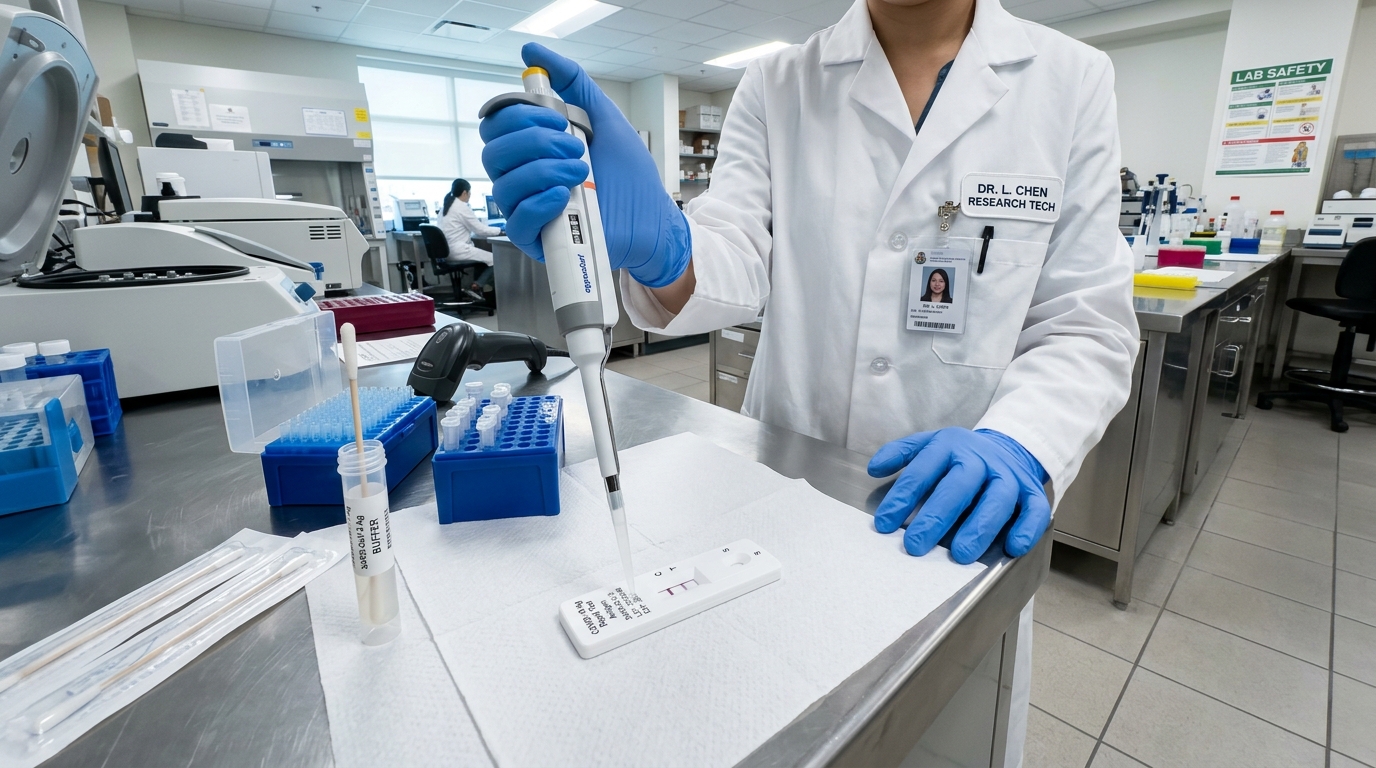
In clinical triage facilities and medical centers throughout Dubai, Abu Dhabi, and the wider UAE, selecting high-performance diagnostic tools safeguards clinical staff and patients alike. Sourcing verified professional COVID-19 and respiratory rapid test kits in the UAE ensures clinic directors utilize assays engineered with validated sensitivity compliant with international regulatory benchmarks.
Analytical Sensitivity: The Concentration Threshold Challenge
The primary performance divergence between professional rapid antigen tests and central laboratory molecular assays centers on the biological limit of detection (LoD):
- Real-Time RT-PCR: Amplifies viral RNA fragments enzymatically by billions of times, detecting viral concentrations down to 100 to 500 copies/mL (equivalent to cycle threshold Ct values ≥ 35 to 38).
- Professional Antigen Lateral Flow: Relies on unamplified, stoichiometric binding between immobilized monoclonal antibodies and native viral nucleocapsid protein. Typical analytical limits of detection range between 100,000 and 1,000,000 copies/mL (Ct values ≤ 25 to 28).
- Clinical Significance: A patient with early viral replication (Ct 30–34) who is actively incubating the virus will test falsely negative on rapid antigen testing while testing decisively positive on RT-PCR.
Professional Use vs At-Home OTC Kits: Key Distinctions
Healthcare managers must differentiate between over-the-counter (OTC) consumer home kits and professional clinical-grade rapid tests:
| Operational Parameter | Professional POC Rapid Antigen Test | At-Home Self-Test OTC Kit | Clinical Practice Takeaway |
|---|---|---|---|
| Operator Certification | Trained healthcare professionals (nurses, lab technologists) | Untrained general consumers | Professional administration eliminates collection errors and improper buffer pipetting. |
| Sampling Modality | Validated for deep Nasopharyngeal (NP) or combined Nasal/Oropharyngeal swabbing | Strictly limited to anterior nasal (nares) swabbing | NP swabbing collects epithelial cells from the primary viral replication zone, yielding 10% higher sensitivity. |
| Optical Reading Infrastructure | Often integrated with digital optical readers / barcode scanners | Visual naked-eye line inspection under ambient room light | Digital readers eliminate subjective interpretation of faint test lines and log lot numbers directly to EMR. |
| Regulatory Accreditation | CLIA-waived or Moderate Complexity IVD CE-marked under EU IVDR | Consumer OTC clearance | Professional kits satisfy DHA, DOH, and hospital accreditation audit standards. |
Pre-Analytical Pitfalls Driving Diagnostic Failure
Even when performed by licensed healthcare staff, procedural deviations frequently undermine test accuracy:
- Timing from Symptom Onset: Sensitivity is highest between Days 2 and 5 of active symptoms. Testing on Day 1 (before viral replication peaks) or after Day 7 (when host mucosal IgA antibodies neutralize free antigens) generates false-negative results.
- Swab Depth and Residence Time: In professional nasopharyngeal swabbing, the flexible swab must be inserted horizontally along the floor of the nasal cavity until resistance is met (distance equal to that from nostril to earlobe), left in place for several seconds to absorb secretions, and slowly rotated. Superficial anterior swabbing misses the infected mucosal bed.
- Buffer Extraction Compliance: Failing to pinch the extraction tube walls against the swab tip before withdrawing traps significant liquid antigen on the swab fibers, reducing signal intensity.
- Ambient Temperature and Humidity: Performing tests in unconditioned triage tents (> 30°C) causes rapid buffer evaporation, producing non-specific background clearing anomalies and false-positive ghost lines.
Viral Kinetics, Incubation Windows & The Serial Testing Paradigm
Understanding viral shedding kinetics is essential to interpreting negative rapid antigen tests accurately in clinical settings:
- Viral Load Trajectory and Limit of Detection: Following exposure to SARS-CoV-2, viral replication increases exponentially during the pre-symptomatic incubation phase. Rapid lateral flow assays require an antigen density corresponding to a cycle threshold (Ct) of 25 to 28 or lower (equivalent to approximately 105 to 106 genomic copies/mL) to produce a detectable chromogenic band. Patients evaluated within the first 24 to 36 hours of symptom onset often exhibit sub-threshold viral shedding, producing a false-negative antigen result despite active transmissible infection.
- The CDC & FDA Serial Testing Schedule: To compensate for the analytical sensitivity threshold of point-of-care immunoassays, international health agencies mandate serial testing protocols. In symptomatic patients with an initial negative rapid antigen test, a repeat test performed 48 hours later increases cumulative sensitivity from approximately 65%–70% to greater than 88%–94%, matching clinical RT-PCR utility for detecting contagious individuals. For asymptomatic contacts with confirmed close exposure, a three-test regimen spaced 48 hours apart (Day 0, Day 2, and Day 4) is recommended before ruling out infection.
- Variant Evolution & Anatomical Tropism: Contemporary Omicron sublineages (including JN.1, KP.2, and KP.3) demonstrate high viral titers in the oropharynx early during illness, sometimes preceding peak nasopharyngeal shedding. In professional ambulatory clinics, combining oropharyngeal and bilateral anterior nasal swabbing provides superior diagnostic yields compared to superficial single-nostril swabbing.
Environmental Stability & Gulf Climate Quality Assurance
Operating point-of-care rapid testing in Middle Eastern healthcare environments presents distinctive operational hurdles:
- Temperature Extremes & Buffer Integrity: Rapid antigen cassettes, extraction buffers, and conjugated colloidal gold antibodies are certified for performance between 2°C and 30°C. In the UAE summer climate, ambient outdoor temperatures exceeding 40°C to 48°C can rapidly degrade reagents if kits are transported in unconditioned courier vehicles or operated in outdoor drive-through testing booths. Thermal stress denatures monoclonal capture antibodies and alters buffer viscosity, inducing invalid control lines or false-negative readings.
- High-Dose Hook Effect & Cross-Reactivity Profiles: In rare cases of extraordinarily elevated viral antigen loads, excess free antigen can saturate both mobile labeled antibodies and fixed capture line antibodies independently, attenuating the visible test line intensity (the prozone or hook effect). Furthermore, diagnostic manufacturers must rigorously validate assays against endemic Middle Eastern pathogens—including MERS-CoV, seasonal human coronaviruses (OC43, HKU1, 229E, NL63), Influenza A/B, and Respiratory Syncytial Virus (RSV)—to confirm zero cross-reactivity.
- EMR Integration & Public Health Compliance: In accordance with Dubai Health Authority (DHA) and Department of Health (DOH Abu Dhabi) diagnostic regulations, point-of-care respiratory testing in outpatient clinics must be logged with lot numbers, expiration dates, and licensed operator identifiers into interconnected health information exchanges (such as Nabidh and Malaffi), ensuring seamless epidemiological tracking.
Structured Clinical Decision Algorithms in UAE Clinics
To safely navigate rapid antigen limitations, healthcare institutions must enforce structured clinical triage protocols:
- Symptomatic Patient + Positive Antigen Test: Confirms active COVID-19 infection with > 99% positive predictive value. Initiate immediate respiratory isolation, report to public health surveillance (DHA Hasana / DOH Malaffi), and prescribe antivirals (Paxlovid) if high-risk. No confirmatory PCR required.
- Symptomatic Patient + Negative Antigen Test: Presumptive negative only. If the patient is at high risk, severely symptomatic, or planned for inpatient ward admission, an immediate confirmatory real-time RT-PCR is mandatory. Alternatively, outpatient ambulatory patients should perform serial testing 48 hours later.
- Pre-Operative Surgical Clearance: Rapid antigen tests are insufficient for pre-operative surgical clearance involving general anesthesia or aerosol-generating procedures. Hospital guidelines mandate high-sensitivity RT-PCR within 48 to 72 hours prior to elective surgery.
Frequently Asked Questions (FAQ)
Can a professional rapid antigen test detect new COVID-19 variants?
Yes. Commercial professional antigen tests target the highly conserved internal Nucleocapsid (N) protein, not the rapidly mutating surface Spike (S) protein. Unless critical structural mutations occur in the nucleocapsid gene, the tests maintain their diagnostic accuracy across Omicron sublineages.
Why does a faint test line still count as a positive result?
In lateral flow immunochromatography, any visible color band at the test line (T)—regardless of intensity—indicates specific antibody-antigen binding. Faint lines typically reflect low viral load (early infection or resolving convalescence) and must be reported as Positive.
What causes a false-positive rapid antigen test?
False positives are rare (< 1%) but can occur due to: (1) reading the cassette past the validated read window (> 30 minutes) due to drying artifacts, (2) highly viscous mucous specimens causing non-specific conjugate trapping, or (3) presence of high-titer rheumatoid factor (RF) or heterophile antibodies.
Authoritative Clinical References
- Centers for Disease Control and Prevention (CDC) – Guidance for Point-of-Care and Rapid Antigen Testing for SARS-CoV-2
- U.S. Food and Drug Administration (FDA) – Coronavirus Testing Basics and Antigen Assay Performance Standards
- World Health Organization (WHO) – Antigen-Detection in the Diagnosis of SARS-CoV-2 Infection: Interim Guidance