
Respiratory Adenovirus Rapid Test Indications: Pharyngoconjunctival Fever, Pediatric Croup Triage & Outpatient Antiviral Stewardship
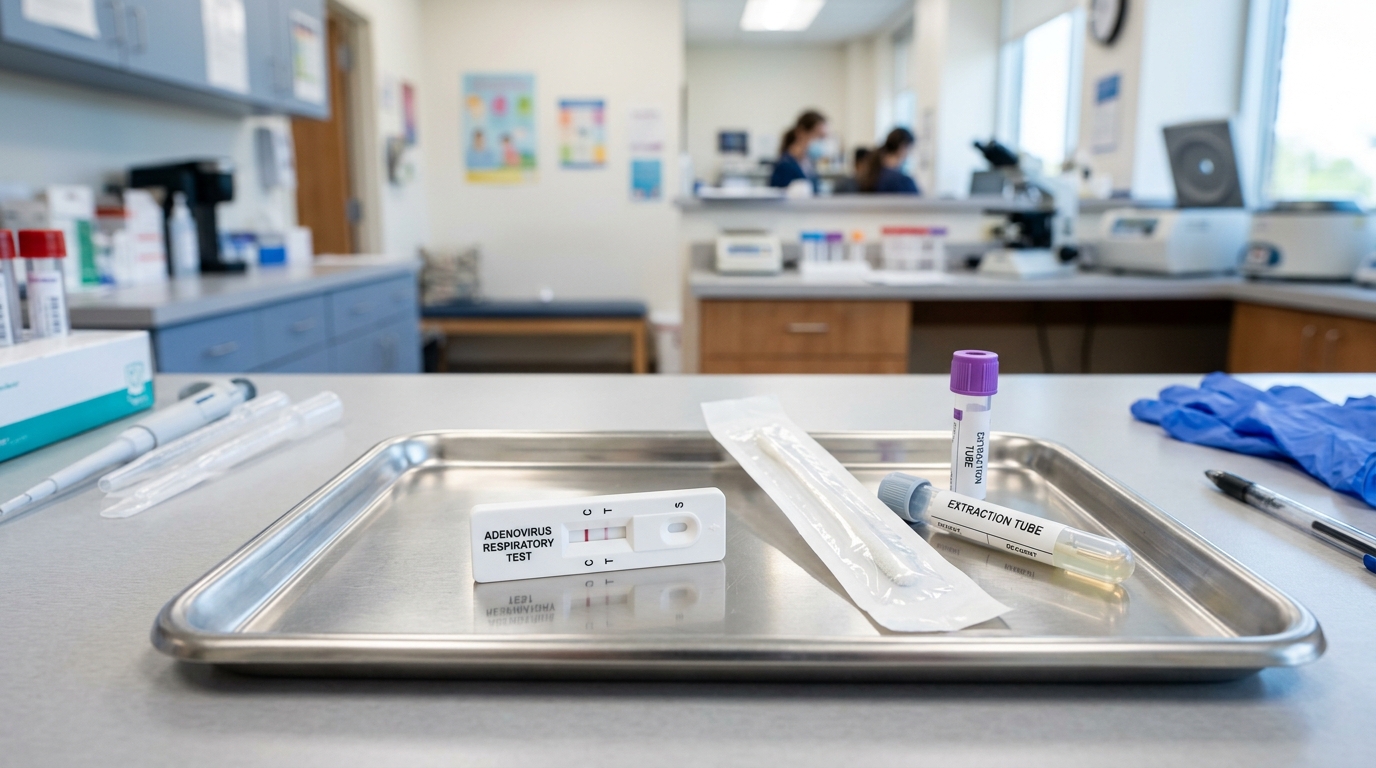
In pediatric outpatient centers and walk-in urgent care facilities throughout Dubai, Abu Dhabi, and the Northern Emirates, acute febrile respiratory illnesses represent the vast majority of consultations during the autumn and winter months. Parents are often deeply alarmed by persistent high fevers (39.5°C to 40.0°C) lasting up to 5 to 7 days. Integrating certified advanced respiratory rapid antigen test kits in UAE allows physicians to distinguish self-limiting viral adenoviral syndromes from bacterial infections right at the bedside.
Virological Characteristics: The Resilience of Non-Enveloped Adenoviruses
Adenoviruses possess unique biological features that dictate their epidemiology and diagnostic handling:
- Non-Enveloped Icosahedral Capsid: Unlike influenza, RSV, or SARS-CoV-2 which possess fragile lipid envelopes, adenoviruses are non-enveloped. Their robust protein capsid confers extreme environmental resilience, allowing virions to survive for weeks on clinic surfaces, examination couches, and ophthalmic instruments.
- Hexon Protein Target: Rapid immunochromatographic cassettes utilize monoclonal antibodies targeting the highly conserved, family-specific hexon antigen, ensuring broad reactivity across all circulating respiratory serotypes.
- Biphasic Mucosal Replication: Adenoviruses efficiently infect both the respiratory tract epithelium and conjunctival mucosa, explaining the hallmark presentation of Pharyngoconjunctival Fever (PCF).
Core Clinical Indications for Rapid Adenovirus Testing
Point-of-care rapid testing is clinically indicated when patients present with specific clinical patterns:
| Clinical Syndrome | Hallmark Symptoms & Signs | Primary Age Group | Actionable Clinical Outcome |
|---|---|---|---|
| Pharyngoconjunctival Fever (PCF) | Triad: High pyrexia (>39°C), severe exudative tonsillitis, and bilateral follicular conjunctivitis with watery discharge | Children aged 3 to 12 years; school-age outbreaks | Pathognomonic for Adenovirus (serotypes 3 & 7); halts antibiotic prescriptions; advises strict school quarantine |
| Strep A-Negative Exudative Tonsillitis | Prominent tonsillar enlargement with thick whitish-yellow follicular exudates, but rapid Strep A test is negative | Toddlers, school children, and adolescents | Prevents empiric amoxicillin/augmentin prescription for viral tonsillitis; explains prolonged fever course |
| Pediatric Bronchiolitis & Croup Triage | Barking cough, inspiratory stridor, tachypnea, subcostal retractions | Infants and children under 2 years | Identifies viral cause of lower respiratory distress; guides nebulized saline and supportive oxygen therapy |
| Nosocomial Infection Control & Daycare Outbreaks | Clusters of febrile respiratory illness in pediatric wards or institutional daycares | All pediatric cohorts | Triggers contact and droplet isolation precautions; mandates rigorous chlorine surface disinfection |
| Immunocompromised Host Assessment | Pediatric oncology, bone marrow transplant recipients with persistent fevers and pneumonitis | Immunocompromised patients | Rapid bedside screening triggers urgent referral for quantitative blood PCR to detect fatal disseminated adenoviral disease |
Adenovirus vs. Strep Throat vs. Infectious Mononucleosis (EBV)
Because Adenovirus causes follicular tonsillar exudates identical in visual appearance to bacterial strep and Epstein-Barr virus, point-of-care diagnostic differentiation is essential:
| Diagnostic Feature | Adenoviral Pharyngitis | Group A Strep Pharyngitis | Infectious Mononucleosis (EBV) |
|---|---|---|---|
| Tonsillar Exudate | Prominent, whitish-yellow follicular | Prominent, patchy or coalescent | Extensive, shaggy white-gray exudate |
| Bilateral Conjunctivitis | Present in 50% to 70% of cases | Absent | Absent (may have periorbital edema) |
| Cough & Rhinitis | Commonly present | Typically ABSENT | Infrequent |
| Lymphadenopathy | Cervical and preauricular nodes | Tender anterior cervical nodes | Diffuse posterior cervical & generalized |
| Hepatosplenomegaly | Extremely rare | Absent | Common (splenomegaly in >50%) |
| Rapid POC Test | Adenovirus Rapid Cassette Positive | Rapid Strep A Positive | Monospot / EBV IgM Positive |
Specimen Collection SOP: Optimizing Diagnostic Sensitivity
Rapid antigen cassettes possess high specificity (>98%), but clinical sensitivity depends directly on harvesting sufficient viral load:
- Nasopharyngeal Swab: Insert a sterile flocked flexible swab through the nostril parallel to the palate until resistance is met. Rotate the swab 3 to 5 times over the posterior nasopharyngeal surface for 5 seconds to absorb cellular secretions.
- Posterior Pharyngeal Swab: If conjunctivitis or tonsillitis is prominent, a vigorous posterior pharyngeal swab can be combined with the nasopharyngeal sample in the same extraction buffer.
- Conjunctival Swab: For patients with active conjunctival erythema, gently evert the lower eyelid and wipe the palpebral conjunctiva with a Dacron swab moistened in sterile saline.
- Buffer Extraction & Dispensing: Swirl swab in the extraction buffer tube for 15 seconds, squeeze the tube walls to express liquid from the swab tip, and dispense 3 vertical drops into the cassette well. Read strictly at 10 to 15 minutes.
Clinical Management & Infection Control in UAE Facilities
Unlike influenza (which responds to Oseltamivir) or COVID-19, there is no FDA-approved oral antiviral therapy for uncomplicated adenoviral respiratory infection in immunocompetent patients:
- Supportive Care: Antipyretics (paracetamol and ibuprofen alternated), oral rehydration therapy, humidified air, and preservative-free artificial tears for conjunctival irritation.
- Antibiotic Stewardship: Explaining the positive viral test result to anxious parents provides concrete validation that antibiotics are unnecessary and ineffective, preventing adverse drug reactions and diarrhea.
- Exclusion Periods: Children with adenoviral pharyngoconjunctival fever should remain home from school or nursery until afebrile for ≥24 hours and until conjunctival discharge has completely resolved (typically 5 to 7 days).
- Surface Disinfection: Standard alcohol-based hand rubs have reduced efficacy against non-enveloped adenoviruses. Meticulous handwashing with soap and water, combined with 0.5% sodium hypochlorite (bleach) disinfection of medical equipment, is mandatory.
Frequently Asked Questions (FAQ)
Why does Adenovirus fever last so much longer than other common colds?
Adenovirus induces robust endogenous pyrogen release (interleukin-1 and tumor necrosis factor), commonly producing biphasic or remittent high fevers (39°C to 40°C) that persist for 5 to 7 days, and occasionally up to 10 days. As long as the child remains active during afebrile windows and hydration is maintained, this protracted fever course is typical.
Can rapid antigen testing miss Adenovirus?
While rapid antigen test specificity exceeds 98%, analytical sensitivity ranges from 70% to 85% compared to molecular RT-PCR. If a hospitalized infant or immunocompromised patient with severe pneumonia tests negative on a rapid cassette, a comprehensive multiplex respiratory PCR panel should be performed.
Is swimming pool water a risk factor for Adenovirus transmission?
Yes. Adenoviral pharyngoconjunctival fever is colloquially known as “swimming pool conjunctivitis” because the virus can survive in inadequately chlorinated community pools, transmitting rapidly through contaminated water.
Scientific References & Authoritative Clinical Guidelines
- Centers for Disease Control and Prevention (CDC). Human Adenoviruses: Clinical Guidance, Outpatient Triage & Infection Control. CDC Guidelines, 2024.
- American Academy of Pediatrics (AAP). Red Book: 2024 Report of the Committee on Infectious Diseases: Adenovirus Infections. AAP Press, 2024.
- Dubai Health Authority (DHA). Infection Prevention and Control (IPC) Guidelines for Pediatric Outpatient Respiratory Infections. UAE Health Regulations, 2024.