
Respiratory Diagnostic Algorithms for Urgent Care Clinics: Rapid Point-of-Care Testing, Triage & Dubai Antibiotic Stewardship
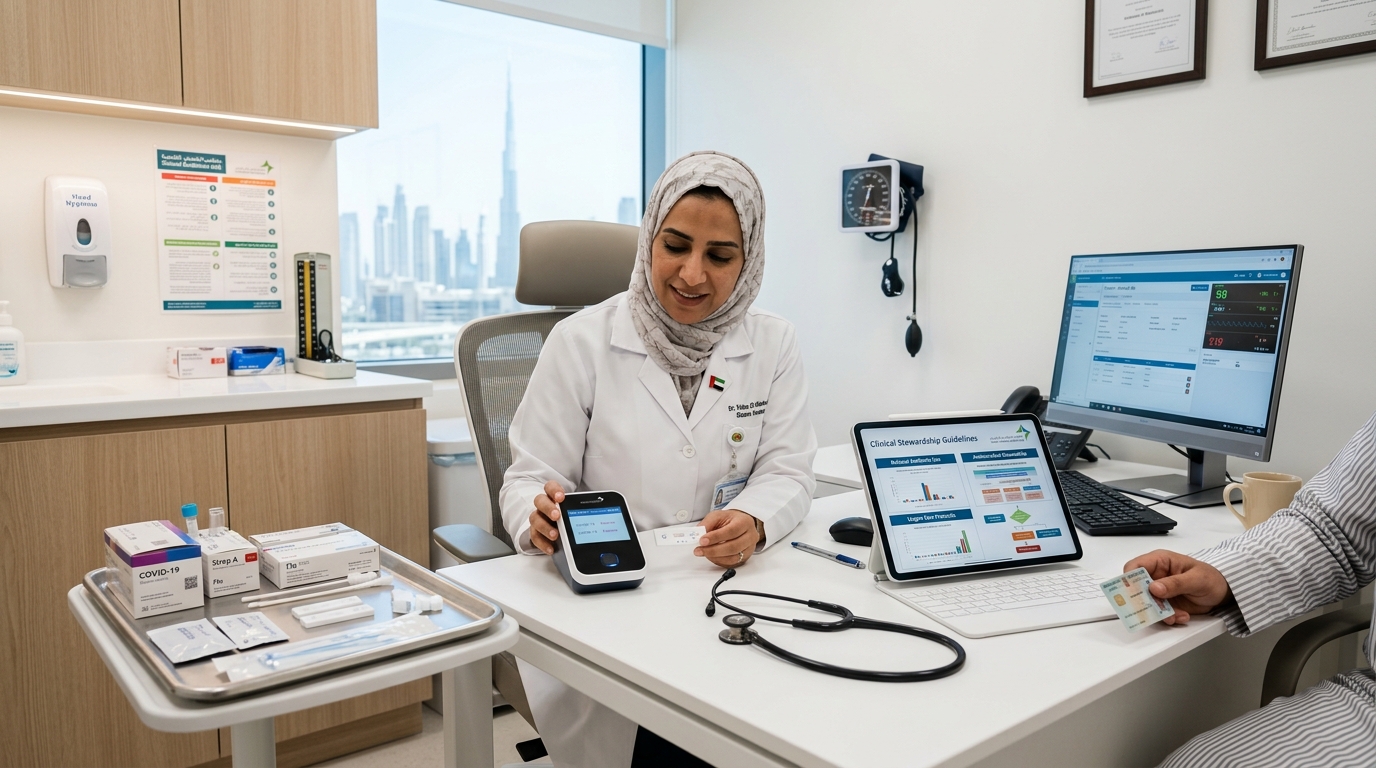
In urgent care centers throughout the UAE, algorithmic diagnostic precision underpins operational excellence. Discover certified point-of-care respiratory rapid antigen test kits in Dubai designed for high-throughput ambulatory workflows, sharp analytical band clarity, and immediate clinical decision support.
The Urgent Care Dilemma: Time Pressure vs Diagnostic Precision
Ambulatory urgent care settings present unique operational obstacles that accelerate diagnostic errors if structured pathways are absent:
- Compressed Consultation Windows: Unlike scheduled specialist appointments, urgent care encounters average 8 to 12 minutes per patient. Clinicians must rapidly gather history, perform physical exams, formulate diagnoses, and discharge patients safely.
- Patient Expectation Pressures: Patients visiting urgent care clinics frequently arrive with entrenched expectations of receiving a “quick fix” prescription, most commonly an oral antibiotic (such as Amoxicillin-Clavulanate or Azithromycin). Without objective diagnostic proof of viral etiology, clinicians often succumb to defensive medicine.
- Symptom Overlap & Clinical Mimicry: Physical examination signs—fever, injected pharynx, purulent nasal secretions, productive cough—fail to distinguish viral from bacterial pathogens. Clinical studies demonstrate that physicians predicting viral vs bacterial etiology based on clinical impression alone achieve an accuracy rate no better than a coin toss (~50%).
- The Critical Antiviral Window: For high-risk influenza patients, neuraminidase inhibitors (Oseltamivir) must be administered within 48 hours; for high-risk COVID-19 patients, oral nirmatrelvir/ritonavir (Paxlovid) must be initiated within 5 days. Delayed central laboratory testing misses these therapeutic windows entirely.
The 4-Step Urgent Care Respiratory Diagnostic Pathway
A validated clinical algorithm operationalizes patient flow from the triage nurse to physician discharge:
| Triage Step | Clinical Activity & Risk Stratification | Actionable Tool / Diagnostic Test | Target Turnaround & Clinical Impact |
|---|---|---|---|
| Step 1: Vital Signs & Red-Flag Screen | Check pulse oximetry (SpO2), respiratory rate, blood pressure, temperature. Assess for stridor, severe dyspnea, confusion, hemoptysis. | Clinical Red-Flag Checklist | Immediate (2 Mins). If SpO2 <92%, RR >28, or hypotension: trigger immediate ED transfer and oxygen therapy. |
| Step 2: Nurse-Initiated POC Sampling | For stable patients presenting with acute fever (≤4 days) + cough, sore throat, or body aches: perform rapid anterior nasal swab. | Multiplex Lateral Flow Rapid Antigen (COVID-19 + Influenza A/B Combo) | 15 Minutes. Cassette incubates while patient is placed in exam room; results ready when physician enters! |
| Step 3: Pharyngitis Score (If Sore Throat) | Calculate Modified Centor / McIsaac Score. Check for tonsillar exudates, tender cervical lymph nodes, absence of cough, age. | Rapid Strep A Dipstick Test (Only if Centor Score ≥2) | 5 Minutes. If Strep A positive: prescribe Penicillin/Amoxicillin. If negative: reassure patient; zero antibiotics. |
| Step 4: Targeted Antiviral / Supportive Care | Physician synthesizes physical exam with objective POC test result; issues targeted pathogen-directed therapy. | Electronic Health Record (EHR) Guided Order Sets | Final Discharge. Targeted antiviral for positive Flu/COVID; written viral education + symptom pack for negative tests. |
The Pharyngitis Decision Tree: Centor Scoring Integration
In patients presenting primarily with sore throat, the Centor criteria must govern diagnostic testing and antimicrobial therapy:
- Criteria Scoring:
- Tonsillar exudate or swelling: +1 point
- Tender anterior cervical lymphadenopathy: +1 point
- History of fever >38°C: +1 point
- Absence of cough: +1 point
- Age adjustment: 3–14 years (+1); 15–44 years (0); ≥45 years (-1)
- Clinical Protocol:
- Score 0 or 1: Risk of Group A Beta-Hemolytic Streptococcus (GABHS) is <10%. Do NOT perform rapid test; do NOT prescribe antibiotics. Diagnosis: Viral pharyngitis.
- Score 2 or 3: Risk is 15% to 30%. Perform rapid Strep A antigen test. Treat with antibiotics only if rapid test is positive.
- Score 4 or 5: Risk is 30% to 50%. Perform rapid Strep A test. In pediatric patients aged 3–15, if rapid test is negative, send throat swab for confirmatory molecular PCR or culture due to pediatric rheumatic fever risks.
Managing Antigen-Negative Symptomatic Patients
A critical component of urgent care algorithms is managing patients who present with classic viral symptoms but test negative on initial POC antigen screening:
- Understanding the Sensitivity Curve: Rapid antigen tests possess excellent specificity (>99%) but moderate sensitivity (80%–90%). In patients presenting within the first 12 to 24 hours of fever, viral nucleoprotein concentrations may be below the analytical limit of detection.
- Reflex Escalation Criteria (When to Order Molecular PCR):
- Patients aged >65 years or infants <6 months.
- Severely immunocompromised patients (chemotherapy, organ transplant, active biologics).
- Patients with chronic respiratory disease (severe COPD, cystic fibrosis, refractory asthma).
- Patients exhibiting worsening clinical trajectory despite 48 hours of outpatient supportive care.
- Empowering Patients with “Delayed Antibiotic Prescriptions”: For borderline presentations (e.g., acute rhinosinusitis lasting <10 days), providing a post-dated “delayed prescription” with instructions to fill only if fever or purulent discharge worsens after Day 10 successfully prevents antibiotic consumption in >70% of patients.
Antimicrobial Stewardship Key Performance Indicators (KPIs)
Urgent care clinical medical directors in Dubai should monitor performance against international benchmarks:
- Acute Bronchitis Prescribing Target (<10%): Acute bronchitis in otherwise healthy individuals is virtually 100% viral; antibiotic prescribing should be near zero.
- Upper Respiratory Infection (URI) Stewardship Target (<15%): Overall antibiotic utilization across all non-pneumonic respiratory consultations should not exceed 15%.
- Diagnostic Utilization Ratio (>85%): Over 85% of patients receiving an antimicrobial prescription must have a documented laboratory-confirmed bacterial indication (e.g., positive Strep A, confirmed urinary tract infection, or radiographic pneumonia).
- Door-to-Discharge Efficiency: Implementing nurse-initiated POC testing upon patient arrival maintains average urgent care door-to-discharge times below 35 minutes while eliminating diagnostic guessing.
Frequently Asked Questions (Clinical FAQ)
How does nurse-initiated POC testing improve urgent care clinic throughput?
In traditional workflows, the doctor examines the patient, orders a rapid test, and waits 15 minutes for results before returning to write the prescription. In nurse-initiated triage protocols, the nurse collects the nasal swab during vital sign assessment. By the time the physician conducts physical auscultation, the test cassette is already read, saving 10 to 15 minutes per consultation and dramatically increasing daily patient capacity.
Can urgent care clinics rely on rapid antigen tests for RSV in older adults?
While rapid antigen tests for Respiratory Syncytial Virus (RSV) have high sensitivity (>90%) in infants and young children due to heavy viral shedding, their sensitivity in adults aged >65 is significantly lower (often 50%–60%). In vulnerable elderly adults with severe bronchitis or exacerbation of COPD, syndromic multiplex RT-PCR is the preferred diagnostic modality.
What is the recommended antibiotic for confirmed Group A Strep pharyngitis?
Under international and UAE guidelines, oral Penicillin V (500 mg BID to TID for 10 days) or Amoxicillin (50 mg/kg/day once daily or 500 mg BID for 10 days) remains the first-line gold standard. Group A Streptococcus has never demonstrated resistance to penicillin. Broad-spectrum macrolides (Azithromycin) should be reserved strictly for penicillin-allergic patients due to rising macrolide resistance rates.
Authoritative Clinical References
- Centers for Disease Control and Prevention (CDC) — Core Elements of Antibiotic Stewardship for Urgent Care and Emergency Departments
- World Health Organization (WHO) — Point-of-Care Diagnostics and Antimicrobial Stewardship Implementation
- Infectious Diseases Society of America (IDSA) — Clinical Practice Guideline for the Diagnosis and Management of Group A Streptococcal Pharyngitis