
TSH Fertility Testing Meaning: Optimal Thyroid Ranges for Conception, Miscarriage Risk & Implantation
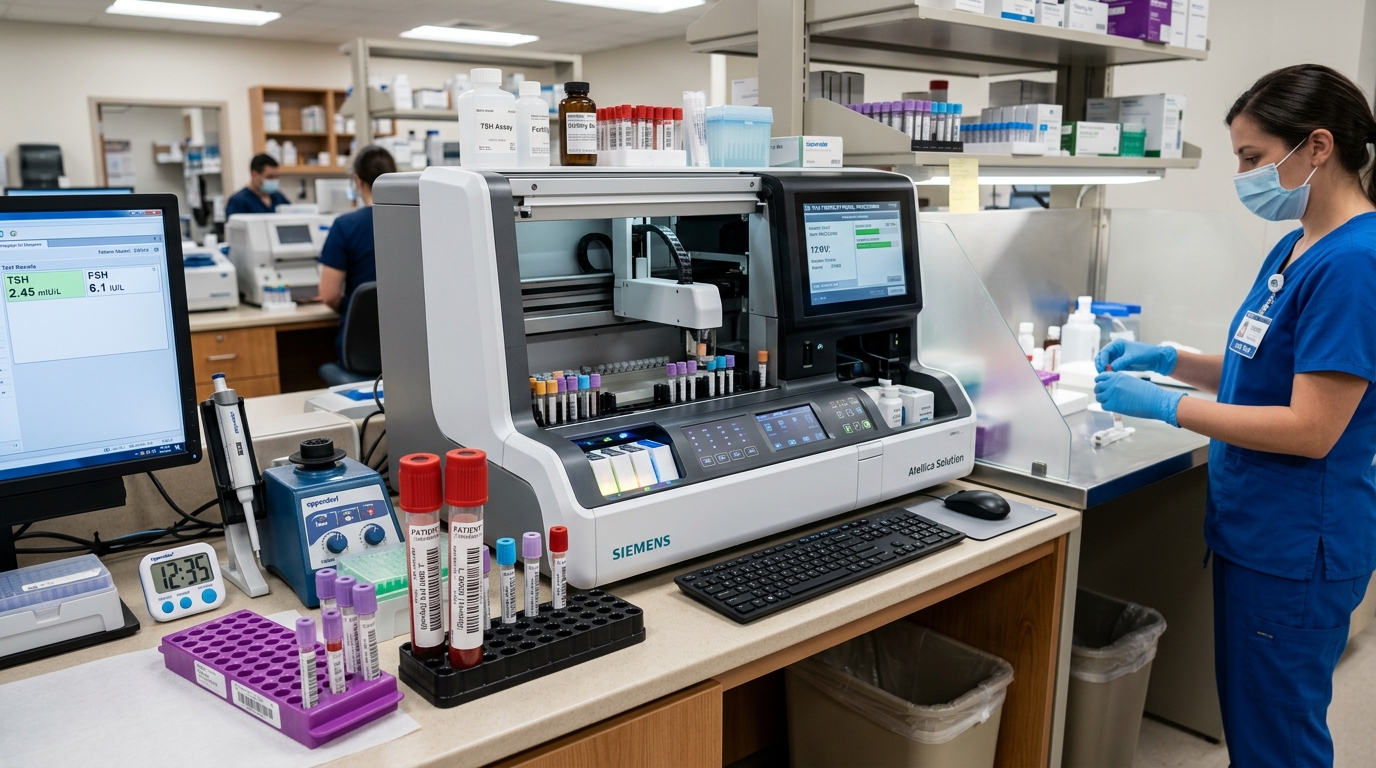
Couples experiencing recurrent implantation failure, irregular menstrual cycles, or early pregnancy loss across Dubai, Abu Dhabi, and the wider UAE often discover that a “normal” thyroid result on a routine health checkup is suboptimal for reproductive medicine. Understanding the direct molecular synergy between thyroid receptors and ovarian granulosa cells is paramount. When evaluated within specialized advanced fertility blood testing panels in Dubai, precise TSH management unlocks crucial pathways to successful natural conception and assisted reproductive therapy (ART/IVF).
The Molecular Link: How Thyroid Function Controls Reproduction
Thyroid hormones are not merely metabolic regulators; they act as essential co-factors for reproductive tissues:
- Synergy with FSH in Granulosa Cells: Receptors for triiodothyronine (T3) are densely expressed on human ovarian granulosa and cumulus cells. T3 synergizes directly with Follicle-Stimulating Hormone (FSH) to promote follicle maturation, aromatase enzyme activity, and robust estradiol synthesis.
- Luteal Phase Progesterone Competence: Inadequate thyroid signaling impairs corpus luteum vascularization and function, leading to premature luteal phase defects, subnormal progesterone output, and failure of secretory endometrial transformation.
- Hyperprolactinemia Induction: When the thyroid gland underproduces thyroxine (hypothyroidism), the hypothalamus increases secretion of Thyrotropin-Releasing Hormone (TRH). TRH stimulates not only TSH but also acts as a potent secretagogue for pituitary prolactin, suppressing ovulatory GnRH pulses and causing amenorrhea.
- Endometrial Receptivity & Implantation: Human endometrium expresses thyroid hormone receptors that modulate immune tolerance, uterine natural killer (uNK) cell activity, and vascular remodeling necessary for placental trophoblast invasion.
The Critical Discrepancy: General Lab Range vs. Fertility Target
The distinction between population-based reference ranges and fertility-specific targets is critical:
| Clinical Context | Standard Laboratory Range | Fertility & Preconception Target | Clinical Significance & Action |
|---|---|---|---|
| Non-Pregnant Adult Population | 0.4 to 4.0 – 4.5 mIU/L | N/A | Broad statistical range designed to screen for overt clinical disease |
| Preconception & Natural Conception | 0.4 to 4.5 mIU/L | 0.5 to 2.5 mIU/L | Optimal reproductive target; levels >2.5 mIU/L linked to longer time-to-pregnancy |
| Assisted Reproduction (IUI / IVF) | 0.4 to 4.5 mIU/L | < 2.5 mIU/L | Rigorous requirement; prevents ovarian hyperstimulation-induced thyroid drop |
| First Trimester of Pregnancy | 0.1 to 2.5 mIU/L | 0.1 to 2.5 mIU/L | Fetus relies 100% on maternal T4 transfer for fetal brain development prior to week 12 |
| Second & Third Trimester | 0.2 to 3.0 mIU/L | 0.2 to 3.0 mIU/L | Maintains maternal metabolic support and fetal growth |
Subclinical Hypothyroidism (SCH) & Miscarriage Risk
Subclinical Hypothyroidism (SCH) is defined as a serum TSH between 2.5 and 10 mIU/L with normal circulating free T4. While typically asymptomatic in everyday life, SCH has profound reproductive consequences:
- Increased Miscarriage Rates: Meta-analyses demonstrate that women with untreated TSH >2.5 mIU/L exhibit a two-fold higher rate of first-trimester spontaneous miscarriage compared to women with TSH <2.5 mIU/L.
- Impaired Implantation in IVF: Elevated TSH impairs blastocyst attachment competence and alters endometrial cytokine expression, contributing to recurrent unexplained IVF cycle failure.
- Correction with Levothyroxine: Initiating low-dose oral levothyroxine (25 to 50 mcg daily) safely lowers TSH below 2.5 mIU/L, restoring normal pregnancy outcomes and significantly lowering miscarriage rates.
The Crucial Role of Thyroid Autoantibodies (Anti-TPO & Anti-Tg)
Evaluating thyroid function for fertility requires testing not only TSH and free T4, but also thyroid autoimmune markers:
- Thyroid Peroxidase Antibodies (Anti-TPO): Present in over 10% to 15% of reproductive-age women (Hashimoto’s thyroiditis). Even with normal baseline TSH, the presence of positive anti-TPO antibodies is an independent risk factor for miscarriage and preterm delivery.
- Thyroglobulin Antibodies (Anti-Tg): Secondary marker of autoimmune thyroiditis; indicates underlying autoimmune activation that may affect maternal-fetal immune tolerance.
- ASRM & ATA Recommendation: Women who are anti-TPO positive with TSH between 2.5 and 4.0 mIU/L derive significant clinical benefit from levothyroxine therapy to maintain TSH <2.5 mIU/L throughout preconception and gestation. Point-of-care triaging with advanced hormonal rapid diagnostic kits provides fast baseline screening.
Impact of Suboptimal Thyroid Function on Male Fertility
While often viewed as a female diagnostic issue, thyroid dysfunction directly impairs male reproductive parameters:
- Spermatogenesis Suppression: Sertoli cells and Leydig cells in the testes contain T3 receptors. Hypothyroidism reduces total sperm count, impairs forward progressive motility, and increases abnormal morphological sperm defects.
- Testosterone & SHBG Alterations: Thyroid disorders disrupt hepatic Sex Hormone-Binding Globulin (SHBG) synthesis, lowering bioavailable testosterone and causing erectile dysfunction, reduced semen volume, and low libido.
Frequently Asked Questions (FAQs)
Why do fertility doctors want TSH below 2.5 mIU/L instead of 4.5 mIU/L?
While a TSH up to 4.5 mIU/L is acceptable for general bodily health, clinical studies show that levels above 2.5 mIU/L significantly increase the risk of early miscarriage, reduce embryo implantation rates, and delay time to conception. Maintaining TSH <2.5 mIU/L creates the optimal hormonal environment for pregnancy.
Is levothyroxine safe to take during pregnancy?
Yes, levothyroxine is identical to natural human thyroxine (T4) and is completely safe and essential during pregnancy. In fact, maternal thyroid hormone is critical for the baby’s brain and nervous system development during the first trimester before the fetal thyroid gland begins functioning.
When should I test my TSH for fertility?
TSH can be tested on any day of the menstrual cycle, as it does not fluctuate with cycle phases like estrogen or progesterone. However, blood should ideally be drawn in the morning while fasting, and any biotin-containing supplements should be avoided for 48 hours prior to testing.
Scientific References & Clinical Guidelines
- American Thyroid Association (ATA). 2017 Guidelines of the American Thyroid Association for the Diagnosis and Management of Thyroid Disease During Pregnancy and the Postpartum. Thyroid. 2017;27(3):315-389.
- American Society for Reproductive Medicine (ASRM). Subclinical Hypothyroidism in the Infertile Female Population: A Guideline. Fertil Steril. 2015;104(3):545-553.
- Human Reproduction Update. Thyroid Autoimmunity and Female Infertility: A Comprehensive Systematic Review and Meta-Analysis. Hum Reprod Update. 2020;26(5):708-724.