
Typhoid Antigen Rapid Test Indications: Salmonella Typhi O/H Antigens, Widal Test Pitfalls & UAE Travel Medicine Triage
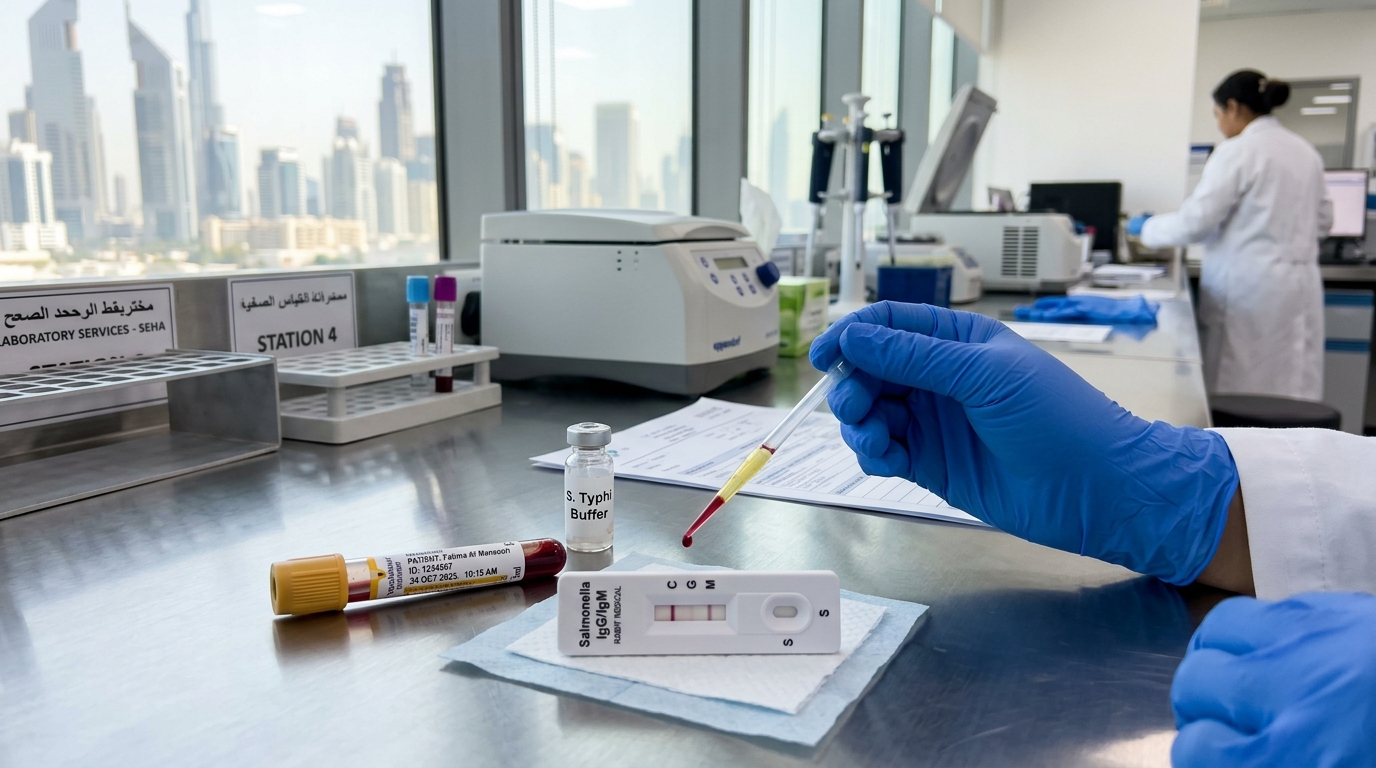
In international medical clinics, travel medicine services, and hospital emergency triage facilities across Dubai, Abu Dhabi, and the wider UAE, rapid enteric diagnostics guide lifesaving antibiotic selection. Procuring certified professional tropical and gastrointestinal rapid test kits in the UAE guarantees healthcare directors deploy assays compliant with international regulatory benchmarks.
Pathophysiology & Disease Timeline: The 4-Week Typhoid Course
The clinical presentation and diagnostic yield of enteric fever vary dynamically across the disease timeline:
- Week 1 (Bacteremic Infiltration): Ingestion of contaminated food or water allows S. Typhi to penetrate small intestinal M cells, enter mesenteric lymph nodes, and invade the bloodstream via the thoracic duct. Patients develop insidious “step-ladder” fever (rising daily to 39°C–40°C), relative bradycardia (Faget sign), dry cough, and malaise. Blood culture exhibits its highest sensitivity (> 80%–85%) during Week 1.
- Week 2 (Intestinal Hyperplasia & Rose Spots): Spirochetes re-invade the gut wall from the biliary tract, multiplying within the Peyer’s patches of the terminal ileum. Faint salmon-pink maculopapular blanching rash (“rose spots”) appears on the trunk in 30% of patients, accompanied by abdominal distension and “pea-soup” diarrhea or constipation. Rapid antigen/antibody tests become reactive during Week 2.
- Week 3 (Complications & Intestinal Perforation): Extensive lymphoid necrosis leads to severe longitudinal ulceration over Peyer’s patches, carrying a catastrophic risk of gastrointestinal hemorrhage or terminal ileal bowel perforation requiring emergency laparotomy.
- Week 4 (Convalescence or Chronic Carriage): Fever resolves slowly, but 3% to 5% of patients become chronic biliary carriers (excreting S. Typhi in stool for > 1 year), acting as ongoing community transmission vectors (the “Typhoid Mary” phenotype).
Core Clinical Indications for Rapid Typhoid Testing
International infectious disease guidelines from the WHO, CDC, and Emirates Health Services (EHS) outline clear indications:
| Clinical Scenario | Target Patient Population | Diagnostic Objective | Clinical Impact on Care |
|---|---|---|---|
| Returning Traveler Pyrexia Triage | Travelers from India, Pakistan, Bangladesh, Nepal with fever > 3 days | Rapid bedside exclusion of enteric fever vs malaria or dengue | Enables prompt initiation of targeted intravenous antibiotics (Ceftriaxone / Azithromycin). |
| Emergency Sepsis Differential | Patients presenting with high fever, leukopenia, and abdominal tenderness | Differentiate typhoidal from non-typhoidal sepsis or appendicitis | Prevents inappropriate emergency appendectomy for typhoidal mesenteric adenitis. |
| Institutional / Food Handler Outbreak Investigation | Hospitality staff, cafeteria food handlers, communal housing clusters | Screening for acute infection during epidemiological outbreaks | Halts foodborne transmission chains in public dining and commercial kitchens. |
| Delayed Laboratory Workup Bridge | Urgent care centers without on-site 24/7 blood culture incubation | Provide preliminary actionable direction within 15 minutes | Bridges the 48 to 72-hour delay while confirmatory blood cultures incubate. |
Why the Traditional Widal Test Must Be Abandoned
For over a century, the Widal agglutination test was widely used to measure agglutinating antibodies against S. Typhi O (somatic) and H (flagellar) antigens. Modern clinical guidelines strongly discourage its use:
- Notorious Cross-Reactivity & False Positives: The Widal test frequently yields false-positive agglutination titers due to cross-reactivity with non-typhoidal Salmonella, malaria, dengue, acute viral hepatitis, and autoimmune diseases. In endemic populations, baseline background titers remain elevated for years, making single-sample Widal tests completely uninterpretable.
- Delayed Antibody Kinetics: Antibodies do not reach significant titers until the end of the second week of illness. Relying on the Widal test during the first 7 to 10 days produces frequent false-negative results during the critical early treatment window.
- The Modern Rapid Test Alternative: Contemporary rapid lateral flow tests detect specific outer membrane protein (OMP) antigens or recombinant lipopolysaccharide IgM/IgG antibodies (e.g., Typhidot, Tubex TF), demonstrating significantly higher analytical specificity (> 90%–95%) and speed.
The Diagnostic Hierarchy: Blood Culture as the Gold Standard
While rapid antigen tests provide essential triage, blood culture remains the absolute gold standard for confirming enteric fever:
- Blood Culture Sensitivity: Sensitivity is highest (80%–85%) during Week 1 of symptoms, dropping to 40%–50% by Week 3 as bacteremia clears. Clinicians must collect at least 15 to 20 mL of blood in adults prior to initiating antibiotics to maximize culture yield.
- Antimicrobial Susceptibility Criticality: Widespread emergence of Extensively Drug-Resistant (XDR) Salmonella Typhi in South Asia—strains resistant to chloramphenicol, ampicillin, co-trimoxazole, fluoroquinolones (ciprofloxacin), and third-generation cephalosporins (ceftriaxone)—makes isolating living bacteria via culture essential to perform susceptibility testing for Azithromycin and Carbapenems (Meropenem).
Frequently Asked Questions (FAQ)
Does a negative rapid typhoid test completely rule out enteric fever?
No. Rapid tests have moderate sensitivity (70%–85%) and can be negative early in Week 1 before adequate antigenemia or antibody response develops. If clinical suspicion is high in a returned traveler with persistent fever, empiric therapy should be initiated and blood cultures dispatched regardless of rapid test results.
Can a person who received the typhoid vaccine test positive on a rapid test?
Injectable Vi polysaccharide typhoid vaccines do not induce antibodies against the O, H, or outer membrane antigens used in most rapid test cassettes. However, the oral live-attenuated Ty21a vaccine can occasionally produce low transient seropositivity. Clinical correlation is always required.
What is the first-line antibiotic treatment for typhoid fever today?
Due to high rates of fluoroquinolone resistance, first-line empiric therapy for uncomplicated enteric fever is oral Azithromycin (20 mg/kg/day for 7 days) or intravenous Ceftriaxone (2 to 3 g daily for 10 to 14 days). In patients returning from regions with documented XDR typhoid (such as Pakistan), intravenous Meropenem is indicated pending culture AST.
Authoritative Clinical References
- Centers for Disease Control and Prevention (CDC) – Typhoid and Paratyphoid Fever: Clinical Guidance and Diagnostic Testing
- World Health Organization (WHO) – Typhoid Vaccine and Surveillance Standards: Laboratory Diagnostic Recommendations
- Clinical and Laboratory Standards Institute (CLSI) – M47: Principles and Procedures for Blood Cultures in Enteric Infections